Why AI Search Recommends Your Competitors and How to Fix It
Blog Summary
- ✦ AI platforms follow clear citation signals — your competitors know them and you should too
- ✦ Understand exactly why competitors get cited and you don't
- ✦ Actionable fixes you can start implementing today
Your competitors appear in ChatGPT and Gemini results and you don’t. You’ve noticed it. Someone asks an AI assistant to recommend a tool, an agency, a product, or an expert in your space, and a competitor’s name comes up. Yours doesn’t. It feels like being left off a guest list you didn’t know existed.
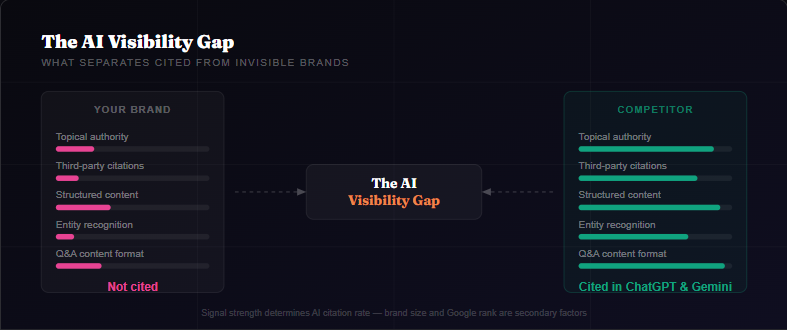
This isn’t random. AI search engines ChatGPT with Browse, Gemini, Perplexity, and Claude don’t rank brands by accident. They use a specific set of signals to decide whose content is trustworthy enough to cite, whose expertise is clear enough to reference, and whose digital presence is structured clearly enough to parse. If your competitors have those signals and you don’t, they show up. You don’t.
The good news: this gap is closable. This guide explains exactly why the gap exists and gives you a concrete, step-by-step plan to close it.
How AI Search Changed the Rules of Online Visibility
For twenty years, SEO meant ranking on Google’s blue links. You optimised for keywords, earned backlinks, and climbed the SERP. That model still matters but it’s no longer the whole game. A growing portion of online discovery now happens inside AI interfaces that don’t show a list of ten links. They give a single, synthesised answer and they credit the sources they trust.
ChatGPT’s Browse capability, Gemini’s real-time web integration, Perplexity’s citation model, and AI Overviews in Google Search have collectively created a new type of search result: the AI-generated answer. In this format, your brand either gets named and credited, or it doesn’t exist for that user, in that moment. There is no page 2.
This shift has created what researchers are calling the AI Visibility Gap – the growing divide between brands with high AI citation rates and those with near-zero AI presence, even when their Google rankings are strong. Traditional SEO rank and AI citation rate are correlated but not identical. You can rank #3 on Google and never appear in a ChatGPT answer. You can have a modest Google presence and be cited constantly by Gemini. The signals overlap but the optimisation is different.
“AI models don’t crawl and rank in real time the way Google does. They synthesise from what they’ve already ingested – which means the battle for AI visibility is won or lost long before a user types their query.” – Generative Engine Optimisation Research, 2026
Traditional SEO vs AI search: what’s different
| AI Search (ChatGPT / Gemini) | Traditional Google SEO |
|---|---|
| Synthesises one answer from multiple sources | Returns a ranked list of links for user to click |
| Cites brands by authority and clarity of expertise | Ranks by keyword relevance, authority, UX signals |
| Rewards structured, direct, factual writing | Rewards comprehensive, long-form content |
| Favours third-party mentions and entity recognition | Backlinks are a primary trust signal |
| No concept of “ranking position” – cited or not cited | Position 1–10 visible; position drives traffic |
How ChatGPT and Gemini Actually Pick Which Sources to Cite
Understanding why your competitors appear in AI results requires understanding the mechanics of how AI language models select and surface sources. It’s not a simple algorithm you can game with meta tags – it’s a combination of training data ingestion, real-time web retrieval, and entity trust signals that together determine whose name appears in an AI’s answer.
- Training data presence: Large language models like GPT-4o and Gemini 1.5 Pro are trained on enormous corpora of web content. Brands and experts whose content was widely indexed, cited, and linked at training time have a significant head start – they exist in the model’s “memory” as known, trusted entities. If your brand barely existed online two or three years ago, you may simply not be in the model’s foundational knowledge base, regardless of your current content quality.
- Real-time retrieval and Browse: ChatGPT with Browse, Gemini with Google Search grounding, and Perplexity all retrieve live web results at query time. For these retrieval-augmented answers, the selection criteria mirror quality signals: clear, well-structured pages from domains with established authority that directly answer the query get cited. Thin pages, slow-loading sites, and content buried in walls of text get skipped.
- Entity recognition and Knowledge Graph presence: AI models think in entities – named brands, people, products, and concepts – not just keywords. Brands that appear in Google’s Knowledge Graph, Wikipedia, Wikidata, and Crunchbase are far more likely to be cited because the AI can confidently identify them as real, verified entities rather than anonymous web pages. This is why well-known brands appear even in response to queries where their content isn’t the best available.
- Citation signals from third parties: When reputable third-party sources – industry publications, review platforms, news outlets, analyst reports – mention and link to your brand, AI models receive corroborating evidence that you are a legitimate authority in your space. A brand mentioned approvingly in five independent, reputable sources carries far more AI citation weight than a brand with excellent self-published content and nothing else.
Why You’re Not Showing Up in ChatGPT and Gemini: 7 Real Reasons
Most brands that are invisible in AI search share the same set of problems. Here are the seven most common reasons – and why each one matters more in AI search than in traditional SEO.
Your content doesn’t directly answer questions
AI models are fundamentally question-answering systems. If your content is written to rank for keywords rather than to directly, clearly answer specific questions your audience asks, AI assistants have nothing clear to extract and cite. Competitor content written in a direct Q&A or definition-first structure gets pulled far more consistently.
You have no brand presence outside your own website
If your brand only appears on its own properties – your website, your social channels – AI models have weak corroborating evidence of your legitimacy. Without third-party mentions in industry press, review sites, podcasts, forums, or analyst reports, the AI has no independent confirmation that you are who you say you are.
Your expertise signals are unclear or absent
AI models prioritise content that signals clear, demonstrated expertise. Thin author bios, no credentials, no case studies, no data – all of these reduce the AI’s confidence in your authority. Competitors with named expert authors, cited research, and verifiable credentials consistently outperform anonymous content in AI citations.
You’re not in any AI training data or knowledge bases
If your brand was founded recently, changed names, or simply never attracted significant third-party coverage, you may not exist in an AI model’s training data at all. Without a Wikipedia entry, Wikidata record, Crunchbase listing, or significant press coverage, even a technically excellent website may be invisible to the model’s entity recognition.
Your content structure is hard for AI to parse
Long, meandering introductions. No headers. Dense paragraphs with no clear answers. Poor use of structured data markup. AI retrieval systems favour content that is easy to extract a specific answer from quickly – not content written for human readers who enjoy narrative flow. If your pages don’t have clear H2/H3 structure and direct answer paragraphs, AI models move on to a competitor that does.
You’re not covering the right topics with enough depth
AI models build a mental map of who covers what. A brand that has published 50 articles across 50 unrelated topics is perceived as a generalist. A brand that has published 20 articles all deeply exploring one domain is recognised as a topical authority. If your competitors have clearer topical depth than you, they win the citation even on queries you both technically address.
Your website has technical barriers to crawling
JavaScript-heavy pages that render content client-side, missing or misconfigured robots.txt, no sitemap, slow load times, or pages blocked from indexing are all invisible to AI retrieval systems. If a crawler can’t efficiently read your content, it won’t be retrieved – regardless of how good the content is.
How to Appear in ChatGPT and Gemini: 8 Step-by-Step Fixes
Closing the AI visibility gap is a systematic process, not a single hack. The following eight fixes address the root causes identified above, ordered roughly from quickest to implement to most long-term in impact. Apply them in sequence and you’ll see your AI citation rate improve over 60–90 days.
- Rewrite your key pages with direct, answer-first structure: Take your 10 most important pages and rewrite the opening paragraph of each to directly answer the primary question the page is targeting. Replace “Welcome to our guide on X” with “X is [concise, direct definition or answer].” AI retrieval systems extract the most answer-dense part of a page – usually the first 100–150 words. Make those words the most informative of your career.
- Add a dedicated FAQ section to every key piece of content: AI models are trained on Q&A patterns. Content that explicitly contains questions and direct answers is structurally easy to extract from. Add 5–8 FAQs to every major blog post, landing page, and product page using the exact question phrasing your audience uses. Use FAQ schema markup to reinforce this structure in the HTML. This single change can meaningfully increase how often AI cites your content within weeks.
- Build a topical authority cluster around your core domain: Choose one to three topics where you want to be recognised as the authority. Publish at least 10–15 pieces of deeply interconnected content on each topic – pillar pages, supporting articles, case studies, comparison pieces, and FAQ content. Link them together with consistent internal anchor text. AI models assign topical authority to brands they see consistently covering a domain from multiple angles, not brands that publish one post about a topic.
- Establish your brand as a named entity across the web: Create or claim your brand’s profiles on Wikipedia (if eligible), Wikidata, Crunchbase, and Google Business Profile. Ensure your brand name, description, and key facts are consistent across all of these. This process – called entity establishment – is how AI models learn that your brand is a real, verifiable actor in your space. Even a basic Wikidata entry with accurate data can meaningfully improve AI recognition of your brand as a trustworthy entity.
- Earn mentions and citations from reputable third-party sources: Actively pursue coverage in industry publications, podcasts, analyst reports, and respected community forums. Guest posts on authoritative sites, expert commentary for journalists via platforms like HARO or Qwoted, and contributions to community discussions on Reddit, Quora, and LinkedIn all create the third-party corroboration AI models use to confirm your authority. One genuine mention in a respected trade publication is worth more for AI visibility than 50 self-published blog posts.
- Implement structured data markup across your site: Add Schema.org structured data for your Organisation entity (name, logo, founding date, social profiles), Article schema on every blog post (author, date, description), FAQ schema on pages with question-and-answer content, and Product/Service schema where relevant. Structured data is machine-readable metadata – it makes your content significantly easier for AI retrieval systems to understand and classify correctly, reducing the risk of being misinterpreted or skipped.
- Optimise your content for the specific AI models your audience uses: Different AI models have different strengths. ChatGPT with Browse retrieves live pages – so technical SEO, page speed, and clear content structure matter. Gemini is closely integrated with Google’s index – so traditional Google SEO signals compound directly into Gemini visibility. Perplexity retrieves and cites sources aggressively – so pages with clear citations, statistics, and expert-attributed claims get pulled most often. Understand where your audience’s AI queries happen and prioritise those signals.
- Publish original data, research, and cited statistics: Original research – surveys, proprietary data, case studies with real numbers – is the single most powerful AI citation magnet because AI models actively seek statistics to support their answers. When your brand publishes a stat that gets widely cited across the web, the AI learns two things: your brand produces reliable data, and your brand is an authority others defer to. Even one well-executed original study can generate AI citations for months or years after publication.
AI Ranking Signals: Complete Cheat Sheet for ChatGPT & Gemini
Use this reference table to audit your current AI visibility signals and identify which to prioritise first. The impact column reflects influence specifically on AI citation rate, not traditional SEO ranking.
| Signal | What It Means | ChatGPT Impact | Gemini Impact | Effort |
|---|---|---|---|---|
| Answer-first content | First paragraph directly answers the core question | Very High | Very High | Low |
| FAQ schema markup | Structured Q&A in HTML for machine reading | High | High | Low |
| Topical authority cluster | 10+ interlinked pieces covering one domain | Very High | Very High | High |
| Entity presence (Wiki/Wikidata) | Verified brand record in knowledge bases | High | Very High | Medium |
| Third-party press mentions | Coverage in industry publications & news | Very High | Very High | High |
| Original data & statistics | Proprietary research others cite | Very High | High | High |
| Author E-E-A-T signals | Named experts, credentials, author pages | Medium | High | Low |
| Organisation schema | Structured data identifying brand entity | Medium | High | Low |
| Page speed & crawlability | Fast, indexable pages without JS barriers | High | Medium | Medium |
| Community forum presence | Mentions on Reddit, Quora, niche forums | Medium | Medium | Medium |
| Review platform ratings | G2, Trustpilot, Clutch, Google Reviews | Low–Med | Medium | Low |
| Social media authority | Follower count, engagement, brand mentions | Low | Low | High |
How to Format Content So AI Models Actually Cite You
Even a brand with strong authority signals will be skipped if its content is poorly structured for AI extraction. Formatting is not a minor consideration – it is often the deciding factor between two equally authoritative sources. Here is the exact structure that AI models consistently prefer.
The ideal page structure for AI citation
| What AI models love | What AI models struggle with |
|---|---|
| Definition or direct answer in the first 2 sentences – before any context, before any story, before any qualification. | Long, narrative introductions that delay the core answer by 3+ paragraphs |
| Clear H2 and H3 structure that matches the questions your audience asks – not creative section titles that require interpretation. | Content that assumes context — AI models need self-contained explanations |
| Short, declarative paragraphs of 3–5 sentences that make one point cleanly before moving on. | Dense paragraphs where the key claim is buried mid-paragraph |
| Numbered or bulleted lists for steps, comparisons, and feature explanations — these are structurally easy for AI to extract as discrete, citable facts. | Vague section titles like “Our Approach” or “Bringing It Together” — AI cannot infer what question these answer |
| Cited statistics with source attribution — AI models that retrieve live content treat cited data as more reliable than uncited claims. | Content padded with filler to reach a word count without adding informational value |
| FAQ section using the exact question phrasing users type, with a direct 2–4 sentence answer to each. | Claims without specificity — “many companies use this” vs “67% of Fortune 500 companies use this” |
The AEO content formula
Think of every key page as a series of micro-answers. Each H2 or H3 is a question. The first sentence after it is the answer. The following sentences are the evidence and context. This structure – known in the industry as Answer Engine Optimisation (AEO) – is the content equivalent of speaking directly to an AI model rather than hoping it figures out what you mean.
How to Track Your AI Visibility and Measure Progress
Unlike traditional SEO where you can check your ranking in seconds, AI visibility requires a more manual and systematic measurement approach – at least until more mature AI analytics tools emerge. Here is how to build a tracking system today.
Manual AI query monitoring
Build a list of 20-30 questions your ideal customer would ask an AI assistant that your brand should be answering. Queries like “What is the best [your category] tool for [use case]?” or “Who are the leading [your niche] companies?” Run these queries weekly across ChatGPT, Gemini, and Perplexity. Record which brands are cited, including your competitors. This creates a baseline and tracks your improvement over time as you implement the fixes above.
Tools emerging for AI visibility tracking
- Semrush AI Overview tracking – monitors which brands appear in Google AI Overviews for tracked keywords.
- Perplexity Pages analytics – if you publish content on Perplexity, view citation and reach data directly.
- Brand monitoring tools (Mention, Brand24) – capture when your brand is mentioned across web content that AI models index.
- ChatGPT custom GPT prompting – run competitor analysis prompts against your query list and manually log results in a spreadsheet.
- Ahrefs and Moz brand mention tracking – monitor third-party citation growth as a proxy for AI visibility improvement.
Key metrics to track
AI citation rate (how often you appear in your 20–30 tracked queries), share of AI voice versus competitors (what percentage of citations go to you vs them), and third-party mention velocity (are new authoritative sources mentioning your brand each month) are the three most meaningful leading indicators of improving AI visibility. Track these monthly and expect the first meaningful changes 60–90 days after implementing the structural fixes in this guide.
Conclusion
The reason your competitors appear in ChatGPT and Gemini while you don’t is not mysterious, and it is not permanent. It comes down to a set of measurable, improvable signals: how clearly your content answers questions, how well-structured your pages are for machine extraction, how consistently you are recognised as an authority by third-party sources, and whether AI models can confidently identify your brand as a verified entity in your space. These are all things you can change.
The brands building AI visibility right now are establishing citation habits that compound over time. Every new piece of genuinely authoritative content, every earned press mention, every FAQ schema added to a page, and every Wikidata entity established makes AI models incrementally more likely to include your brand in the next relevant answer they generate. The cumulative effect of consistent effort applied to the right signals is significant – and the window for first-mover advantage in AI search is still open for most niches.
Start with the quick wins this week. Rewrite your opening paragraphs to lead with direct answers. Add FAQ sections to your most important pages. Implement Organisation schema on your homepage. These three changes alone can shift your AI citation rate within 30–45 days. From there, work systematically through the longer-term plays – topical authority clusters, entity establishment, original research, and earned third-party coverage – and you will build a brand that not only ranks on Google but is cited confidently by every AI assistant your customers use.
The rules of digital visibility have changed. The brands that understand this first, and act on it most consistently, will own the AI search landscape for the next decade.
Your competitors likely have stronger AI visibility signals – clearer topical authority, better-structured content, more third-party mentions in reputable sources, and potentially entity recognition through Wikipedia or Wikidata. AI models cite brands they can confidently identify as authoritative and verifiable. It is rarely about having better products – it is almost always about having clearer, more widely corroborated digital signals of expertise.
For live retrieval models like ChatGPT with Browse and Gemini with Search grounding, structural content improvements can show results in 4-8 weeks as pages get recrawled and re-indexed. For improving presence in AI model training data (which affects responses that don’t use live retrieval), the timeline is longer – 6 to 12 months of consistent authority building is a realistic expectation for meaningful change.
Generative Engine Optimisation (GEO) is the practice of optimising your content and brand presence to be cited by AI-generated answers, rather than simply ranking in traditional search results. While SEO focuses primarily on keyword relevance, backlinks, and technical page quality to earn search engine rankings, GEO focuses on answer-first content structure, topical authority, entity establishment, and third-party citation building to earn inclusion in AI-synthesised responses. The two disciplines overlap significantly but have meaningfully different optimisation priorities.
Yes – and this is one of the most important insights about AI search. AI models favour clarity of expertise over size of brand. A small brand that has published a genuine topical authority cluster, earned coverage in three or four relevant industry publications, and structured its content for direct answer extraction can regularly outperform a large brand with a sprawling, poorly structured content library. AI search is currently a more meritocratic visibility channel than traditional SEO, where domain authority and backlink budgets tend to favour larger organisations.
Social media has a low direct impact on AI citation rates. AI models do not primarily draw from social media content when constructing factual answers. However, social media can indirectly improve AI visibility by increasing brand awareness that leads to press coverage, driving traffic to your content that signals relevance, and creating a presence that makes your brand easier to verify as a real entity. Focus first on the higher-impact signals listed in this guide before investing heavily in social as an AI visibility strategy.
Share this article
Newsletter
Stay ahead of AI search
Weekly insights on AI visibility, AEO strategies, and brand intelligence. No spam.

Sahil Bajaj: With 7+ years of digital marketing expertise, I'm dedicated to fusing technology and creativity for business success. Known for innovative strategies that drive growth and a passion for continuous improvement.
Related Articles