Google’s R4T-Diffusion: How Query Fan-Out Is Changing AI Visibility
Blog Summary
- ✦ Google’s R4T-Diffusion is a new query fan-out framework designed to generate semantically diverse AI search sub-queries 12–20x faster than previous approaches.
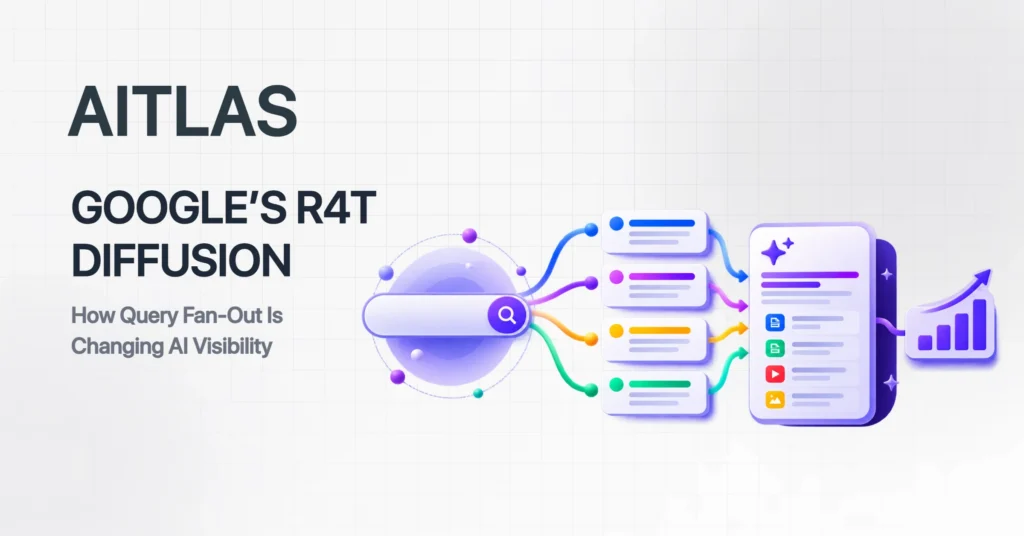
- ✦ Query fan-out is the process by which AI search systems expand one user query into multiple related sub-queries, retrieve information across different angles, and synthesise it into a single answer.
- ✦ R4T-Diffusion uses a small 53.9 million parameter diffusion model that generates multiple sub-queries simultaneously instead of producing them one at a time.
- ✦ The framework optimises for three core factors: Groundedness, ensuring sub-queries retrieve real content; Diversity, ensuring broad semantic coverage; and Alignment, keeping sub-queries relevant to the original intent.
- ✦ For brands, broader query fan-outs mean AI search can retrieve content across more topic angles, increasing the importance of comprehensive and semantically rich content rather than narrow keyword-focused pages.
- ✦ Technical accessibility also matters more because content that is difficult for AI systems to crawl, retrieve, or understand may not surface across fan-out sub-queries even if the content itself is valuable.
- ✦ Brands should now focus on broader topic coverage, real user intent, structured and retrievable content, and tracking which topic angles their brand is being cited for across AI search platforms.
- ✦ The shift reinforces a broader change in search strategy: visibility in AI-generated answers increasingly depends on covering the full semantic neighbourhood around a topic, not just ranking for individual keywords.
On September 15, 2026, Google published a blog post about a new query fan-out framework called R4T-Diffusion, six months after the underlying research paper was first published. That gap is significant. Google rarely blogs about research unless it is production-relevant. The six-month window between the paper and the blog post was almost certainly the time Google needed to determine where, how, and whether to deploy it.
If you are a brand, marketer, or SEO professional trying to understand why AI-generated answers seem to be changing, why some brands appear more consistently, why answers feel broader and more comprehensive, and why traffic from AI Mode is behaving differently from traditional organic, R4T-Diffusion may be part of the explanation. This post explains what the system does, how it works, and what it means for how your content needs to be structured to appear in AI-generated answers.
What Is Query Fan-Out and Why It Matters
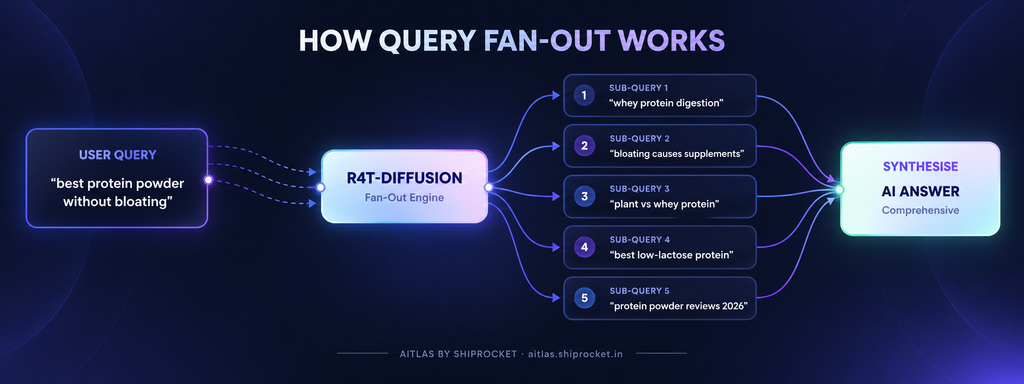
When you type “best protein powder for muscle gain without bloating” into Google AI Mode or ask Perplexity a product question, the AI does not simply match your query to a ranked list of pages. Instead, it fans your query out into a set of related sub-queries, covering different facets of what you might be asking. These might include queries about specific ingredients, scientific research on absorption rates, user reviews by body type, comparisons between product categories, and so on. The AI then retrieves the best available content for each sub-query and synthesises it all into one answer.
This is fundamentally different from how traditional Google search works. Traditional search optimises for your exact query and close variants. Fan-out optimises for the entire semantic neighbourhood of your intent. This is why two pieces of content can target the same keyword but perform very differently in AI search, the one that covers the full semantic space around the topic will be retrieved across more sub-queries and cited more often in the final answer.
Query fan-out is also what powers the comprehensiveness that users now expect from AI search. When AI Mode gives you a three-paragraph answer that covers history, mechanism, use cases, and caveats, all in response to a single sentence query, fan-out is what made that possible. The system retrieved specialist content for each dimension of the topic and assembled them into a unified answer.
Why this matters for your brand
If AI search systems fan out your category query into eight sub-queries and you only have content that addresses two of them, you will only be cited in those two. A competitor with content covering six of the eight sub-queries will appear more consistently and with greater authority in the final AI-generated answer, regardless of whose domain has higher traditional authority.
What Is R4T-Diffusion?
R4T-Diffusion stands for Retrieve-for-Train Diffusion. It is Google’s new framework for generating query fan-outs that is faster, less computationally expensive, and produces higher-quality sub-queries than the systems it replaces.
The core innovation is this: instead of generating sub-queries one at a time using a large autoregressive language model (which is slow and expensive at scale), R4T trains a small 53.9 million parameter diffusion model to generate all sub-queries simultaneously in a single parallel pass. The small model is trained by distilling the behaviour of a much larger model, meaning it learns to produce fan-outs that are as good as those from the expensive large model, at a fraction of the cost and time.
The result, according to Google’s blog post, is a system that has “smashed the latency bottleneck”, reducing fan-out generation from up to 50 seconds under heavy load to sub-second to a few seconds. That difference matters enormously for production-scale AI search, where millions of queries need fan-outs generated in real time.
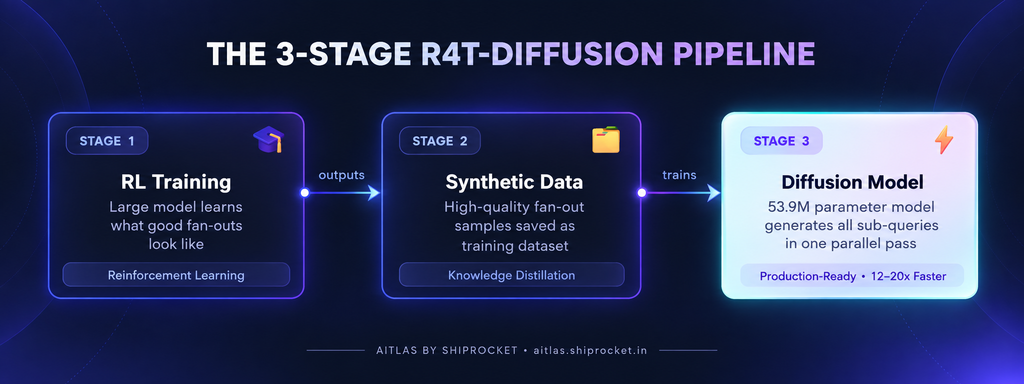
How R4T-Diffusion Works: The Three-Stage Framework
1. Reinforcement Learning Training, Learning What Good Fan-Outs Look Like
A large model is trained using reinforcement learning (RL) to generate high-quality query fan-outs. The model learns to produce sub-queries that are grounded in real retrievable content, semantically diverse (not just synonyms of each other), and clearly related to the original query. This RL-trained model defines what “good” looks like, but it is too large and slow to run at production scale.
2. Synthetic Data Generation, Capturing the Large Model’s Behaviour
The outputs of the RL-trained large model are saved as training data. Thousands of examples of high-quality query fan-outs, generated by the expensive large model, are captured and used to build a dataset of “ideal fan-out behaviour.” This is the knowledge distillation step, a technique that has been central to efficient AI model development since 2015.
3. Diffusion Model Training, The Small Fast Model That Goes to Production
A small 53.9 million parameter diffusion model is trained on the synthetic dataset from Stage 2. This model learns to generate fan-outs that match the quality of the large model but runs in a single, non-autoregressive parallel pass, generating all sub-queries at once rather than one at a time. This is the model that actually runs at production scale, delivering fan-outs in under a second even under heavy query loads.
The Three Reward Pillars: Groundedness, Diversity, Alignment
What makes R4T-Diffusion different from simply generating more queries is that it is trained to optimise three competing properties simultaneously. Google’s researchers describe these as a “composite reward” that balances three pillars:
Groundedness
Every generated sub-query must correspond to something that actually exists and is retrievable in the database. The model is penalised for generating sub-queries that would retrieve nothing real. This is what keeps AI answers factually anchored rather than hallucinated.
Diversity
Sub-queries must cover broad semantic breadth rather than clustering around synonyms of the original query. The model is explicitly rewarded for generating sub-queries that explore different angles, dimensions, and aspects of the topic. Diversity is measured using the Vendi Score across the full set of sub-queries.
Alignment
Sub-queries must remain connected to the original user intent. The model is penalised for “semantic drift”, generating sub-queries so far from the original that they are no longer useful for answering what the user asked. Alignment anchors diversity so that breadth does not come at the cost of relevance.
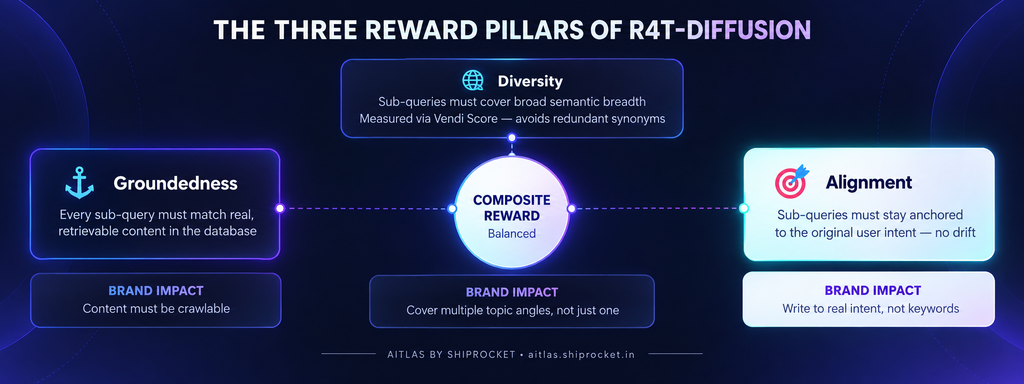
“This composite reward is a weighted balance of three competing pillars: Groundedness, penalizes distance to the database manifold, ensuring every generated sub-query corresponds to a real, retrievable item in the database. Diversity, measured using the Vendi Score over the entire set of sub-queries, forcing the model to explore broad semantic breadth. Alignment, anchors candidate sub-queries to the original broad prompt to prevent semantic drift.”
Google Research, R4T-Diffusion paper, March 2026
These three pillars have direct implications for what kind of content gets cited in AI answers. Content that is retrievable (indexed, accessible, well-structured), covers diverse aspects of a topic (not just one angle), and is clearly aligned to real user intent, this is exactly the content that fan-out sub-queries will surface. Thin, keyword-stuffed pages that cover only one dimension of a topic will only appear in the narrow sub-query that matches their single angle.
The Speed Breakthrough: Smashing the Latency Bottleneck
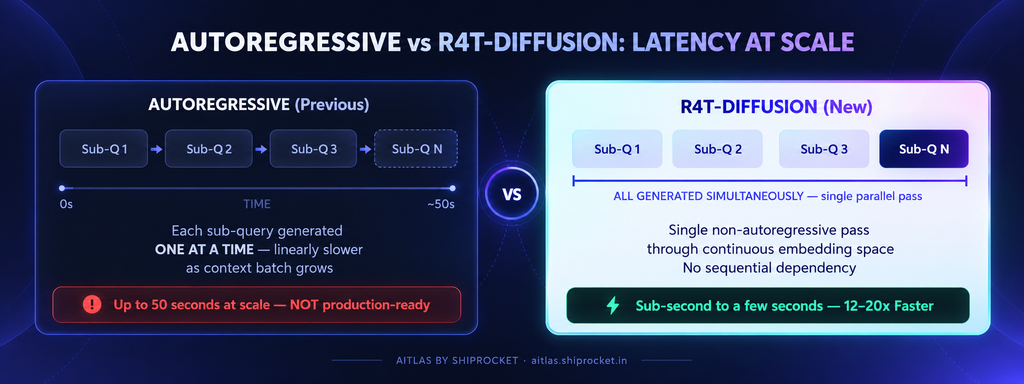
The most immediately practical achievement of R4T-Diffusion is speed. Previous approaches to query fan-out used autoregressive models, large language models that generate text token by token, one piece at a time. Under production load, generating a full set of fan-out sub-queries with an autoregressive approach could take up to 50 seconds. That is unusable for real-time search.
R4T-Diffusion’s diffusion model generates all sub-queries simultaneously in a single parallel pass through continuous embedding space. Because it is non-autoregressive, the generation time does not scale linearly with the number of sub-queries. The result is fan-out generation in sub-second to a few seconds even under large context batches, a 12 to 20 times speedup.
| Property | Autoregressive Fan-Out (Previous) | R4T-Diffusion (New) |
|---|---|---|
| Generation approach | Sequential, one sub-query at a time | Parallel, all sub-queries simultaneously |
| Latency at scale | Up to 50 seconds under heavy load | Sub-second to a few seconds |
| Speed vs previous | Baseline | 12–20x faster |
| Model size | Large (billions of parameters) | 53.9M parameters (distilled) |
| Diversity of sub-queries | Moderate, tends toward synonyms | High, explicitly rewarded for semantic breadth |
| Production scalability | Limited, prohibitively expensive at scale | Production-ready at search scale |
| Groundedness of outputs | Moderate | Rewarded, penalises non-retrievable sub-queries |
| Applications beyond search | Search only | Recommendation systems, creative search, planning |
Has Google Already Deployed R4T-Diffusion?
This is the question everyone in AI search is asking. Google’s blog post describes R4T-Diffusion as “production-ready”, a term that means it is capable of running in a high-demand real-world environment. The research paper itself was published in March 2026. Google’s blog post about it appeared in September 2026, six months later.
That six-month gap is telling. Google rarely writes practitioner-facing blog posts about research just to share academic interest. Publishing a blog post, as distinct from just a research paper, signals that the technology is entering or has entered deployment. The six months between the paper and the blog post is consistent with the time needed to test, iterate, and evaluate whether to deploy in production, and in which contexts.
The cautionary note from the researchers
Interestingly, the original research paper included a cautionary statement that was absent from Google’s blog post. The researchers noted that R4T performed well in “fashion and music” contexts but expressed concern that it could amplify biases in sensitive topic areas, and recommended domain-specific bias audits before deployment in those contexts.
The fact that the blog post omits these caveats may suggest that Google has resolved these concerns for at least some deployment contexts, or that R4T is being deployed selectively in lower-sensitivity query categories while sensitive topics continue using different systems.
Several SEO practitioners have noted increases in AI Mode traffic and more links appearing in AI Overviews in recent weeks. Whether this is directly attributable to R4T-Diffusion being deployed or to other factors is impossible to confirm from outside Google. What is clear is that AI Mode is evolving rapidly and the query fan-out mechanism is central to how it retrieves and assembles answers.
What R4T-Diffusion Means for Brand AI Visibility
The practical implications of R4T-Diffusion for brand marketers and content teams fall into three categories:
1. Broader fan-outs mean more content surface area, and more competition
Because R4T generates more semantically diverse sub-queries, AI answers will draw from a wider range of content sources than before. This is good news for brands with comprehensive topical content, more of your pages will be in scope for retrieval across more sub-queries. It is bad news for brands relying on a small number of high-authority pages to cover an entire topic, because each of those pages may only appear in one or two sub-queries.
2. Diversity reward means repetition is penalised
R4T is explicitly rewarded for diversity, meaning it avoids generating redundant sub-queries and will look for different sources rather than citing the same brand or page multiple times. This means that if you are currently appearing in AI answers for one sub-query, you are not automatically protected across all sub-queries in that fan-out. You need content that covers multiple distinct angles to maintain consistent presence across a broader fan-out.
3. Groundedness means inaccessible content is invisible
The groundedness pillar penalises sub-queries that do not correspond to real, retrievable content. This means that if your content is behind paywalls, loaded dynamically in ways that prevent crawling, or structured in formats that AI retrievers cannot process, it effectively does not exist for R4T-powered fan-out. Technical accessibility of your content is not optional, it is a prerequisite for appearing in AI-generated answers at all.
What Brands Should Do Now
Audit your topic coverage breadth, not just keyword rankings
Map out the full semantic neighbourhood of your most important topics. Identify which sub-questions and adjacent angles your content currently covers and which it leaves unanswered. Every gap in your topic coverage is a sub-query in a fan-out that a competitor can fill instead.
Build content for semantic diversity, not keyword density
R4T rewards sub-queries that explore different dimensions of a topic. Your content should do the same. A single long-form guide that covers definition, mechanism, use cases, advantages, disadvantages, India-specific context, and how-to guidance is far more likely to be retrieved across multiple sub-queries than five separate pages each optimised for one keyword angle.
Ensure your content is technically accessible for AI retrieval
Check that your key pages are crawlable, indexable, and load their primary content server-side rather than requiring JavaScript execution. Use structured data such as FAQ schema, HowTo schema, and Article schema to help AI systems parse the structure and intent of your content. Content that cannot be retrieved cannot be cited.
Write to real user intent, not just query strings
The alignment pillar of R4T means sub-queries must stay anchored to the original user intent. Content that matches real-world intent, what someone is actually trying to accomplish, understand, or decide, will be retrieved more consistently than content written to match search engine patterns. Write for what the user needs, not for what the keyword implies.
Monitor your brand’s presence across AI platforms, not just Google
R4T’s framework is designed for retrieval at scale across AI systems. The same principles driving Google AI Mode’s fan-out are at work in Perplexity, ChatGPT Search, and Gemini. Tracking where your brand appears across all of these, not just traditional Google rankings, is now an essential part of understanding your content’s performance.
Track which sub-query angles your brand is being cited for
As fan-outs become more sophisticated, understanding not just whether your brand appears in AI answers but which aspects of a topic you are being cited for gives you a meaningful competitive signal. If a competitor is consistently cited for the “how it works” sub-query and you are not, that is a specific content gap you can close.
Track Your Brand Across AI Search, Before Your Competitors Do
R4T-Diffusion means AI search answers are now broader, faster, and more semantically diverse. AiTLAS’s RADAR module monitors how your brand appears across ChatGPT, Gemini, Google AI Overviews, AI Mode, Perplexity, and Microsoft Copilot, automatically, every week.
- See your AI mention rate, share of voice, and citation rate across 5 platforms
- Identify which topic angles your brand is being cited for, and which gaps competitors are filling
- HYDRA publishes AEO-structured content that improves your citation rate across fan-out sub-queries
- 87% average increase in AI mentions within 60 days across 500+ brands
Conclusion
R4T-Diffusion is not a minor technical update. It represents a meaningful step in Google’s ability to generate comprehensive, semantically diverse query fan-outs at production scale and speed. When Google describes something as “production-ready” and writes a practitioner blog post about it six months after the research paper, the reasonable inference is that it is being used or is very close to being used in real search results.
For brands, the practical signal is clear: AI search is getting better at covering the full semantic space around any topic, and the content that gets cited is the content that covers that space comprehensively. Keyword-focused, single-angle content will underperform. Deep, well-structured, topically authoritative content will gain citations across the diverse sub-queries that fan-out systems generate.
The brands that understand this shift early, and build their content and monitoring strategies around it, are the ones that will compound their AI search advantage while competitors are still thinking in terms of keyword rankings.
Query fan-out is the process by which an AI search system expands a single user query into multiple sub-queries that it then uses to retrieve information from across the web. For example, a user query like “best running shoes for flat feet” might fan out into sub-queries about arch support, pronation control, specific brand comparisons, orthopedic guidance, and price ranges. The AI retrieves the best available content for each sub-query and synthesises it all into one comprehensive answer. Query fan-out is the core mechanism behind why AI search answers feel so much more comprehensive than traditional keyword search results.
R4T-Diffusion (Retrieve-for-Train Diffusion) is Google’s new query fan-out framework announced in September 2026. It uses a three-stage process combining reinforcement learning, synthetic data generation, and a small 53.9 million parameter diffusion model to generate high-quality query fan-outs 12 to 20 times faster than previous autoregressive approaches. The key innovation is that it generates all sub-queries simultaneously in a single parallel pass rather than one at a time, which reduces latency from up to 50 seconds to sub-second to a few seconds at production scale.
R4T-Diffusion changes AI search in three ways that directly affect brand visibility. First, because it generates more semantically diverse sub-queries, AI answers will draw from a broader range of content rather than a narrow set of high-ranking pages. Brands with content covering multiple angles of a topic will have more surface area to be cited. Second, because fan-outs now happen faster and at scale, more queries across more categories will receive AI-generated answers. Third, the diversity reward built into R4T means AI answers will avoid repeating the same brand and actively surface a range of relevant sources, so brand presence needs to be built across multiple content angles, not just one authority page.
Traditional keyword search matches the user’s exact query or close variants to indexed pages and returns a ranked list of results. Query fan-out takes the user’s intent, expands it into many related sub-queries covering different facets of that intent, retrieves information for each sub-query separately, and synthesises it all into one answer. This means AI search is not optimised for any single keyword, it optimises for the full semantic space around user intent. Brands covering that full semantic space with comprehensive, well-structured content will be cited more often than brands optimising for individual keywords.
R4T-Diffusion reinforces the direction AI search has been moving for years: away from keyword optimisation and toward topic authority and semantic depth. If your content strategy is already focused on comprehensively covering topics, answering related questions, and building topical clusters, R4T-Diffusion works in your favour. If your strategy is still built around individual keyword pages with thin coverage, R4T-Diffusion makes it less likely your content will be retrieved across the broader fan-out. The practical action is to audit your content for topic depth, ensure you cover the full semantic neighbourhood of your most important topics, and track your brand’s citation rate across AI platforms using a tool like AiTLAS RADAR.
Yes. Google’s researchers explicitly note that R4T-Diffusion can be applied beyond search retrieval to recommendation systems, creative search, and exploratory information access. They also suggest the underlying framework, using reinforcement learning to synthesise training data for a smaller generative model, could be applied to tasks like planning and creative generation. Within Google’s own products, this means R4T or similar systems could influence Google Discover, YouTube recommendations, and other AI-driven surfaces beyond AI Mode and AI Overviews.
Share this article
Newsletter
Stay ahead of AI search
Weekly insights on AI visibility, AEO strategies, and brand intelligence. No spam.

Sahil Bajaj: With 7+ years of digital marketing expertise, I'm dedicated to fusing technology and creativity for business success. Known for innovative strategies that drive growth and a passion for continuous improvement.
Related Articles