Blog Summary
- ✦ AI SEO is the use of artificial intelligence to improve brand visibility across both traditional Google search results and AI-generated answers. In 2026, you need both.
- ✦ Google itself uses multiple AI systems, including RankBrain, BERT, MUM, and Gemini, to understand search queries. Understanding these systems is foundational to AI-powered SEO.
- ✦ The eight main applications of AI in SEO range from keyword research and content creation to technical audits, link intelligence, and the newest category, AI search visibility and AEO.
- ✦ How AI is changing SEO goes beyond faster content writing. It has shifted what signals matter, which content earns citations, and where buyers now first encounter brands.
- ✦ Fully automated AI SEO pipelines now handle end-to-end workflows, from gap identification and content publication to performance monitoring, with minimal human input.
- ✦ AITLAS by Shiprocket is the leading AI-powered SEO and AEO platform for Indian eCommerce and D2C brands, with RADAR for AI visibility monitoring and HYDRA for AEO content publishing. A free plan is available at ₹0.
Search engine optimisation has always evolved with the technology powering search engines. When Google introduced PageRank, SEO became about links. When Google launched Panda and Penguin, it became about content quality and natural link profiles. When RankBrain arrived in 2015, it became about intent. In 2026, AI-powered SEO (AI powered SEO) has changed search more profoundly than any of those updates combined, because it has changed not just how search engines rank results, but where those results appear and whether they appear as a list of links at all.
This guide explains what AI SEO is in 2026, how Google uses AI to process and rank content, how AI is changing SEO at a fundamental level, and what you need to do to use AI for SEO success across both traditional search and the AI-generated answer layer that now sits above it.
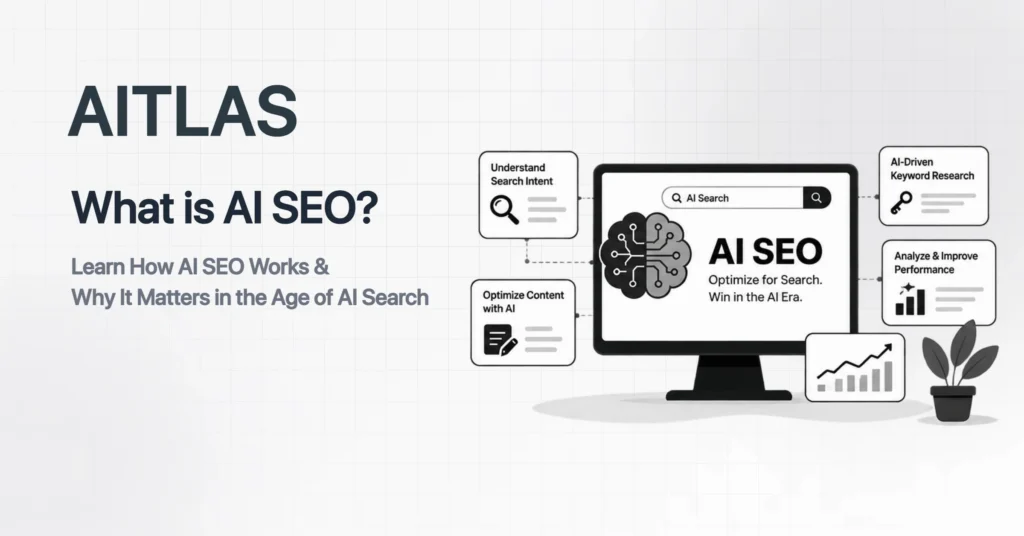
What Is AI SEO?
The term “AI SEO” is used to describe several different things, which causes confusion. It can mean using AI tools to do traditional SEO faster and better. It can mean optimising for Google’s own AI-driven ranking systems like RankBrain, BERT, and Gemini. And it can mean the newest dimension: optimising for the AI platforms that now generate answers directly for users, bypassing the traditional link-click experience entirely.
All three meanings are correct, and all three matter. A complete AI SEO strategy in 2026 addresses all of them. This guide covers each one.
- Keyword research and clustering
- AI content brief generation
- On-page SEO scoring
- Technical site auditing
- Backlink analysis
- Rank tracking and SERP monitoring
- E-E-A-T signals
- Semantic and intent-based content
- Structured data and schema
- Core Web Vitals and page experience
- Natural language queries
- Topical authority building
- Brand monitoring in ChatGPT
- Gemini and AI Overviews tracking
- Google AI Mode presence
- Perplexity citation monitoring
- AEO content publishing
- Share of AI voice vs competitors
How Google Uses AI in Search
Before examining how to use AI for SEO, it helps to understand that Google’s search engine has been an AI-powered system for nearly a decade. Most of the “ranking signals” that traditional SEO targets are processed by AI systems, not simple rule-based algorithms. Understanding these systems clarifies why the practices that work for AI-powered SEO look different from older approaches.
RankBrain (2015)
RankBrain was the first AI system Google confirmed as a significant ranking factor. It uses machine learning to interpret queries it has never seen before, matching them to the most relevant results based on patterns from similar queries. Before RankBrain, unknown queries were handled by simple keyword matching. After it, Google could understand that “best way to fix a leaky pipe without professional help” and “DIY plumbing repair guide” are asking for the same thing. For SEO, RankBrain shifted the focus from exact keyword matching to intent matching.
BERT (2019)
Bidirectional Encoder Representations from Transformers (BERT) allowed Google to understand the context of individual words within a query by reading the full sentence in both directions simultaneously. Before BERT, function words like “to,” “for,” and “without” were often ignored. After BERT, Google understood that “can you get medicine for someone pharmacy” is asking about picking up a prescription for another person, not about getting medication for yourself. BERT now processes the vast majority of searches in over 70 languages.
MUM (2021)
Multitask Unified Model (MUM) is 1,000 times more powerful than BERT and can understand information across text, images, video, and audio simultaneously. MUM processes information in 75 languages at once. It allows Google to answer complex, multi-part queries that used to require dozens of individual searches. For AI-powered SEO, MUM means comprehensive, multi-format content covering a topic from multiple angles now has a genuine ranking advantage over thin, single-format content.
Gemini (2024 to present)
Gemini is Google’s most capable AI system, powering Google AI Overviews, Google AI Mode, the Gemini app, and increasingly the core of Google Search itself. Unlike the earlier systems which operated primarily as ranking filters, Gemini generates the AI-written answers that appear above organic results for a growing proportion of queries. This is the system responsible for the most significant structural change in search in two decades: the AI Overview that delivers an answer before a user sees a single link.
matching
understanding
more powerful
above search results
How AI Is Changing SEO in 2026
How AI is changing SEO is not a gradual evolution of existing practices. Several of the changes are structural breaks from what worked before 2023. Understanding each one is the starting point for building an effective AI and SEO strategy.
1. AI-generated answers are replacing clicks
The most visible way AI is changing SEO is the Google AI Overview. These AI-generated summaries appear at the top of search results for a growing proportion of queries and directly answer the user’s question without requiring a click. Research from SparkToro and Similarweb found that 68% of Google searches in early 2026 ended without a click, the highest zero-click rate ever recorded. For informational queries, the rate is even higher.
This does not mean traditional SEO is irrelevant. Pages that are cited within AI Overviews still receive traffic. But the nature of what drives that citation is different from what drives a traditional top-10 ranking. Being cited in an AI Overview requires structured, authoritative, directly-answering content that the AI system can extract and surface, not just a page that ranks highly on general authority signals.
2. Semantic search has displaced keyword matching
Thanks to BERT, MUM, and Gemini, Google now understands queries at the level of meaning and intent, not keyword presence. A page that mentions a keyword 15 times but does not thoroughly cover the topic will rank below a page that mentions it twice but comprehensively answers every related question a user might have. AI-powered SEO in 2026 means building topical depth and semantic coverage, not targeting individual keywords in isolation.
3. E-E-A-T signals now carry algorithmic weight
Experience, Expertise, Authoritativeness, and Trustworthiness (E-E-A-T) have been in Google’s quality rater guidelines since 2015 but they now carry measurable algorithmic weight in AI-powered ranking systems. Pages written by verified experts, with specific first-person experience, citing primary data, and attributed to real authors with credentials, rank differently from anonymously-written content making the same claims. For AI in SEO, this means author bios, original research, primary citations, and first-person experience are no longer optional signals.
4. AI search has created a new brand discovery channel
The most significant long-term impact of how AI is changing SEO is that buyers now form opinions about brands inside AI-generated answers, before they ever visit a website. A product manager researching logistics platforms does not visit ten vendor websites and compare them. They ask ChatGPT or Gemini and read the answer. If your brand is not in that answer, you were never in their consideration set and you have no way of knowing it happened. This is what has driven the emergence of AEO, which we cover in detail below.
5. Fully automated AI SEO workflows are now viable
For the first time, the end-to-end process from identifying a content gap to publishing an optimised, live piece of content can be handled almost entirely by AI systems. Automated keyword clustering, AI brief generation, AI drafting, AI optimisation scoring, automated publishing, and automated performance monitoring can all be chained together with minimal human intervention. The role of the SEO professional is shifting from execution to direction, quality control, and strategic oversight.
8 Key Applications of AI in SEO
The application of AI in SEO now spans every traditional SEO discipline plus several new ones. Here are the eight most significant areas where AI is actively used.
AI SEO vs AEO: The Critical Difference
One of the most important distinctions in AI and SEO in 2026 is the difference between traditional AI SEO and AEO (Answer Engine Optimisation). Understanding this difference is critical for brands building a search visibility strategy that works across all the channels where buyers now discover brands.
| Dimension | Traditional AI SEO | AEO (Answer Engine Optimisation) |
|---|---|---|
| Target platform | Google’s ranked link list | ChatGPT, Gemini, AI Overviews, AI Mode, Perplexity |
| What it optimises for | Page rankings and organic traffic | Brand mentions and citations inside AI answers |
| Success metric | Position, impressions, clicks | Mention rate, share of AI voice, sentiment accuracy |
| Key signals | Backlinks, E-E-A-T, keyword relevance, page speed | Content structure, FAQ schema, original data, brand consistency |
| Measurement tool | Google Search Console, rank trackers | AITLAS RADAR, AI visibility platforms |
| Analytics source | Google Search Console (native) | Dedicated tracking required, no native analytics |
| Content format priority | Long-form depth, keyword coverage | Question-format headings, direct answers, FAQ schema |
| Overlap with top-10 rankings | 100% (by definition) | Only 35% of AI Mode citations match top-10 results |
The 35% overlap figure is the one that matters most for any brand investing in AI in SEO. It means holding the number-one position for a keyword is no guarantee of appearing in the AI-generated answer for that same query. AI platforms draw from a broader and more diverse source pool than Google’s ranked list, and they weight different signals when deciding what to cite. Brands that only focus on traditional AI-powered SEO and ignore AEO are invisible on the AI answer channel, and that channel is growing every month.
Read our complete guide on the difference between the two: AEO vs SEO: Why Your Brand Needs Both in 2026.
Fully Automated AI SEO: What It Looks Like in Practice
Fully automated AI SEO refers to end-to-end workflows where AI systems handle the complete SEO cycle with minimal human input. This has become genuinely viable in 2026 for several parts of the SEO process, though complete automation without human oversight produces inconsistent results for quality-sensitive outputs.
Here is what a fully automated AI SEO pipeline looks like for the AI search visibility use case specifically:
Automated AI Visibility Scanning (RADAR)
AITLAS RADAR runs scheduled scans across ChatGPT, Gemini, AI Overviews, AI Mode, Perplexity, and Microsoft Copilot using the prompts your customers actually type. It captures your mention rate, share of AI voice vs up to seven competitors, and sentiment trends. This runs automatically on a daily or configured schedule without any human input required.
Automated Gap Identification
RADAR identifies and ranks content gaps automatically: the specific prompts and topic areas where competitors appear in AI answers and you do not. These are ranked by strategic priority based on search volume, competitor presence, and your current coverage. No manual analysis required.
Automated AEO Content Creation (HYDRA)
HYDRA generates AEO-optimised articles based on the gaps RADAR identifies. Each article is structured with question-format headings for AI extractability, full schema markup for discoverability, topical authority signals, and citation-ready original content. The content is generated at the brief level and reviewed by the team before publishing.
Automated CMS Publishing
HYDRA publishes directly to WordPress, Webflow, Shopify, Contentful, or any CMS via API with full schema applied. No manual copy-paste, no upload, no formatting work. The article goes from approval to live in the time it takes to click publish.
Automated Performance Measurement and Loop Reset
RADAR monitors the performance of each published piece, tracking whether it improved AI mention rate and share of voice for the targeted prompts. When improvement is confirmed, the loop resets to the next priority gap. When improvement is insufficient, RADAR flags it for content review. The entire cycle runs without manual intervention between steps.
For traditional SEO, fully automated AI SEO looks similar but applied to organic rankings: automated crawls flag technical issues, AI tools prioritise fixes, AI drafts fix the issues, and monitoring confirms the ranking recovery. Platforms like Semrush and Ahrefs have built significant automation into their audit-to-fix workflows.
The honest caveat is that “fully automated” does not mean zero human involvement. Strategic direction, quality review of AI-generated content, relationship management for link building, and final editorial judgment all still require human expertise. What AI automates is the research, data processing, drafting, and monitoring, which typically represents 70% to 80% of the time cost of traditional SEO execution.
Benefits of AI-Powered SEO
The case for investing in AI for SEO in 2026 rests on four concrete business benefits, not abstract promises about the future of search.
Speed at scale
This is one of the core benefits of AI-powered SEO over manual SEO processes.
The most immediate benefit of AI-powered SEO is production speed. A keyword research project that took three days now takes three hours. A content brief that took two hours takes fifteen minutes. A technical audit across a 50,000-page site that previously required specialist developer time now runs in an afternoon. For teams with a long content backlog or a large technical debt on their site, AI tools change the economics of catching up.
Better content quality through data
AI SEO tools analyse the top-ranking pages for any query and tell you specifically what your content is missing, which semantic terms appear in competitor content that yours lacks, and how deep the topic coverage needs to be to compete. This data-driven approach to content quality produces measurably better content than intuition-based writing. Teams using tools like Surfer SEO and Clearscope consistently report that AI-scored content outranks content written without it when everything else is equal.
Visibility across both search channels
The biggest benefit of AI for SEO in 2026 is the ability to be visible across both the traditional search channel and the AI answer channel simultaneously. Without AI visibility tools, brands are entirely blind to what ChatGPT, Gemini, and Perplexity are saying about them. With tools like AITLAS, brands can monitor both channels, measure both, and invest in content that improves their presence on both. The average AITLAS customer sees an 87% increase in AI mentions within 60 days of using the platform.
Competitive intelligence
AI tools for SEO give brands a level of competitive intelligence that was not practically achievable with manual research. Understanding which keywords competitors rank for that you do not, which pages are generating their traffic, which AI answers mention them and not you, which backlinks are driving their authority, and which topics they have content gaps on, can all be surfaced with AI SEO tools in an afternoon rather than weeks of manual analysis.
How to Use AI for SEO Success
Using AI for SEO success in 2026 requires a practical roadmap, not just a set of tools. Here is where to start.
Step 1: Audit your current AI search visibility
Before doing anything else, find out where you currently stand. Open ChatGPT, Gemini, and Perplexity and run 10 to 15 prompts covering the questions your buyers ask about your category. Record which brands appear and whether you are among them. This five-minute check will tell you more about the urgency of the AI visibility gap than any amount of reading about it. Alternatively, AITLAS’s free plan (Rs 0, no card required) runs this scan automatically and gives you structured data across five AI platforms.
Step 2: Fix your on-page AI readiness
Before worrying about what AI platforms say about you, make sure the content on your site is structured for AI extraction. This means adding FAQ schema to pages that answer common questions, using question-format H2 and H3 headings, adding the key answer directly below each heading rather than building to it over three paragraphs, citing your data with sources, and adding author credentials to content pages. These structural changes improve both traditional SEO rankings and AI citation rates simultaneously.
Step 3: Build topical authority in your category
AI-powered SEO rewards topic depth over breadth. A site with 20 comprehensive, well-linked articles on a specific topic will consistently outperform a site with 200 thin articles across many loosely-related topics, both in Google’s traditional rankings and in AI citation frequency. Use a tool like MarketMuse or Ahrefs to identify the full topic cluster your category requires and build a content calendar to cover it systematically.
Step 4: Establish off-site brand consistency
AI platforms draw heavily from third-party sources when generating brand mentions: review platforms, community forums, editorial publications, and industry directories. A brand that appears consistently described on G2, Trustpilot, relevant Reddit communities, and respected industry publications will appear in AI answers more frequently and more accurately than a brand that is only well-represented on its own website. Invest in getting your brand described correctly and consistently across these third-party channels.
Step 5: Monitor, measure, and iterate
AI-powered SEO without measurement is just content production. Use AITLAS RADAR to track your AI visibility across ChatGPT, Gemini, AI Overviews, AI Mode, Perplexity, and Microsoft Copilot on a schedule. Use Google Search Console to track traditional organic performance. Use Surfer or Clearscope for on-page optimisation scores. Connect these data sources and set a monthly review cadence to confirm which investments are producing measurable improvements. This is the foundation of AI for SEO success that compounds over time.
AITLAS: AI-Powered SEO for Indian Brands
AITLAS is Shiprocket’s AI-powered SEO and AEO platform, built specifically for Indian eCommerce and D2C brands. It addresses the third pillar of AI SEO, AI search visibility, that no traditional SEO tool covers, with two integrated modules that form a complete, measurable loop.
RADAR monitors how your brand appears across ChatGPT, Gemini, Google AI Overviews, Google AI Mode, and Perplexity. It tracks your mention rate, share of AI voice against up to seven competitors, sentiment trends, and the content gaps where competitors appear in AI answers and you do not. Scans run automatically on a daily or configured schedule.
HYDRA takes the gaps RADAR identifies and publishes AEO-optimised articles designed to earn AI citations: question-format structure, full schema markup, topical authority signals, and citation-ready data. Articles publish directly to WordPress, Webflow, Shopify, or Contentful via API. RADAR then confirms the improvement, completing the loop.
For teams that want the entire programme handled for them, AITLAS also offers fully managed service plans where the team handles monitoring, content creation, schema, CMS publishing, off-site placements, and monthly reporting. Average results: 87% increase in AI mentions within 60 days, 10 hours per week saved on research and reporting, 500-plus brands monitoring their AI search presence daily.
Start Your AI-Powered SEO Journey Free
AITLAS gives Indian eCommerce and D2C brands complete AI search visibility. RADAR monitors how your brand appears across major AI platforms, while HYDRA publishes AEO-optimised content designed to improve your chances of earning AI citations.
- Free plan at Rs 0, no credit card required
- Free discovery call with a live brand scan
- 87% average increase in AI mentions within 60 days
- Fully managed plans available from Rs 24,999/month
Conclusion
AI SEO in 2026 is not a single thing. It is a category of practices that spans automating traditional SEO workflows with AI tools, optimising for Google’s own AI-powered ranking systems (RankBrain, BERT, MUM, Gemini), and ensuring your brand appears in the AI-generated answers that now sit above or replace traditional search results for a growing proportion of queries.
The brands using AI for SEO success in 2026 are the ones addressing all three dimensions simultaneously. They use AI-powered SEO software to produce better, faster content and research. They build E-E-A-T signals and topical authority to satisfy Google’s AI-driven quality systems. And they use AI visibility tools like AITLAS to monitor and improve their presence in the AI answer layer where an increasing share of their potential customers first encounter their brand.
Of these three, the AI answer layer is the one most brands have not yet addressed, and the one with the widest competitive gap still available to close. Over 50% of Google searches show AI answers. 68% of searches end without a click. Your buyers are reading AI-generated answers about your category every day. The question is whether your brand appears in those answers, or whether your competitors do instead.
The application of AI in SEO is no longer a future consideration. It is a present-day competitive requirement. The free AITLAS plan lets you see exactly where you stand across all five major AI platforms in minutes. What you find will be the most useful data point you have seen about your search visibility all year.
AI SEO is the use of artificial intelligence to improve a brand’s visibility across both traditional search engine results and AI-generated answers. It covers two distinct areas: AI-powered SEO tools that automate keyword research, content optimisation, technical auditing, and rank tracking; and AI search visibility, which tracks and improves how brands appear inside answers from ChatGPT, Gemini, Google AI Overviews, AI Mode, and Perplexity. Both are now required for comprehensive search visibility in 2026.
AI is changing SEO in four fundamental ways. First, Google’s own algorithms now use AI systems including RankBrain, BERT, MUM, and Gemini to understand query intent rather than match keywords. Second, AI-generated answers in Google AI Overviews and AI Mode are replacing clicks on organic results for a growing share of queries. Third, AI tools are automating the time-consuming parts of SEO including keyword research, content briefs, and technical audits. Fourth, a new discipline called AEO (Answer Engine Optimisation) has emerged to help brands appear in AI-generated answers from ChatGPT, Gemini, and Perplexity. See our guide on AEO vs SEO for the full breakdown.
Fully automated AI SEO refers to end-to-end workflows where AI systems handle the complete SEO cycle with minimal human input: identifying keyword and content gaps, generating optimised content, publishing it, monitoring performance, and iterating. AITLAS implements this for AI search visibility through RADAR (automated monitoring across five AI platforms) and HYDRA (automated AEO content generation and CMS publishing). The honest qualification is that complete automation without human oversight produces inconsistent quality. AI automates 70% to 80% of execution work. Strategic direction and editorial review still require human judgment.
Five steps for AI for SEO success in 2026: First, audit your current AI search visibility by running test prompts in ChatGPT, Gemini, and Perplexity, or using AITLAS’s free scan. Second, fix your on-page AI readiness by adding FAQ schema, using question-format headings, and placing direct answers immediately after each heading. Third, build topical authority by covering your core topic cluster comprehensively rather than spreading thin content across many loosely-related topics. Fourth, establish off-site brand consistency across G2, Trustpilot, industry publications, and relevant community forums. Fifth, monitor performance with AITLAS for AI visibility and Google Search Console for traditional SEO, and review both monthly.
Yes. AI-powered SEO levels the playing field for smaller brands because it removes the production bottleneck that used to favour large teams. A two-person marketing team using AI SEO tools can produce the research quality, content volume, and monitoring coverage that used to require a team of ten. For Indian brands specifically, AITLAS offers the only free AI visibility plan at Rs 0 with no card required, and paid DIY plans from Rs 999/month. Scalenut offers INR billing with no currency conversion friction. The investment required to start an effective AI SEO programme is lower in 2026 than it has ever been.
Share this article
Newsletter
Stay ahead of AI search
Weekly insights on AI visibility, AEO strategies, and brand intelligence. No spam.

Sahil Bajaj: With 7+ years of digital marketing expertise, I'm dedicated to fusing technology and creativity for business success. Known for innovative strategies that drive growth and a passion for continuous improvement.
Related Articles