Blog Summary
- ✦ Check your AI search visibility manually in under 10 minutes — no paid tools needed
- ✦ 3 metrics to track: Presence, Sentiment, and Comparative Position
- ✦ Indian market tools compared alongside global options
Here’s a question most marketing teams in India have never stopped to ask:
When a potential customer opens ChatGPT or Perplexity and asks for the best logistics partner, the most reliable D2C fulfilment platform, or the top eCommerce tools for Indian sellers, does your brand show up?
Not on Google. Not in a paid ad.
In the AI’s actual answer. The synthesised, confident response that millions of buyers are reading instead of scrolling through search results.
The uncomfortable truth is that most brands have no idea.
They track SEO dashboards, social analytics, and ad performance. But they have zero visibility into how AI platforms describe them, recommend them, or ignore them entirely. As AI search becomes a primary discovery channel, this gap is turning into a serious business problem.
The good news is simple. You do not need an enterprise tool or a large budget to get started.
This guide will show you how to check your AI search presence, understand the three most important metrics, and explore tools, including options built for the Indian market, to track it consistently.
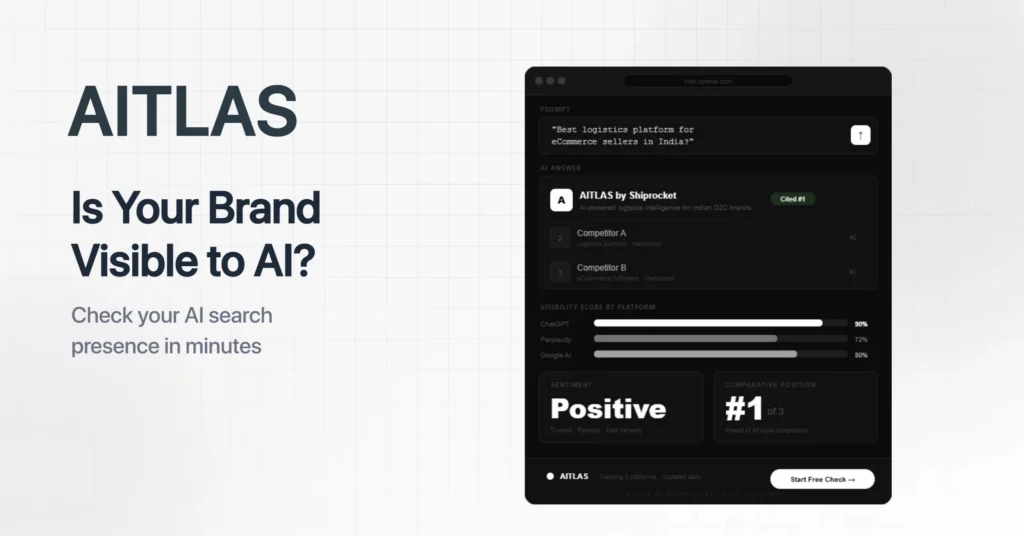
Why Might Your Brand Be Invisible Where It Matters Most?
Think about how buyers research in 2026.
They may still start with Google. But increasingly, especially younger and tech-savvy users, they go straight to AI tools and ask questions like:
- “Best shipping partner for Shopify sellers in India”
- “Compare top eCommerce platforms for D2C brands”
They receive a clear, conversational answer.
That answer shapes their shortlist before they visit a single website.
Here’s the challenge. AI platforms do not provide analytics. There is no AI Search Console. No impressions. No click data. As Yext describes it, AI search is a black box.
At the same time, the opportunity is massive:
- ChatGPT alone has over 900 million weekly users
- Users from AI platforms convert 4.4 times higher than traditional organic traffic
- Only 44.3% of top Google pages appear in AI answers
This means you can rank number one on Google and still be invisible in AI search.
These are two different ecosystems. Winning one does not guarantee the other.
What Are the 3 Metrics That Define AI Visibility?
Before you start checking, you need to know what you are actually looking for. Yext, one of the leading platforms in AI search measurement, has built a framework around three core metrics that together give a complete picture of a brand’s AI visibility. These are simple enough to track manually but powerful enough to guide a full AI visibility strategy.
1. Presence – Are You Being Cited at All?
This is the most fundamental question. Presence measures whether your brand is mentioned or referenced when AI platforms generate answers related to your category, product, or industry. When a buyer asks “What are the best logistics platforms for eCommerce sellers in India?”, is your brand part of the response at all?
If you are not present, nothing else matters. The encouraging news, as Yext’s research shows, is that presence is something you can actively influence. A Yext study found that 86% of sources cited by AI models are brand-managed content your website, help articles, product pages, and location information. This means you have far more control over what AI knows about you than most brands realise.
2. Sentiment – How Is AI Describing You?
Appearing in an AI answer is only half the battle. AI engines do not just list brand names they interpret and frame them. They describe your brand based on everything they have absorbed from reviews, articles, forum discussions, and your own content. The question is whether that description matches how you actually want to be known.
Are you described as a trusted, reliable option? A budget choice? A platform best suited to large enterprises but difficult for small sellers? Understanding sentiment helps you identify where your brand narrative may have drifted in the AI’s understanding, and what content or messaging updates could correct it before the perception becomes entrenched in future model training.
3. Comparative Position – Where Do You Stand Against Competitors?
AI answers are typically concise. Unlike a Google results page with ten blue links, an AI platform usually surfaces just two to four options in response to a comparison or recommendation prompt. Your relative position in that short list whether you are mentioned first, second, or not at all – can directly determine whether a potential customer considers you.
Comparative position is especially important in India’s eCommerce and logistics space, where the competitive landscape is dense and buyers actively compare providers before committing. Knowing that a competitor is consistently mentioned first in AI answers about your category is actionable intelligence and it is the kind of insight you simply cannot get from traditional SEO reports.
How Can You Check Your AI Visibility in 10 Minutes?
You can do this manually right now.
- Step 1: Open 3 platforms
- ChatGPT
- Perplexity
- Google with AI Overviews
- Step 2: Create 5 to 10 prompts
- Think like a customer, not an SEO expert.
- Step 3: Track these 4 things (In a simple sheet, record:)
- Is your brand mentioned?
- Is your website linked?
- Position vs competitors
- How your brand is described
- Step 4: Repeat prompts multiple times
- AI responses vary. Run each query 3 to 5 times for accuracy.
- Step 5: Check for outdated information and Ask directly:
- What does your brand do?
- Pricing?
- Features?
Compare with reality. Fixing outdated information is often the fastest win.
Which Prompts Can You Use to Test AI Visibility?
Here are ready-to-use prompts organised by buyer journey stage. Replace the bracketed text with your actual brand name, product category, and competitors. Run these across ChatGPT, Perplexity, and Google AI Overviews.
| Research Stage |
|---|
| “What are the best [product category] platforms for eCommerce sellers in India?” |
| “How does [your product or service] work?” |
| “What should I look for when choosing a [product category] solution for a D2C brand?” |
| Comparison Stage |
|---|
| “[Your brand] vs [Competitor] which is better for eCommerce sellers in India?” |
| “Top [product category] tools for small businesses in India in 2026” |
| “Alternatives to [Competitor] for [your use case]” |
| Evaluation Stage |
|---|
| “What is [your brand] and what does it offer?” |
| “Is [your brand] worth it for a small D2C business in India?” |
| “How much does [your brand] cost and what plans are available?” |
| “What are the pros and cons of [your brand]?” |
How Should You Read Your AI Visibility Results?
Once you have run your prompts and filled in your tracking sheet, here is how to interpret each scenario and what action it calls for.
If your brand does not appear at all, it means AI systems do not have enough signals to recognise or trust your brand in that context. The fix is foundational: earn more third-party mentions in credible publications, publish original content that directly addresses the questions your category attracts, and add structured data to your core pages so AI can accurately understand what you offer.
If your brand is mentioned but no link to your website is included, AI knows about you but is not citing your pages as sources. This usually means your content structure needs attention clearer headings, FAQ schema markup, and information that is easy for AI systems to extract and attribute will help close this gap without requiring new content from scratch.
If your brand appears but consistently after competitors, you have presence but weaker authority signals on this topic. Audit what the brands appearing ahead of you have that you do not more third-party reviews, more in-depth content on specific topics, or more consistent brand messaging across owned and earned channels.
If AI describes your brand inaccurately or with outdated information, it is drawing from old or conflicting sources. The most effective fix is to update and consolidate your owned content homepage, about page, product pages, and pricing with clear, consistent, and current information. Since AI prioritises brand-managed content, the more authoritative and accurate your own pages are, the less likely AI is to reference stale third-party sources instead.
If your brand appears first and is described positively, document carefully what is driving this. What content, structured data, or external mentions are working? Replicate that approach systematically across the other prompts and topics where you are not yet winning.
How Often Should You Check Your AI Visibility?
This depends on how seriously AI visibility sits on your current priority list. Semrush recommends a daily cadence for brands actively running an AI visibility improvement campaign, where frequent checks help you see whether your content and outreach efforts are moving the needle in near real-time.
For most marketing teams, a weekly check is the practical sweet spot. A weekly review lets you catch platform shifts, compare week-on-week trends, and spot new visibility gaps before they grow into larger competitive problems. It is also manageable manually with a focused prompt list of ten to fifteen queries.
A monthly check is the minimum for brands where AI visibility is not yet a high priority. At this cadence, you will catch major changes but may miss faster-moving competitive shifts. As AI search becomes a more significant driver of discovery in India’s eCommerce market, monthly checks will likely feel insufficient within the next year.
Regardless of cadence, remember: AI platforms update constantly. A prompt that surfaces your brand reliably today may not do so next week. This is not a one-time exercise it is an ongoing monitoring habit, much like checking your SEO rankings or reviewing your paid ad performance every week.
Which AI Visibility Tools Should You Consider?
Manual checks are a strong starting point, but as your prompt list grows and the competitive landscape shifts faster, automated tools become essential for consistent and reliable monitoring. Here is a comparison of tools available today, with a focus on what works for Indian market brands alongside the leading global options.
| Tool | Best For | India Ready? | Pricing | Key Strength |
|---|---|---|---|---|
| AITLAS by Shiprocket | eCommerce and D2C brands in India | Built for India | Talk to team | AI visibility combined with eCommerce intelligence; designed around Indian buyer journeys and market context |
| Resultify AI | Indian SMBs and marketing agencies | India focused | From ₹2,999/mo | Tracks mentions across ChatGPT, Gemini, and Perplexity with Indian keyword and category support |
| BrandMentions AI Monitor | Indian D2C and consumer brands | India compatible | Free plan; Pro from ₹4,499/mo | Real-time mention tracking across AI platforms and the web; supports Hindi and regional language queries |
| Semrush AI Visibility Toolkit | Mid-size and enterprise teams | Global, works for India | 7-day free trial; $99/mo | Tracks across 239M+ prompts; strong recommendations and competitive benchmarking |
| Nightwatch | Teams combining SEO and AI tracking | Global, works for India | 14-day free trial; from $39/mo | Combines traditional rank tracking with AI visibility monitoring in a single dashboard |
| Otterly AI | Small teams and freelancers | Global, works for India | 14-day free trial; $29/mo | Simplest setup of any paid tool; tracks brand mentions and share of voice affordably |
| AI Search Watcher | Anyone starting with zero budget | Global, works for India | Free plan available | Free basic tracking across AI platforms a good way to start before investing in a paid tool |
| Manual (Google Sheet) | Any brand, zero budget | Works everywhere | Free | Full control over your own prompt list and tracking cadence; use the templates in this guide to get started today |
Why Does AITLAS Stand Out for Indian Brands?
Running a manual AI visibility check once or twice gives you a useful snapshot. But building a real AI visibility strategy one that tracks consistently, spots competitive shifts early, and connects visibility to business outcomes requires something more systematic than a weekly spreadsheet exercise.
AITLAS is Shiprocket’s AI intelligence platform built specifically for the Indian eCommerce and D2C ecosystem. Unlike global tools that treat India as one market among many, AITLAS is designed around how Indian buyers actually search, compare, and decide across ChatGPT, Google AI Overviews, Perplexity, and Gemini, and across the product categories and competitive landscapes that matter most to sellers operating in India.
With AITLAS, brands can track their Presence, Sentiment, and Comparative Position consistently across all major AI platforms without running manual checks every week. The platform surfaces which prompts and topics your brand is winning, where competitors are gaining ground, and what specific content or structural changes are most likely to improve your visibility prioritised by potential impact so your team knows exactly where to focus next.
Beyond tracking, AITLAS connects AI visibility intelligence to the broader eCommerce context helping brands understand not just whether they appear in AI answers, but how that visibility is translating into discovery, consideration, and orders. For sellers managing fulfilment through Shiprocket, this means AI visibility becomes part of the same operational picture rather than a separate marketing metric tracked in isolation from business results.
As AI search becomes a primary discovery channel for Indian buyers, the brands building their AI presence now will be the ones that potential customers find first and find most favourably six months from today. AITLAS is here to help you build that presence systematically, with tools and intelligence designed for how Indian eCommerce actually works.
Conclusion
If you have never checked whether your brand appears in AI-generated answers, the most important thing to do right now is not finish reading this article and open AITLAS Platform in a new tab and type in a question your customer would genuinely ask. See if your brand comes up. See how it is described. See who gets mentioned first if you do not.
That five-minute check will tell you more about your AI visibility gap than any report. And once you have seen it, you will want to fix it.
The three metrics Presence, Sentiment, and Comparative Position give you the framework to understand what you find. The prompt templates in this guide give you a starting point for your first check today. The tools comparison helps you choose the right level of monitoring as your strategy matures. And the understanding that 86% of what AI knows about your brand comes from your own content should give you genuine confidence that this is something you can actually influence with the right focus and consistency.
AI search is not a future problem. It is already where your customers are looking. The brands that figure out how to show up there today consistently, accurately, and favourably will have a meaningful head start on every competitor that waits until the data is impossible to ignore.
Start with the check. Build the habit. And do not let your brand be invisible in the answers your customers are already reading.
AI responses are not fixed. They vary each time.
If your brand appears in:
1. 60 to 70% of results: strong presence
2. 10 to 20%: weak and inconsistent
Consistency matters more than occasional visibility.
No. Only a portion of top-ranking pages appear in AI results. SEO helps, but AI visibility requires a separate strategy.
Yes.
1. AITLAS is built specifically for Indian eCommerce
2. Resultify AI and BrandMentions support Indian use cases
3. Global tools work, but lack regional depth
Share this article
Newsletter
Stay ahead of AI search
Weekly insights on AI visibility, AEO strategies, and brand intelligence. No spam.

Sahil Bajaj: With 7+ years of digital marketing expertise, I'm dedicated to fusing technology and creativity for business success. Known for innovative strategies that drive growth and a passion for continuous improvement.
Related Articles