
Blog Summary
AI now drives product research, ChatGPT has ~900M weekly users and Google's AI Overviews show up on nearly half of all searches. Answer engines cite only 1-3 sources per query, so ranking "okay" isn't enough. This guide covers AEO/GEO: the 5-step framework to get your brand cited by ChatGPT, Gemini, and Perplexity.
If your brand doesn’t show up when someone asks ChatGPT “what’s the best [category] brand in India,” you’re already losing customers you’ll never see in your analytics. That’s not a Google ranking problem it’s an AI visibility problem, and it needs a different playbook.
The scale of that shift is no longer speculative. ChatGPT alone had crossed roughly 900 million weekly active users by February 2026, up from about 500 million a year earlier and product-research and shopping queries were its fastest-growing use case, up 89% year-over-year. On Google, AI Overviews were showing up on approximately 48% of tracked search queries by March 2026, meaning close to half of all searches now return an AI-generated summary before a single blue link. And this isn’t confined to informal browsing: about 37% of consumers say they now begin their research with an AI tool rather than a traditional search engine, and 47% say AI already influences which brands they trust.
The catch for brands is that these answer engines don’t behave like a search results page. When ChatGPT answers a question, it typically cites only one to three sources not ten. Being “pretty visible” on Google no longer guarantees you’re one of them. And the payoff for actually being cited is measurable: brands referenced inside AI Overviews see roughly 35% more organic clicks and 91% more paid clicks than uncited competitors on the same query. Meanwhile, ordinary organic click-through rates on queries where an AI Overview appears have dropped as much as 61%, per Seer Interactive’s tracking so the traffic that used to flow to page one is increasingly being consumed inside the answer itself, not passed on to a website at all.
This guide breaks down Answer Engine Optimization (AEO) sometimes called Generative Engine Optimization (GEO) or LLM optimization and gives you a practical framework to get your brand surfaced and cited inside AI Overviews, ChatGPT, Gemini, and Perplexity, backed by what’s actually driving citations in 2026.
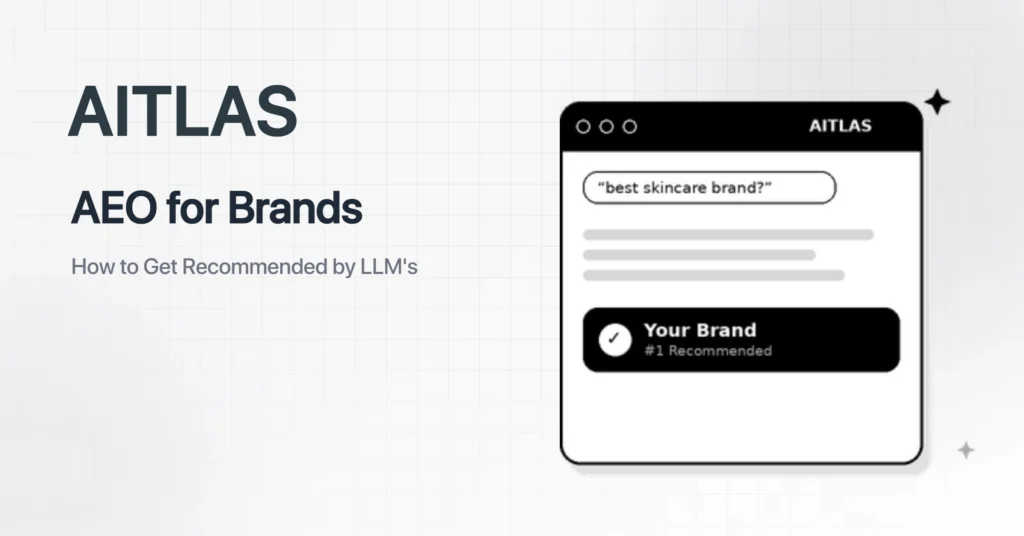
What Is AEO (Answer Engine Optimization)?
AEO is the practice of structuring your brand’s content and data so large language models can find it, trust it, and cite it when a user asks a relevant question. Where traditional SEO optimizes for a ranked list of blue links, AEO optimizes for being the answer the single brand, product, or fact an AI model chooses to surface in a conversational response.
The shift matters because AI answer engines don’t show ten options. They typically surface one to three. If you’re not one of them, you don’t exist in that conversation.
Why AI Visibility Is Becoming a Growth Channel
More shoppers are starting product research inside AI chat interfaces instead of a search bar asking for comparisons, recommendations, and “best of” lists in plain language. For D2C brands specifically, this shifts where the buying journey actually begins: before a customer ever visits your website, an LLM may have already told them what to buy.
Brands that show up consistently across AI answers build a compounding advantage: LLMs tend to reinforce sources that have already been cited elsewhere, so early, credible visibility snowballs over time.
How Does LLM Optimization Actually Work?
1. Structured, Extractable Content
LLMs pull specific facts, not full pages. Content that answers one clear question per section with the answer stated plainly in the first sentence gets extracted more reliably than long, narrative paragraphs.
2. Verifiable, Specific Data
Vague claims get ignored. Specific numbers, named comparisons, and sourced statistics get cited. If you claim a result, back it with a real, checkable figure not a placeholder percentage.
3. Consistent Entity Signals Across the Web
LLMs cross-reference how your brand is described across your site, review platforms, news mentions, and third-party listicles. Inconsistent positioning (different taglines, different claims) dilutes how confidently a model recommends you.
4. Freshness and Update Cadence
Answer engines favor recently updated, actively maintained sources over stale ones, especially for anything price-, feature-, or availability-related.
A Step-by-Step AEO Framework for D2C Brands
Step 1: Find Out What AI Is Already Saying About You
Before optimizing anything, run your brand and category through ChatGPT, Gemini, Perplexity, and Google AI Overviews. Note whether you’re mentioned, how you’re described, and who gets recommended instead of you.
Step 2: Map the Prompts Your Customers Actually Ask
Identify the real questions potential customers type into AI tools “best skincare brand for sensitive skin in India,” “is [competitor] worth it,” etc. These prompts, not keywords, are your new targeting unit.
Step 3: Build Answer-First Content
For each priority prompt, create or restructure a page that answers it directly in the opening lines, followed by supporting detail, comparisons, and a clear FAQ block.
Step 4: Strengthen Off-Site Trust Signals
Get accurately mentioned on comparison sites, review platforms, and industry roundups. LLMs weigh third-party corroboration heavily your own site claiming something is worth far less than five independent sources confirming it.
Step 5: Track AI Citations, Not Just Rankings
Traditional rank tracking won’t show you whether an LLM is recommending you. You need visibility tracking built specifically for AI answer engines, checked on a recurring basis since AI answers can shift week to week.
How AITLAS Helps
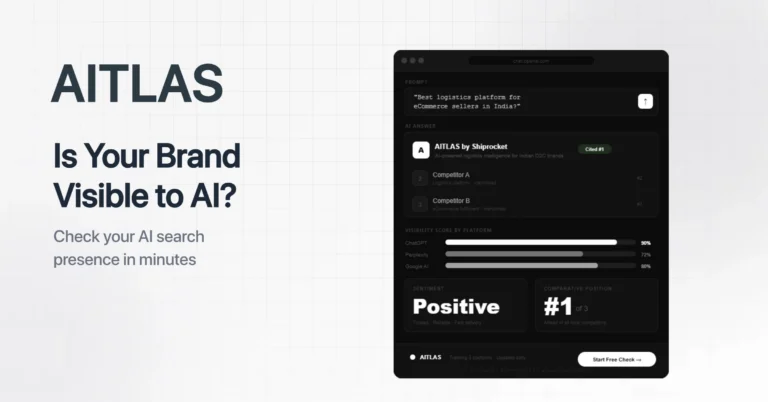
AITLAS is Shiprocket’s AEO platform, built specifically for this shift. It runs on two engines:
- RADAR tracks your brand’s visibility across ChatGPT, Gemini, Perplexity, and AI Overviews showing exactly when and how you’re being recommended (or missed) against competitors.
- HYDRA auto-publishes AEO-optimized content structured the way LLMs actually extract and cite information, so your brand shows up as the answer, not just a search result.
For D2C brands trying to win the AI recommendation game instead of just the SEO game, this closes the loop between measuring visibility and actually improving it.
Common Mistakes That Hurt AI Visibility
- Publishing vague, unsourced claims that AI models can’t verify or cite confidently.
- Treating AEO as a one-time project instead of an ongoing tracking-and-publishing loop.
- Ignoring third-party mentions and review platforms where LLMs cross-check your claims.
- Writing content structured for human skimming but not for AI extraction (no direct answers, no clear Q&A format).
The Future of Brand Discovery Is Conversational
As AI answer engines take on more of the research phase of buying, brands that adapt their content and data strategy now will hold a durable advantage over those still optimizing purely for the search results page. AEO isn’t a replacement for SEO it’s the next layer on top of it.
AEO is the process of optimizing content and brand data so AI models like ChatGPT, Gemini, and Perplexity surface and recommend your brand in response to relevant user questions.
SEO optimizes for ranking in a list of search results. AEO optimizes for being the specific answer an AI model chooses to cite or recommend, often to the exclusion of competitors.
Ask relevant category questions directly in ChatGPT, Gemini, and Perplexity, or use a dedicated AI visibility tracking tool like AITLAS’s RADAR to monitor this at scale and over time.
No. AEO builds on strong SEO fundamentals structured content, authority, and trust signals while adding the extractability and citation-worthiness that AI answer engines specifically reward.
Share this article
Newsletter
Stay ahead of AI search
Weekly insights on AI visibility, AEO strategies, and brand intelligence. No spam.
Related Articles