What Is Google AI Mode? Strategy to Rank in AI Search Results
Blog Summary
- ✦ Google AI Mode replaces the 10 blue links entirely — a fully separate AI search experience
- ✦ Query fan-out breaks one search into up to 16 parallel sub-searches simultaneously
- ✦ 7 strategies to get your brand cited in Google AI Mode responses
For years, getting found on Google meant one thing: ranking in the top ten organic results. You optimised your page, built your backlinks, and watched your blue link climb the SERP. That model worked – until it did not.
First came AI Overviews, which placed a generated summary above the organic results and cut click-through rates by nearly 49% according to Pew Research. Now comes something more disruptive: Google AI Mode – a fully separate search experience that eliminates the traditional results page entirely and replaces it with a deep, conversational, multi-source AI answer. No 10 blue links. No sponsored results. Just the AI’s synthesised response, with citations to the sources it chose to trust.
If your brand is not built for this environment, it will not appear. And increasingly, if it does not appear in AI Mode, it does not exist for a growing share of your potential customers. This guide covers everything you need to know and do – to change that.
What Is Google AI Mode?
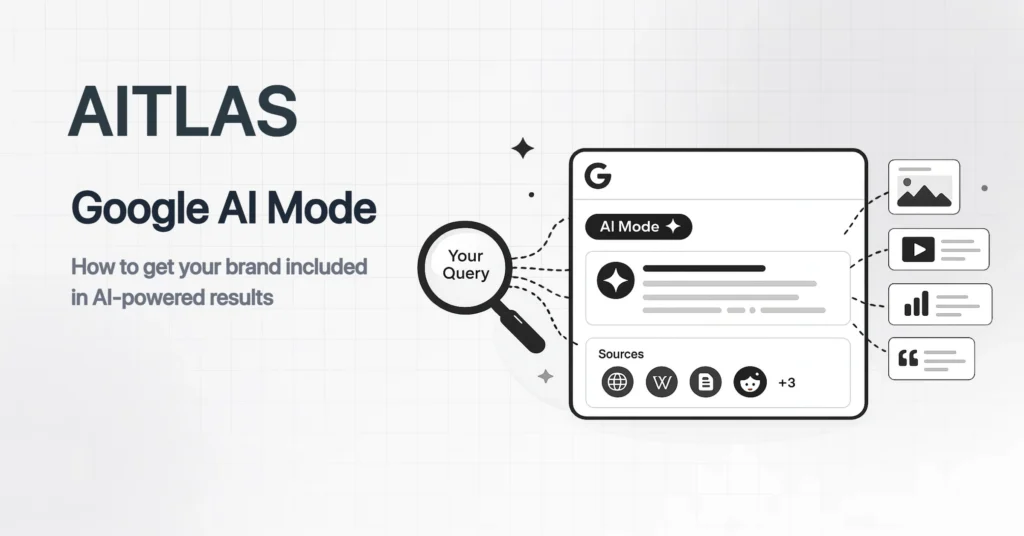
Google AI Mode is a fully AI-powered search experience built on Google’s Gemini 2.5 model. Rather than returning a ranked list of links, it delivers a comprehensive, conversational response that synthesises information from multiple sources into a single structured answer, with follow-up questions supported throughout the session.
You can access it three ways: through the “AI Mode” tab that appears alongside “Images” and “Videos” in standard search, by going directly to google.com/aimode, or on mobile by tapping “Show More” within an AI Overview. Once you are in AI Mode, the experience feels more like talking to a knowledgeable research assistant than typing into a search engine. You ask something, get a detailed answer with source citations, ask a follow-up, and the system maintains the full context of the conversation.
What makes AI Mode categorically different from everything that came before is what happens the moment you submit a query. It does not look something up. It researches it – simultaneously, in parallel, across many different angles at once. To understand what that means for your brand, you need to understand query fan-out.
How Google AI Mode Works: Query Fan-Out Explained
When a user submits a query to Google AI Mode, the system does not process it as a single search request. Instead it uses a technique called query fan-out the original query is broken into multiple parallel sub-searches that run simultaneously, each designed to retrieve a specific dimension of a complete answer.
Consider a query like “best fulfilment platform for D2C brands in India.” AI Mode does not just look for pages that rank for that phrase. It fans out into parallel queries covering shipping speed comparisons, platform integrations with Shopify and WooCommerce, pricing structures for different order volumes, return management features, customer reviews and ratings, and regional coverage across Indian pin codes. Each sub-query retrieves its own set of sources. Gemini 2.5 then synthesises all of it into one cohesive, multi-faceted answer.
AI Mode can issue up to 16 simultaneous sub-searches per query. This changes the competitive dynamic for brands entirely. You are no longer competing to rank for a single keyword on a single page. You are competing to be cited across a cluster of related sub-queries, each of which may pull from a different page on your website, a review on a third-party platform, a case study, or a mention in an industry publication. As upGrowth’s research puts it, brands optimising for single keywords are now invisible in half the searches that matter the strategic response is to build an answer-cluster strategy that covers the full breadth of questions your category generates.
Google AI Mode vs AI Overviews: Key Differences
AI Mode and AI Overviews both run on Gemini technology, but they serve fundamentally different purposes and operate in fundamentally different ways. Treating them as the same thing leads to badly misaligned strategy. Here is how they compare across the dimensions that matter most for brands.
| Feature | AI Overviews | Google AI Mode |
|---|---|---|
| Where it appears | Inside regular search, above organic links when helpful | Separate tab or google.com/aimode – no traditional 10 blue links shown |
| Organic results alongside | Yes, traditional results remain visible | No, AI response fully replaces organic listings |
| Query handling | Single-pass synthesis one query, limited sources | Query fan-out up to 16 parallel sub-searches simultaneously |
| Response depth | Quick summaries for complex questions | Deep, multi-source, interactive exploration with full follow-up support |
| Follow-up questions | Limited | Full multi-turn conversation with context retained throughout |
| Overlap with organic top 10 | High, ~80% of exact URLs match organic results | Low, only 35% of cited URLs match Google’s top 10 |
| Input types | Text only | Text, voice, and images (multimodal) |
| Best suited for | Fast, surface-level answers to known questions | Deep research, comparisons, planning, and complex evaluations |
That 35% URL overlap figure is the number every marketer should write down. Two-thirds of what AI Mode cites is not in your traditional top 10. A brand that has built its entire digital presence around SEO rankings could still be completely absent from AI Mode – while a competitor with modest traditional rankings but well-structured, citation-worthy content could be prominently featured. The two channels reward different things, and winning one does not give you the other.
Google AI Mode vs ChatGPT and Perplexity
For brands tracking AI visibility across platforms, it is worth understanding how Google AI Mode compares to ChatGPT and Perplexity, since each platform draws from different sources and rewards different optimisation signals.
Google AI Mode shows approximately seven unique domains in its response sidebars, with around 51% overlap with Google’s broader organic results – significantly higher than ChatGPT’s overlap with Google rankings, which is just 2.1%. AI Mode also has a distinctive sidebar format that gives cited brands meaningful visual prominence rather than just embedding a link in flowing text. It frequently references Reddit and community-generated content, which is a signal that real user discussion about your brand and product category carries weight in AI Mode citations alongside your owned content.
ChatGPT relies partly on fixed training data and partly on real-time retrieval in its paid tiers, making it less responsive to recent content updates than AI Mode. Perplexity pulls heavily from recent content and provides clear citation links but typically surfaces fewer unique domains per response. Both are important channels for brands to monitor, but for Indian brands, Google AI Mode is the highest-priority platform to optimise for Google commands over 95% of India’s search market, which means AI Mode’s reach will dwarf any other AI search platform as it scales.
Why Google AI Mode Matters for Indian Brands Right Now
Google AI Overviews now reach 2 billion monthly users across more than 200 countries – the fastest-adopted feature in Google’s history, according to Alphabet CEO Sundar Pichai. Google AI Mode is the next layer of that infrastructure – deeper, more interactive, and designed for exactly the high-consideration queries where buying decisions get made.
SE Ranking research shows that long-tail queries of four or more words trigger AI Overviews 60.85% of the time. These are precisely the queries Indian buyers use when they are close to a decision: “best shipping partner for Shopify sellers in India”, “compare D2C fulfilment platforms for 500 orders per month”, “how to reduce return rates for fashion eCommerce in India”. If your brand is not in AI Mode responses to queries like these, you are absent from exactly the moment that most shapes which shortlist a buyer builds.
For Indian eCommerce and D2C brands, the timing is genuinely advantageous. Most Indian brands have not yet adapted their content strategy for AI Mode citation. The platforms, the technology, and the buyer behaviour are converging simultaneously and the brands that build AI Mode presence now, before the majority of the market catches up, will hold a compounding advantage that becomes progressively harder to displace.
7 Strategies to Get Your Brand Included in Google AI Mode
Getting cited in AI Mode is not about gaming an algorithm. It is about becoming the kind of source that an intelligent, multi-query research system recognises as trustworthy, specific, and useful enough to synthesise. Here is what that looks like in practice for Indian brands.
1. Build Answer Clusters, Not Just Individual Pages
Because AI Mode fans out a single query into multiple parallel sub-searches, one well-ranked page is no longer sufficient. What the system needs from your brand is an interconnected cluster of content that covers a topic from every angle a buyer might approach definitions, comparisons, pricing context, how-tos, use cases, case studies, and FAQs.
For an Indian logistics brand, this might mean building a cluster around “same-day delivery in India” that includes a core guide, a comparison of same-day delivery providers, a page on how same-day delivery pricing works, a case study showing its impact on conversion rates, and a FAQ page covering the specific questions sellers ask. Each page feeds into the others and together they give AI Mode enough material to cite your brand across multiple sub-queries within a single fan-out response.
2. Optimise for E-E-A-T Across Every Content Asset
Google’s Gemini model weights content heavily on Experience, Expertise, Authoritativeness, and Trustworthiness applying these criteria more strictly in AI Mode than in standard search because it cannot afford to cite sources that are later found to be inaccurate or unreliable.
In practice this means publishing content written or reviewed by named experts with verifiable credentials, citing your data sources with clear attribution, keeping your content factually current, and ensuring that your claims are consistent across your website, your help documentation, and any third-party publications that reference your brand. Author pages, credentials, and clear publication dates all contribute to the trust signals AI Mode uses when selecting sources.
3. Structure Content Specifically for AI Extraction
AI Mode’s Gemini model does not read pages the way a human does it looks for structured, extractable information. This means clear heading hierarchies, direct answers that immediately follow question-format headings, FAQ schema markup, and content where the most important facts are visible and unambiguous on the page without requiring JavaScript interaction or expandable elements to access.
Practically, this means framing your H2 and H3 headings as questions your audience would actually ask. Following each heading immediately with a direct, complete answer rather than building up to one. Adding FAQ schema to pages that address common questions in your category. And auditing your highest-priority pages to confirm that critical information is not buried inside tabs, accordions, or other elements that AI systems may be unable to extract.
4. Publish Original Data and First-Party Research
One of the most reliable signals for AI Mode citation is content that contains original information data that does not exist anywhere else on the web. As Semrush notes: AI systems prefer citing data that does not exist elsewhere, because it is both unique and verifiable.
For Indian eCommerce brands, this means publishing your own logistics performance benchmarks, platform-level order data, shipping time averages by region, or return rate analysis by product category. Even small, specific datasets a quarterly survey of 100 Indian sellers, an analysis of order patterns across festive seasons carry significant citation value because they are uniquely yours. Generic content drawing from the same publicly available sources as every competitor has essentially no citation advantage in AI Mode.
5. Build Brand Presence Across Authoritative Third-Party Sources
AI Mode uses external mentions to validate a brand’s authority and relevance, just as all AI search systems do. A brand that appears consistently in credible third-party publications, independent review sites, industry forums, and expert roundups is significantly more likely to be cited than one whose web presence is limited to its own domain.
This includes earning links and mentions from high-authority domains relevant to your industry, as well as maintaining accurate and consistent NAP – name, address, phone information across all business listings. AI Mode specifically uses NAP consistency as a legitimacy signal for local and product queries. Inconsistent information across your owned and third-party profiles creates ambiguity that AI systems tend to resolve by citing more consistent competitors instead.
6. Leverage User-Generated Content and Review Data
Both Semrush and upGrowth note that AI Mode frequently cites Reddit and community-generated content, particularly for product and commercial queries. For D2C and eCommerce brands, product schema, review aggregation, and real customer data are cited more consistently than polished marketing copy. AI systems appear to weight authentic user experience over brand-produced content when the two are in tension.
This means actively encouraging genuine, detailed reviews on Google, Trustpilot, and industry-specific directories in India. It means engaging meaningfully in relevant forums and communities where your category is discussed. And it means making your product pages rich with structured review data — not just star ratings, but specific customer feedback about use cases, delivery experience, and product quality that AI Mode can extract and synthesise in response to comparison queries.
7. Track Your AI Mode Visibility Consistently
Unlike traditional SEO where rank tracking gives you a clear, stable performance signal, AI Mode visibility varies by query, by platform update cycle, and by competitor content activity. A prompt that surfaces your brand consistently today may not do so in three weeks. The only way to manage this channel systematically is to monitor it regularly – running your key prompts, recording your brand’s presence and positioning, and tracking changes over time.
This ongoing tracking data tells you which of your content investments are generating citations, which sub-queries your brand consistently wins or loses, and where competitors are building AI Mode presence in topics relevant to your business. Without this data, your AI Mode strategy is essentially flying blind.
How AITLAS Helps You Stay Visible in Google AI Mode
Understanding what Google AI Mode rewards is one challenge. Knowing whether your content is actually getting cited – consistently, across the queries that matter most for your business is an entirely different one. This is where most Indian brands currently have a critical blind spot, and where the cost of that blind spot grows larger every month.
AITLAS is Shiprocket’s AI visibility intelligence platform built specifically for the Indian eCommerce and D2C ecosystem. As Google AI Mode becomes a primary discovery channel for Indian buyers, AITLAS gives brands the systematic visibility into their AI search presence that traditional SEO tools simply cannot provide.
With AITLAS, brands can monitor whether they are being cited in Google AI Mode responses for the queries most relevant to their category, understand how competitors are being positioned relative to their brand in AI-generated answers, identify the specific content and structural gaps that are limiting their AI Mode inclusion, and get actionable recommendations tied to business outcomes rather than abstract SEO metrics.
Because AITLAS is built within the Shiprocket ecosystem, AI visibility data connects directly to fulfilment and eCommerce intelligence so you understand not just where your brand appears in AI search, but how that visibility is translating into discovery and orders for your business in the Indian market.
Conclusion
Google AI Mode is not an incremental update to how search works. It is a structural shift from a system that ranks pages to one that synthesises answers and it changes the rules of brand visibility in ways that most marketing teams have not yet fully absorbed.
The brands that appear in AI Mode responses are not simply the ones with the strongest domain authority or the most backlinks. They are the ones that have built content ecosystems deep and structured enough to be cited across multiple parallel sub-queries. They are the ones with E-E-A-T signals strong enough that an AI system trusts them as sources. They are the ones with original data, genuine expertise, and external validation that give AI something specific and reliable to reference.
The 35% overlap between AI Mode citations and Google’s organic top 10 is the most important number to take away from this guide. It tells you the playing field is genuinely open. A focused, well-executed AI Mode strategy can outperform much larger competitors who are still optimising for the old model. And in India specifically where AI-powered search adoption is accelerating and most brands have not yet adapted that window of competitive advantage is open right now.
Use the seven strategies in this guide to start building. Audit your content clusters for gaps. Strengthen your E-E-A-T signals. Restructure your key pages for AI extraction. Publish data that only you can publish. And track your AI Mode visibility consistently, because this is a channel that changes and the brands that keep watching will keep winning. In a market where fulfilment speed, seller trust, and brand recognition converge, showing up in AI Mode is not a marketing nice-to-have. It is how the next generation of Indian buyers will find you before they ever type your name.
Google AI Mode is a fully AI-driven search experience powered by Gemini that delivers a single, conversational answer instead of a list of links. Unlike regular search, there are no organic rankings or ads just a synthesised response with citations. It also supports follow-up questions, making it more like an interactive research session than a traditional search query.
Query fan-out is how AI Mode breaks one search into multiple sub-queries and processes them simultaneously. This means a single user query can pull information from different pages, sources, and formats. For brands, it increases the chances of being cited but only if your content covers multiple aspects of a topic, not just one keyword.
Not necessarily. Only a small portion of AI Mode citations come from traditional top-ranking pages. AI Mode selects sources based on relevance, structure, authority, and trust not just rankings. Strong SEO helps, but it doesn’t guarantee visibility in AI-generated answers.
AI Mode prefers content that is clear, structured, and easy to extract. It prioritises pages with direct answers, strong expertise signals, updated information, and credible sources. Content with original data, real examples, and external validation (like reviews or mentions) is far more likely to be cited.
AI Mode reduces traditional click-through rates because users get answers directly within the search experience. However, being cited increases brand visibility at the decision-making stage. Even without clicks, your brand becomes part of the answer users rely on.
There is no fixed timeline, but structured content updates can show impact within a few weeks. Building authority through external mentions and trust signals usually takes a few months. Publishing unique data can speed up visibility, as AI systems prioritise exclusive and verifiable information.
Share this article
Newsletter
Stay ahead of AI search
Weekly insights on AI visibility, AEO strategies, and brand intelligence. No spam.

Sahil Bajaj: With 7+ years of digital marketing expertise, I'm dedicated to fusing technology and creativity for business success. Known for innovative strategies that drive growth and a passion for continuous improvement.
Related Articles