Google AI Models Explained: Gemini vs AI Overviews vs AI Mode
Blog Summary
- ✦ Google uses multiple AI products, including Gemini, AI Overviews, and AI Mode, and each can produce different answers for the same query.
- ✦ Gemini is Google's AI model family, while AI Overviews and AI Mode use different model versions, retrieval systems, and product-specific configurations.
- ✦ AI Overviews are designed for quick, summarised answers, while AI Mode is built for deeper, multi-step research and uses query fan-out.
- ✦ Your brand can appear in Google AI Overviews but remain invisible in AI Mode because the two products use different retrieval and citation mechanisms.
- ✦ Only 35% of URLs cited in AI Mode overlap with Google's organic top 10, showing that strong SEO rankings alone do not guarantee AI visibility.
- ✦ AI Overviews have a much stronger relationship with traditional organic rankings, making technical SEO and strong search performance important for visibility.
- ✦ AI Mode rewards broader content coverage, original research, community presence, reviews, and content that answers multiple dimensions of a topic.
- ✦ For Indian eCommerce and D2C brands, India-specific content, regional use cases, original data, and consistent brand information can create an advantage in AI search.
- ✦ The strongest cross-platform strategy combines traditional SEO with AEO practices such as structured content, direct answers, original research, and authoritative brand signals.
- ✦ Tracking visibility separately across Gemini, AI Overviews, and AI Mode is essential because winning on one Google AI surface does not guarantee visibility on another.
- ✦ AITLAS helps brands monitor AI visibility across Google's AI products, as well as ChatGPT and Perplexity, and identify gaps where competitors are being recommended instead.
Why can the same brand get different answers across Google’s AI products? Ask Gemini, AI Overviews, and AI Mode the same commercial question and you may see different brands, descriptions, sources, and recommendations.
This is not a bug. It is the direct result of Google running multiple different model versions across multiple different products, each with its own retrieval architecture, context window, fine-tuning, and inference pipeline. The brand that appears confidently in Gemini’s app response might not exist at all in the AI Mode answer to the same question – and the citations in AI Overviews come from a partially different pool again.
For brands building an AI visibility strategy, this variability matters because visibility in one Google AI surface does not automatically translate to visibility in another. This guide explains the differences between Gemini, AI Overviews, and AI Mode, what drives variation in their answers, and how brands can build content that is easier for AI systems to understand and cite.
Why Google Model Variability Matters for Your Brand
In traditional SEO, a page either ranks or it does not. The ranking is consistent – if you are in position three for a given keyword, every user searching that term sees you in position three. The same rule does not apply to AI-generated responses.
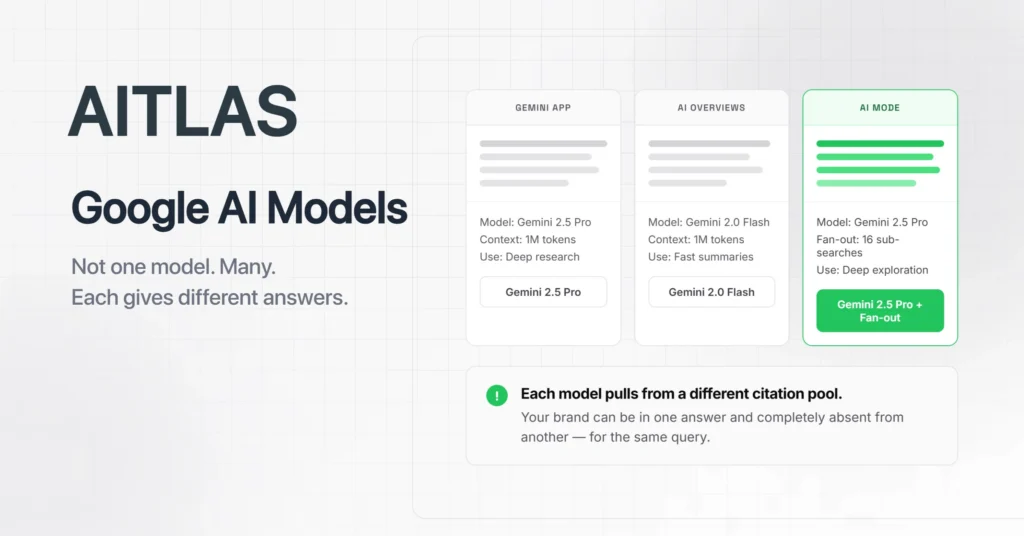
Google’s AI products are powered by different model versions, each trained and fine-tuned differently, each running its own retrieval and ranking logic, and each drawing from a partially distinct pool of indexed sources. This means the same question asked across Google’s different AI products can return genuinely different brand mentions, different descriptions of the same company, and different confidence levels about who the right answer is.
A brand appearing consistently in AI Overviews had essentially no guarantee of appearing in AI Mode – and vice versa. For brands building visibility in Google’s AI ecosystem, this means you cannot optimise for one surface and assume the others follow.
Understanding why this happens starts with understanding the models themselves.
Google Gemini Models: What Each Version Does
Google’s Gemini is not a single model. It is a family of models at multiple sizes and capability levels, each designed for a different balance of speed, depth, and cost. As of mid-2026, the publicly available Gemini family includes the following actively maintained variants. [1]
Gemini 2.5 Pro
Gemini 2.5 Pro is Google’s most capable model and the one powering Google’s most demanding AI products, including AI Mode. It supports a 1-million-token context window – one of the largest of any publicly available model – and excels at complex reasoning, multi-step research, coding, and long-document analysis. It is the model Google uses when depth matters more than speed, and it is the primary engine behind the deep, multi-source responses that AI Mode produces.
Gemini 2.5 Flash
Gemini 2.5 Flash is a hybrid reasoning model designed to balance performance with efficiency. It also supports a 1-million-token context window and can handle thinking tasks with an adjustable compute budget. Google describes it as their “best model for price-performance” – meaning it delivers most of the capability of 2.5 Pro at significantly lower inference cost, which matters at the scale Google operates. It is used across a range of Google products where speed and quality need to be balanced.
Gemini 2.5 Flash-8B
A smaller, faster variant of 2.5 Flash. The 8B refers to approximately 8 billion parameters – a fraction of the full model’s size – making it significantly cheaper to run at scale. It supports a 1-million-token context window and is tuned for lower-latency tasks where the full depth of 2.5 Flash is not required. It is used for high-volume, fast-response applications across Google’s infrastructure.
Gemini 2.0 Flash
Gemini 2.0 Flash is the workhorse of Google’s current AI Overviews product. It is optimised for very fast inference at extreme scale – Google needs to generate AI Overviews for a meaningful fraction of the 8.5 billion searches processed daily, and 2.0 Flash makes that computationally viable. It supports a 1-million-token context window and is multimodal – it can process text, images, audio, and video. It is meaningfully less capable than 2.5 Pro on complex reasoning tasks, but consistently faster and considerably cheaper to run at scale.
Gemini 2.0 Flash-Lite
The most cost-efficient model in the current family. Gemini 2.0 Flash-Lite is designed for applications where volume and latency constraints are the primary concern. It has a 1-million-token context window and handles text and image inputs but at reduced reasoning depth. It is not used in consumer-facing AI search products but powers many backend and developer-facing Google Cloud applications.
Gemini 1.5 Pro and 1.5 Flash (Legacy)
The previous generation. Gemini 1.5 Pro supports a 2-million-token context window – still the largest ever offered by Google – and was the primary model powering Google’s AI products through most of 2025. Gemini 1.5 Flash was its faster, lighter counterpart. Both remain available through the Gemini API for developers who built products around them, and they continue to power some Google services that have not yet migrated to the 2.x series. Their benchmarks are discussed in the next section alongside the current models.
Benchmark Performance: How Google Models Compare
Benchmarks give the most objective comparison of where each model sits in terms of raw capability. The following figures are drawn from Google’s official Gemini API documentation and independently published benchmark analyses.
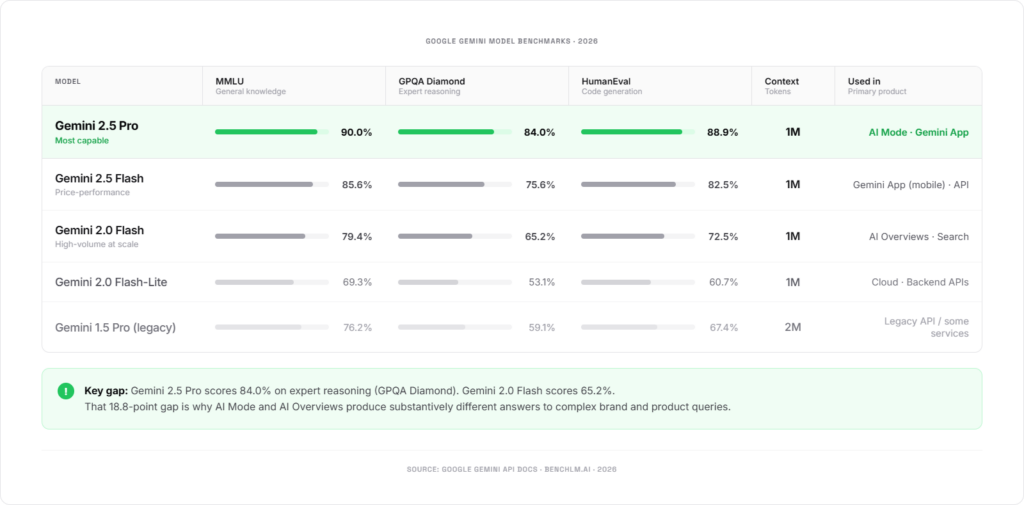
The most important number in that table for brand visibility is the 18.8-point gap between Gemini 2.5 Pro (84.0%) and Gemini 2.0 Flash (65.2%) on the GPQA Diamond benchmark, which measures expert-level reasoning across science, biology, chemistry, and logic. This gap is not academic – it translates directly into how each model handles nuanced commercial queries.
When a user asks AI Mode “which logistics platform offers the best same-day delivery coverage in Tier 2 Indian cities?”, the 2.5 Pro model powering AI Mode can reason across multiple dimensions: geographic coverage data, delivery time benchmarks, pricing structures, and seller reviews. The 2.0 Flash model powering AI Overviews produces a faster answer with less multi-step reasoning – which means it may draw simpler conclusions from fewer sources, and may cite a different set of brands as a result.
The takeaway is not that one model is right and the other is wrong. Both are generating plausible responses from their available information. The point is that they will not always agree – and brands need to be visible enough across enough sources that they appear credibly in both environments.
Gemini vs AI Overviews vs AI Mode: Key Differences
Understanding the models is one layer. Understanding how those models behave within each specific product is the next. Google’s three primary AI-facing consumer products each use the Gemini model family differently.
The Gemini App
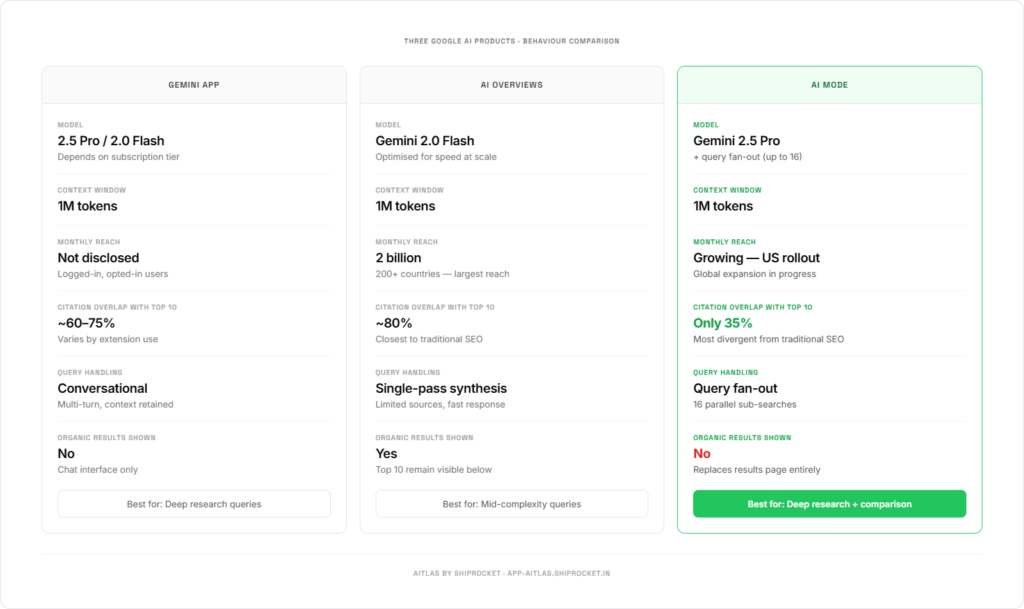
The Gemini app – available at gemini.google.com and as a mobile application – gives users direct conversational access to Google’s most capable models. Users on the free tier interact with Gemini 2.0 Flash; users on the Advanced subscription access Gemini 2.5 Pro and 2.5 Flash. The app maintains conversational context within a session, allows document uploads, and can use Google extensions to access real-time information from Search, Gmail, Drive, and other Google services.
For brand visibility, the Gemini app is most relevant to professional and research-oriented queries – the kind of questions a procurement manager, a marketing strategist, or a senior buyer would ask when evaluating options thoroughly. The model used, the user’s tier, and whether Google extensions are active all affect what sources get cited and how the response is framed.
AI Overviews
AI Overviews are the summarised answer boxes that appear at the top of standard Google search results for a growing proportion of queries. They reach 2 billion monthly users across more than 200 countries, making them by far the largest surface area in Google’s AI ecosystem by reach. They are powered primarily by Gemini 2.0 Flash, optimised for speed at scale.
AI Overviews tend to appear most often for complex, multi-part, or research-oriented queries – SE Ranking found that queries of four or more words trigger AI Overviews 60.85% of the time. Short, navigational, or transactional queries are less likely to receive an overview. When they appear, they cite between three and seven sources and present a concise synthesised answer above the organic results. The organic results remain visible alongside the overview.
Critically, the URL overlap between AI Overviews citations and Google’s organic top 10 is approximately 80% – high enough that good traditional SEO genuinely helps AI Overviews visibility. But the specific pages cited within the overview are not always the top-ranked pages; Google selects based on how well a specific section of a page answers the implied question, not just on overall page authority.
AI Mode
AI Mode is the most architecturally distinct of the three products. As discussed in our previous blog on the topic, AI Mode replaces the traditional search results page entirely and uses a query fan-out technique – breaking one user query into up to 16 parallel sub-searches, each retrieving a different dimension of a comprehensive answer. It is powered by Gemini 2.5 Pro and designed for deep, multi-turn research conversations rather than quick lookups.
The citation behaviour of AI Mode is the most different from traditional search. Only 35% of URLs cited in AI Mode responses match Google’s organic top 10 results – a far lower overlap than AI Overviews. AI Mode also displays approximately seven unique domains per response in its sidebar, and it has a significantly higher rate of citing Reddit, review aggregators, and community forums alongside traditional editorial sources.
Why Your Brand Appears in One and Not the Other
The practical implication of all this for brand visibility is more concrete than most marketers realise. It is not unusual for a brand to achieve the following simultaneously: cited in Gemini app responses for its category, absent from AI Overviews for the same query, and visible again – but described differently – in AI Mode. This is not inconsistency in the brand’s content. It is a predictable consequence of how different models with different retrieval architectures weight the same signals differently.
First, AI Overviews tended to cite the same small set of high-authority domains repeatedly – editorial publications, major review sites, and well-established brand pages – while AI Mode’s citation pool was broader and more diverse, including Reddit threads, niche industry forums, and less well-known publications. A brand with a strong presence in authoritative editorial sources was more likely to appear in AI Overviews; a brand with broader community and forum presence was more likely to appear in AI Mode.
Second, the models differed significantly in how they described the same brands when they did appear. Gemini 2.5 Pro, with its deeper reasoning capability, tended to provide more nuanced brand descriptions – acknowledging strengths and limitations, comparing use cases. Gemini 2.0 Flash produced simpler, more categorical descriptions. A brand whose messaging was nuanced and multidimensional was more likely to be described accurately by the 2.5 Pro model than by the faster Flash variant.
Third, the AI Mode query fan-out creates citation opportunities that single-pass models simply do not produce. Because AI Mode breaks one query into sixteen sub-queries, a brand whose content covers multiple dimensions of a topic – pricing, features, use cases, comparisons, reviews – has sixteen potential citation entry points rather than one. A brand with a single well-ranked page has only one opportunity to appear, which the fan-out may or may not engage.
What Drives Variability: Retrieval, Context, and Fine-Tuning
There are three fundamental reasons why Google’s AI products produce different answers, and understanding each one helps you make smarter decisions about where to invest your visibility efforts.
Retrieval architecture
Each Google AI product connects its language model to a different retrieval system. AI Overviews retrieves from a subset of Google’s index prioritising recently indexed, high-authority pages. AI Mode retrieves across a broader index via its parallel fan-out sub-searches, pulling from a wider variety of source types. The Gemini app, when Google extensions are active, retrieves in real-time from Search. When they are not active, it relies on the model’s training data, which has a knowledge cutoff. The same brand may have different levels of indexed representation across these different retrieval layers.
Context window and token usage
All current Gemini models support a 1-million-token context window (Gemini 1.5 Pro supported 2 million). But supporting a large context window does not mean every response uses all of it – how much context is loaded per inference is determined by the product’s infrastructure configuration, not just the model’s capability. AI Mode, with its deep research design, loads more context per response than AI Overviews, which is optimised for fast generation at scale. More context means more retrieved sources, which means a wider citation pool – and a greater probability that a brand with broad but not necessarily top-ranked coverage will appear.
Fine-tuning and product alignment
The base Gemini models are fine-tuned separately for each product. AI Overviews is tuned to produce concise, helpful summaries suitable for a quick search context. AI Mode is tuned to produce deep, exploratory, multi-perspective responses suitable for extended research. The Gemini app is tuned for conversational fluency and instruction-following. These fine-tuning differences mean that even the same underlying model version behaves differently across products – it has been trained to optimise for different response characteristics, which affects how it selects and weights sources.
What This Means for Indian eCommerce Brands
For brands operating in India’s eCommerce and D2C space, the variability of Google’s models creates both a challenge and an opportunity that is specific to this market.
The challenge is that brand visibility in Google’s AI ecosystem is not a single target – it is multiple targets, each with different requirements. A content strategy that focuses exclusively on AI Overviews (which rewards high-authority editorial coverage and strong traditional SEO) will not necessarily deliver AI Mode presence (which rewards breadth of coverage, community presence, and original data). And neither strategy will guarantee appropriate representation in Gemini app responses for users on the Advanced subscription, which uses a different model version with deeper reasoning.
The opportunity is that India is at an early stage in AI search adoption. Most Indian brands have not yet optimised for any of these surfaces. A brand that builds structured, multi-dimensional, original content now – covering its category from multiple angles, maintaining consistent external representation across review sites and forums, and publishing data specific to the Indian market – can establish a meaningful presence across all three Google AI products before competitors catch up.
The geographic angle matters particularly for AI Mode. Because AI Mode uses query fan-out with up to 16 sub-searches, a query like “best eCommerce shipping partner for small sellers in India” will generate sub-searches that look for India-specific coverage, Tier 2 city delivery capabilities, Hindi-language seller reviews, and regional logistics data. Brands that have published this specific content – Indian market data, India-specific use cases, regional coverage information – have a citation advantage in AI Mode that generic global content cannot replicate.
How to Show Up Consistently Across All Google AI Products
Given how differently each Google AI product cites brands, the most reliable approach is to build content and brand presence that satisfies the citation criteria of all three environments simultaneously, rather than optimising for one at the expense of the others.
For AI Overviews visibility
The 80% overlap between AI Overviews citations and Google’s organic top 10 means that traditional SEO is a meaningful foundation here. Maintain strong technical SEO health on your core pages. Earn backlinks from high-authority editorial publications in your industry. Implement FAQ schema on pages that answer common questions in your category. Write content that directly answers the question implied by each heading, not content that builds slowly to a conclusion. AI Overviews rewards clarity, authority, and fast-to-extract answers above all else.
For AI Mode visibility
The 35% overlap with organic top 10 means AI Mode requires deliberate, separate investment. Build content clusters that cover your core topics from multiple angles – each angle becomes a potential citation entry point in a fan-out response. Publish original, India-specific data that no competitor can replicate. Be present in the community and review sources that AI Mode draws from more heavily than AI Overviews: G2, Trustpilot, Reddit, industry forums, and independent review publications. Ensure your brand information is consistent and current across all of these third-party sources.
For Gemini app visibility
Users of the Gemini app on Advanced plans are interacting with the most capable model – Gemini 2.5 Pro – and they are often asking the most complex, multi-part questions. Content that performs well here needs to demonstrate genuine expertise: specific data, named experts, cited sources, and nuanced positioning that distinguishes your brand from generic competitors. Make sure your Google Business Profile is accurate and complete, as Google extensions give the Gemini app direct access to this data in real time.
Across all three
The signals that benefit all three environments are the same signals that make content genuinely useful: E-E-A-T (Experience, Expertise, Authoritativeness, Trustworthiness), original research, consistent brand information across the web, and content that directly and completely answers the real questions your audience is asking. These are not Google-model-specific tricks – they are the fundamentals of building a brand presence that deserves to be cited across any AI system that evaluates sources for quality.
How AITLAS Tracks Your Visibility Across Google AI Models
The core problem with Google’s model variability is measurement. Without actively checking how each Google AI product describes and cites your brand – separately, regularly, and for the same set of queries – you have no way of knowing which surfaces you are winning on and which you are invisible in.
AITLAS is Shiprocket’s AI visibility intelligence platform, built specifically for Indian eCommerce and D2C brands. It gives you visibility across Google’s AI products – AI Overviews, AI Mode, and the Gemini ecosystem – as well as across ChatGPT and Perplexity, so you get a complete picture of your brand’s AI presence rather than a partial view of one surface.
With AITLAS, you can track whether your brand is being cited consistently across Google’s different AI products, understand how each model describes your brand and whether those descriptions are accurate and current, identify where competitors have AI visibility that your brand lacks, and see whether your content investments are closing the gaps over time. Because AITLAS is built within Shiprocket’s eCommerce ecosystem, this visibility data connects directly to business outcomes – helping you understand how AI search presence translates into discovery, consideration, and orders for your brand in the Indian market.
Conclusion
Google’s AI ecosystem is not one model. It is a family of seven-plus actively maintained model variants, each running differently tuned inference pipelines across different retrieval architectures, producing meaningfully different answers to the same questions. AI Overviews reaches 2 billion monthly users but cites from a pool that aligns closely with traditional search rankings. AI Mode reaches fewer users but cites from a far broader, more diverse pool with only 35% overlap with the organic top 10. The Gemini app gives the deepest responses using the most capable model, but for a smaller, more intentional user base.
For brand visibility, this variability is not a problem to solve – it is a landscape to navigate. The brands that show up consistently across all three environments are the ones that have built content depth, external credibility, and consistent brand representation across the sources each model draws from most heavily. No single tactic wins all three. But the foundational practices – structured content, original data, consistent brand information, genuine expertise – create a base that each model rewards in its own way.
For Indian eCommerce and D2C brands, the window to build this presence before the competitive landscape matures is genuinely open right now. Google’s AI features are growing in India, most brands have not yet started, and the content and coverage investments made today will be the citations that appear tomorrow. The variability of Google’s models is not a reason to feel overwhelmed – it is a reason to start understanding which models are describing your brand, and what they are saying.
Gemini is Google’s underlying large language model family – the engine powering Google’s AI products. AI Overviews are the summarised answer boxes that appear at the top of standard Google search results, powered primarily by Gemini 2.0 Flash. AI Mode is a fully separate, conversational search experience that replaces the blue-link results page entirely, powered by Gemini 2.5 Pro with query fan-out. Each product uses different model versions with different retrieval systems, fine-tuning, and response characteristics – which is why the same query produces different answers and different brand citations across the three.
Because the two products use different model versions with different retrieval and ranking logic. AI Overviews, powered by Gemini 2.0 Flash, tends to draw from a narrower pool of high-authority editorial sources that overlap strongly with traditional organic search rankings. AI Mode, powered by Gemini 2.5 Pro with query fan-out, draws from a broader and more diverse source pool including Reddit, review platforms, and niche forums – that overlaps with only 35% of Google’s organic top 10. A brand that is strong in authoritative editorial sources but weak in community and review presence will typically perform better in AI Overviews than in AI Mode.
Gemini 2.5 Pro is Google’s most capable model, scoring 90.0% on MMLU (general knowledge), 84.0% on GPQA Diamond (expert reasoning), and 88.9% on HumanEval (code generation). It supports a 1-million-token context window and excels at complex, multi-step reasoning tasks. Gemini 2.0 Flash is optimised for speed and scale, scoring 79.4% on MMLU and 65.2% on GPQA Diamond – a meaningful capability gap on complex reasoning tasks. The 18.8-point gap on GPQA Diamond is why AI Mode (powered by 2.5 Pro) and AI Overviews (powered by 2.0 Flash) produce substantively different answers to complex commercial queries. Flash trades some reasoning depth for much faster inference and lower cost – critical at the scale of Google Search.
As of mid-2026, Google’s publicly available Gemini model family includes seven actively maintained variants: Gemini 2.5 Pro, Gemini 2.5 Flash, Gemini 2.5 Flash-8B, Gemini 2.0 Flash, Gemini 2.0 Flash-Lite, Gemini 1.5 Pro (legacy), and Gemini 1.5 Flash (legacy). Different products use different variants: AI Mode uses 2.5 Pro, AI Overviews uses 2.0 Flash, the Gemini app uses 2.5 Pro (Advanced) or 2.0 Flash (free tier), and many Google Cloud and backend applications use the Flash-Lite and 1.5 variants. Each is separately fine-tuned for its product context.
Query fan-out is the technique AI Mode uses to break a single user query into up to 16 parallel sub-searches, each retrieving a different dimension of a comprehensive answer. When a user asks “which logistics platform is best for D2C brands in India?”, AI Mode might simultaneously search for shipping speed data, pricing comparisons, platform integrations, customer reviews, return management features, and regional coverage – across 16 sub-queries running in parallel. The results are then synthesised by Gemini 2.5 Pro into a single, structured response. Fan-out is why AI Mode produces deeper, more multi-dimensional responses than AI Overviews – and why it creates more citation opportunities for brands with broad, structured content coverage across a topic.
Not automatically. AI Overviews citations overlap with the organic top 10 approximately 80% of the time – high but not guaranteed. AI Mode citations overlap with only 35%. Each AI product selects sources based on how well a specific section of a page answers the implied question, not just on the page’s overall ranking. A page ranked #1 for a keyword but structured poorly for AI extraction – with the answer buried in paragraphs of context rather than stated directly – is less likely to be cited than a lower-ranked page with clear, extractable answers and FAQ schema. Technical SEO is a necessary but not sufficient condition for AI visibility.
The most reliable cross-product strategy combines strong traditional SEO foundations (high-authority backlinks, technical health, keyword relevance) with AEO-specific practices: question-format headings with direct answers, FAQ schema, original India-specific research data, and broad community and review presence across G2, Trustpilot, Reddit, and relevant forums. For AI Mode specifically, building content clusters that cover your core topics from multiple angles creates multiple citation entry points through fan-out sub-searches. For AI Overviews, maintaining top organic rankings with clearly structured, fast-to-extract content is the most direct path. For the Gemini app, demonstrating genuine expertise through specific data, named experts, and nuanced positioning is what the 2.5 Pro model rewards most consistently.
Gemini 1.5 Pro and 1.5 Flash remain available through the Gemini API for developers who built applications around them, and some Google backend services that have not yet migrated continue to use them. However, the primary consumer-facing products – AI Overviews, AI Mode, and the Gemini app – have migrated to the 2.x model series. Gemini 1.5 Pro notably supported a 2-million-token context window – still the largest ever offered by Google – but was surpassed on benchmark performance by the 2.5 series. For brand visibility purposes, the models that matter most today are Gemini 2.5 Pro (AI Mode, Gemini Advanced) and Gemini 2.0 Flash (AI Overviews, free Gemini tier).
Share this article
Newsletter
Stay ahead of AI search
Weekly insights on AI visibility, AEO strategies, and brand intelligence. No spam.

Sahil Bajaj: With 7+ years of digital marketing expertise, I'm dedicated to fusing technology and creativity for business success. Known for innovative strategies that drive growth and a passion for continuous improvement.
Related Articles