Blog Summary
LLM citation drift is the change in which sources an AI engine cites when the same prompt is asked again over time. In an 8-week study of Indian personal loan prompts, an average of 39% of cited domains were replaced every week, and ChatGPT churned more than Perplexity or Google AI Mode. There are four practical types of citation drift: drop and return, URL rotation, competitor swap and source-class shift. A single check of an AI answer tells you very little, so measure citation stability with repeated runs, survival rates and weekly churn. Content that survives drift tends to be fresh, answer-first, consolidated on one strong URL and backed by brand mentions on other sites. Citation drift is not link rot: with drift your page still works, but the AI engine has chosen another source.
LLM citation drift is the way AI engines such as ChatGPT, Perplexity and Google AI Mode change the sources they cite for the same question over time. Your page can be the top citation on Monday and missing by Friday, without a single word on it changing.
That makes a one-off screenshot of an AI answer a poor guide to your AI visibility. This guide explains why AI citations change, the types of citation drift you will see, how to measure it and which kinds of content hold their place.
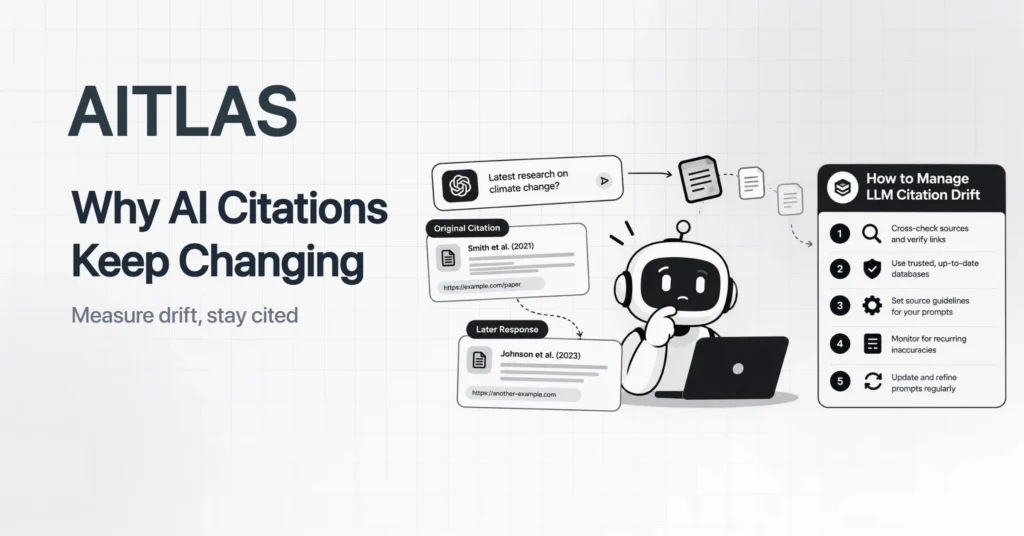
What Is LLM Citation Drift?
LLM citation drift is the change, over repeated runs of the same prompt, in which pages and domains an AI answer cites as its sources. It is measured across runs, days or weeks, not within a single answer.
The term has two uses. In AI search and answer engine optimisation (AEO), it describes source churn in tools like ChatGPT search, Perplexity and Google AI Mode. In research, it also describes references that mutate or get fabricated during a long chat. A December 2025 ACL workshop paper, Citation Drift: Measuring Reference Stability in Multi-Turn LLM Conversations, studied that second meaning across 240 conversations with four LLaMA models.
This post focuses on the first meaning, because that is the one that decides whether buyers see your brand. If AI visibility is new to you, start with our explainer on what AI visibility means for your brand.
Why Do AI Citations Change?
AI citations change because answer engines retrieve a fresh set of candidate pages for each run and then pick only a few to cite. Small differences at either step produce a different source list.
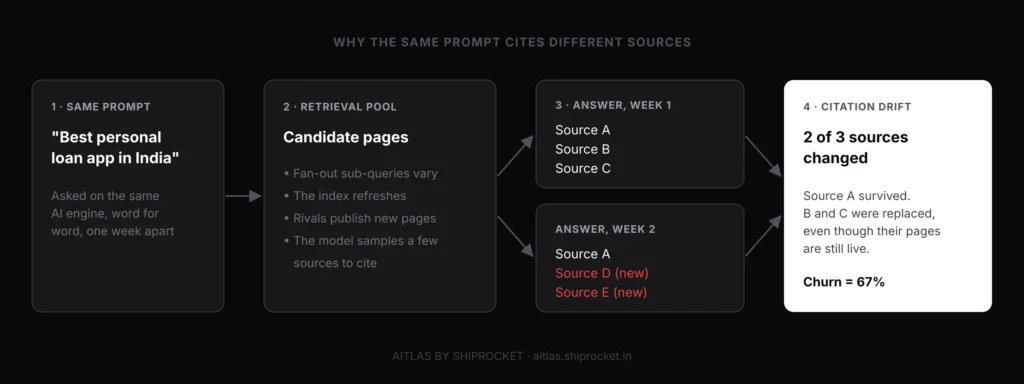
Five forces drive most of the movement:
- Query fan-out. Google says AI Overviews and AI Mode may run several related searches to build one answer. Each run can split the question a little differently, as we explain in our post on query fan-out and AI visibility.
- Sampling. Generative models are not deterministic. Given a pool of similar pages, the model may cite a different subset each time.
- Index freshness. New and updated pages enter the pool every day, and engines tend to prefer recent content for many commercial questions.
- Competitor activity. When a rival publishes a clearer or newer answer, it can take your slot.
- Model and retrieval updates. Platform changes can reshuffle whole classes of sources overnight.
That last force is the most dramatic. Semrush tracked about 230,000 prompts weekly from July to October 2025 and found that ChatGPT's share of responses citing Reddit fell from close to 60% in early August to around 10% by mid-September. Wikipedia fell from roughly 55% to under 20% over the same period.
“I believe the main reason for the drop is an attempt to avoid over-citing on certain websites.”
Sergei Rogulin, Semrush, on ChatGPT’s September 2025 citation shift
How Much Do ChatGPT Citations Change Compared With Other Engines?
ChatGPT citations change more than those of Perplexity or Google AI Mode, according to the most detailed Indian dataset published so far. Each engine retrieves and ranks sources differently, so each one drifts at its own speed.
Techmagnate's LLM Citation Drift Report, published in September 2026, tracked personal loan prompts in India for 8 weeks. It collected 83,633 citations from 2,191 domains and measured weekly churn: the share of domains cited one week that were not cited the next.
| AI engine | Average weekly domain churn | Citations collected |
|---|---|---|
| ChatGPT | 44.8% | 9,954 |
| Perplexity | 35.0% | 28,588 |
| Google AI Mode | 31.8% | 45,091 |
| All three | 39% | 83,633 |
The headline number hides a steadier core. Only 15.1% of domains were cited in all eight weeks, but a group of 330 domains cited every week accounted for 93.4% of all citations. Most of the churn happens in the long tail of occasionally cited sites.
There is a second lesson for Indian brands. The 200 domains that appeared on all three platforms held 80.9% of citations. Being present across engines appears to compound, so tracking only ChatGPT gives you half the picture.
A note on the data
Citation drift research is young, and most studies come from vendors with their own tools and methods. Techmagnate’s data covers one category, personal loans in India, and AirOps does not name the platforms it tested. Treat the figures as directional, and measure drift on your own prompts before you set targets.
Types of Citation Drift
There are four practical types of citation drift, and each one calls for a different response. Classifying the change is the step most teams skip, and it is the step that tells you what to fix.
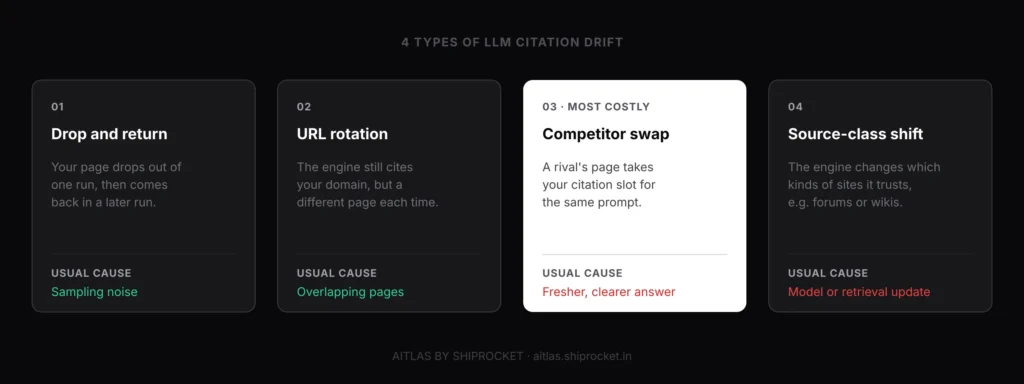
1. Drop and return
Your page disappears from one run and comes back in a later one. This is mostly sampling noise. AirOps found that about 57% of brands that disappeared from a response resurfaced in a later run, and most came back within two runs.
2. URL rotation
The engine keeps citing your domain but picks a different page each time. This often happens when several of your pages answer the same question. It is not always bad, but it splits your authority across thin pages instead of one strong one.
3. Competitor swap
A competitor's page takes your citation for the same prompt and keeps it. This is the most costly type, because the buyer now sees a rival as the trusted source. It usually means their answer is fresher, more specific or better supported than yours.
4. Source-class shift
The engine changes which kinds of sites it trusts for a topic, such as forums, encyclopaedias or publishers. The Reddit and Wikipedia drop in ChatGPT is the clearest example. You can't control these shifts, but you can spread your presence across the source classes an engine favours.
Citation Levels: Mention, Citation and Recommendation
A brand can show up in an AI answer at different citation levels, and drift affects each level differently. Tracking only linked citations misses part of the story.
| Citation level | What it looks like | Why it matters for drift |
|---|---|---|
| Absent | Your brand is not in the answer | The baseline you want to move away from |
| Mentioned | Your brand is named in the text, with no link | Shows the model knows you, even when your pages are not retrieved |
| Cited | Your page is linked as a source | Sends traffic and signals trust in your content |
| Mentioned and cited | Named in the text and linked | The most stable position in current research |
The last row matters most. In the same AirOps study, brands that earned both a mention and a citation were 40% more likely to resurface across runs than brands with citations alone. A mention reflects what the model knows about your brand, while a citation depends on retrieval, so having both gives you two routes back into the answer.
How to Measure Citation Drift
You measure citation drift by running a fixed prompt set repeatedly on each engine, logging every cited URL and comparing the source lists over time. One run of one prompt is a sample of one, and it can mislead you either way.
1. Build a fixed prompt set
Pick 30 to 100 prompts your buyers actually ask, across category, comparison and problem questions. Freeze the wording, because changing prompts breaks your trend lines.
2. Run each prompt several times per cycle
Run every prompt at least three times per engine each week, in a logged-out session from the same location. Repeats separate normal noise from real loss.
3. Log citation level and URL
For every answer, record whether your brand is absent, mentioned, cited or both, plus the exact URLs cited. Save the full answer text so you can check later what changed.
4. Calculate the drift metrics
Turn the logs into a handful of stable metrics, defined below. Report them by engine and by topic cluster.
5. Classify every loss
When you lose a citation, label it as drop and return, URL rotation, competitor swap or source-class shift. Only competitor swaps and lasting drops need urgent content work.
These are the core metrics for measuring citation drift:
| Metric | Formula | What it tells you |
|---|---|---|
| Citation rate | Runs where you are cited ÷ total runs | How often you are a source at all |
| Weekly churn | Domains cited last week but not this week ÷ domains cited last week | How unstable the engine's source pool is |
| Survival rate | Consecutive runs where you stay cited ÷ total runs | How long your visibility lasts |
| Reappearance rate | Times you return after a drop ÷ total drops | Whether losses are noise or real |
| URL rotation rate | Runs citing a different URL from your domain ÷ runs where you are cited | Whether your own pages compete with each other |
| Competitor swap rate | Runs where a named rival replaces you ÷ total runs | How often you lose to a specific competitor |
For a smaller team, a spreadsheet and a weekly routine are enough to start. Our guide to AI visibility tracking for small marketing teams shows a lean setup.
What Types of Content Survive Citation Drift?
The content that survives citation drift is fresh, answers the question directly and sits on one authoritative URL that other sites also talk about. The Techmagnate data shows this in practice: all of the top 20 domains were cited in every one of the 8 weeks, and 18 of them were lenders' own sites rather than aggregators or news.
Freshness
AirOps found ChatGPT-cited pages not updated in over a year were more than twice as likely to lose citations. Update key pages on a schedule and show the date.
Extractability
Pages that open each section with a direct answer, then add tables, lists and specifics, are easy for an engine to quote and hard to replace.
Corroboration
Brands that are mentioned on other sites as well as cited were more likely to resurface. Reviews, press and community mentions back up your own pages.
The freshness data comes from AirOps' study of over 4,000 pages cited by ChatGPT across 900 high-intent queries. It also found that more than 60% of commercial pages cited by ChatGPT had been updated in the previous six months.
Original data is a fourth survivor worth noting. A page with your own figures, such as delivery times by pin code or survey results, gives the engine something it can't get elsewhere. Our guide on how to get cited by LLMs covers these formats in more depth.
Citation Drift and Link Rot: What Is the Difference?
Citation drift means an AI engine stops citing a page that still works, while link rot means the cited page itself has broken or moved. One is a choice by the engine, and the other is a failure of the URL.
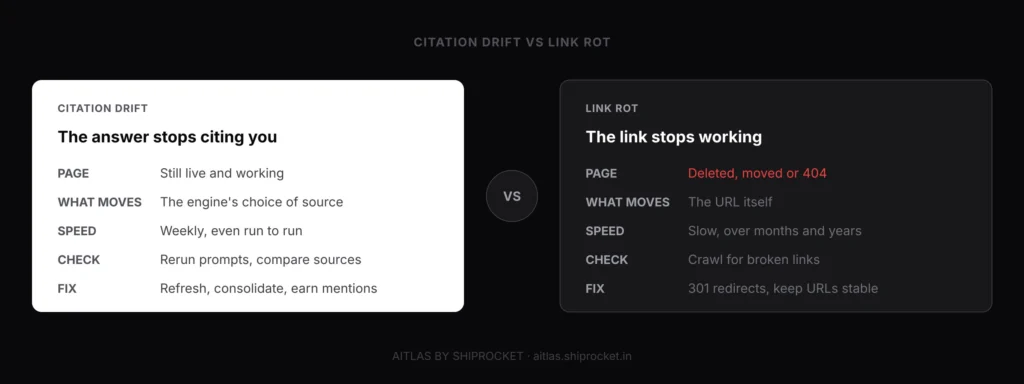
Link rot is the older and slower problem. A Pew Research Center study found that 38% of webpages that existed in 2013 were no longer accessible in October 2023, and 11% of references linked on Wikipedia were no longer accessible.
The two problems do connect. If you delete or move a page without a 301 redirect, any AI citation pointing to it breaks, and the engine is likely to replace it with a working source. Keep URLs stable and redirect every retired page to its closest match.
Why this matters for your brand
If your team reports AI visibility from a single check, a good week can hide a slow loss and a bad week can trigger a needless rewrite. Drift-aware tracking tells you which losses are noise and which ones a competitor is winning, so your content budget goes to the prompts that actually slipped.
How to Manage Citation Drift
You manage citation drift by reducing the reasons an engine would swap you out: stale facts, scattered pages, weak corroboration and thin answers. You can't stop drift, but you can make your citations more stable.
Set a weekly drift baseline
Run your fixed prompt set on ChatGPT, Perplexity, Gemini and Google AI Mode, and record citation rate and churn for each engine before you change anything.
Refresh your most-cited pages
Update facts, prices, dates and examples on the pages that win citations, and show a visible “last updated” date. Start with commercial pages, where freshness matters most.
Consolidate competing URLs
If URL rotation is high, merge overlapping pages into one strong answer and redirect the rest. One authoritative page is easier for an engine to keep choosing.
Write answer-first sections
Open every section with a one-sentence answer, then add steps, tables and India-specific detail. This is the format engines lift most easily into answers.
Earn mentions on other sites
Pursue reviews, expert quotes, marketplace listings and community discussion, so the model meets your brand in sources it already trusts.
Study every competitor swap
When a rival replaces you, compare their page with yours for freshness, depth and structure, then close the gap. Our guide on why AI search recommends your competitors covers common causes.
Give each change time to show up. Because drop-and-return drift is common, judge a content change on three to four weeks of repeated runs, not on the first answer you see after publishing.
See Your Citation Drift Before It Costs You Buyers
AI answers change week to week, so a single check can’t tell you whether you are gaining or losing ground. AiTLAS by Shiprocket gives you a weekly view of how ChatGPT, Gemini, Perplexity and Google AI Overviews describe and cite your brand, and helps you act on it.
- RADAR monitors how your brand appears across AI platforms every week, so you can spot lasting drops and competitor swaps early.
- HYDRA publishes AEO-structured content designed to improve your citation rates on the prompts you are losing.
Conclusion
LLM citation drift is a normal feature of AI search, not a sign that something is broken. Engines resample sources on every run, and as of October 2026 the best public data shows that a large share of cited domains changes every week.
The brands that hold their place tend to keep a fresh, answer-first page for each important question, and they get talked about on other sites too. They also measure with repeated runs instead of single snapshots.
Start with a fixed prompt set and a weekly drift baseline. Within a month you will know which losses are noise, which are competitor swaps and which pages deserve your next update.
LLM citation drift is the change in which sources an AI engine cites when the same prompt is asked again over time. A page cited in one run may be dropped, swapped for another page on the same site or replaced by a competitor in the next. It happens even when the page has not changed, because engines retrieve and sample sources afresh each time. That is why AI visibility should be measured across repeated runs.
AI citations change because each run retrieves a new pool of candidate pages and the model picks only a few to cite. Query fan-out, newly published pages, competitor updates and platform changes all alter that pool. Generative models are also not deterministic, so they can choose different sources from similar options. Major model updates can shift whole types of sources at once, as happened with Reddit citations in ChatGPT in September 2025.
Build a fixed set of buyer prompts and run each one several times a week on every AI engine you care about. Log whether your brand is absent, mentioned or cited, along with every cited URL. Then calculate citation rate, weekly churn, survival rate and reappearance rate. Classify each loss by type so you know whether it is noise or a real competitor win.
Citation drift is not always bad, because much of it is temporary noise and dropped pages often return in a later run. It becomes a problem when your citation rate falls steadily or a competitor keeps your slot. Drift also works in your favour, since it gives new or improved pages a chance to win citations. The goal is to make your best pages stable, not to stop drift altogether.
Citation drift happens when an AI engine stops citing a page that still works and chooses another source instead. Link rot happens when the cited page itself is deleted, moved or broken. Drift is fast and can change week to week, while link rot builds up over months and years. You manage drift with fresher, clearer content and wider mentions, and you prevent link rot with stable URLs and 301 redirects.
In Techmagnate's 8-week study of Indian personal loan prompts, published in September 2026, ChatGPT had the highest average weekly domain churn at 44.8%. Perplexity followed at 35.0% and Google AI Mode was the most stable at 31.8%. These figures cover one category, so your own industry may differ. Track each engine separately rather than assuming one pattern applies everywhere.
Share this article
Newsletter
Stay ahead of AI search
Weekly insights on AI visibility, AEO strategies, and brand intelligence. No spam.

Sahil Bajaj: With 7+ years of digital marketing expertise, I'm dedicated to fusing technology and creativity for business success. Known for innovative strategies that drive growth and a passion for continuous improvement.
Related Articles