AI Hallucinations: Why ChatGPT Gives Wrong Answers and How to Reduce Them
Blog Summary
AI hallucinations are answers that sound fluent and confident but are false, unsupported or invented, such as fake citations, wrong dates or made-up product details. Language models predict likely text rather than look up facts, so rare, one-off facts are the ones they get wrong most often. A 2026 Nature paper by OpenAI and Georgia Tech researchers shows that accuracy-only benchmarks reward guessing over saying "I don't know", which pushes models to hallucinate. In that study, a model that abstained more often made far fewer errors, even though its raw accuracy score looked slightly worse. You can detect hallucinations by checking claims against sources, sampling the same prompt several times and measuring how consistent the answers are. Businesses reduce hallucinations by grounding answers in their own documents, rewarding abstention, keeping humans in the loop for high-stakes outputs and publishing clear, consistent facts about their brand.
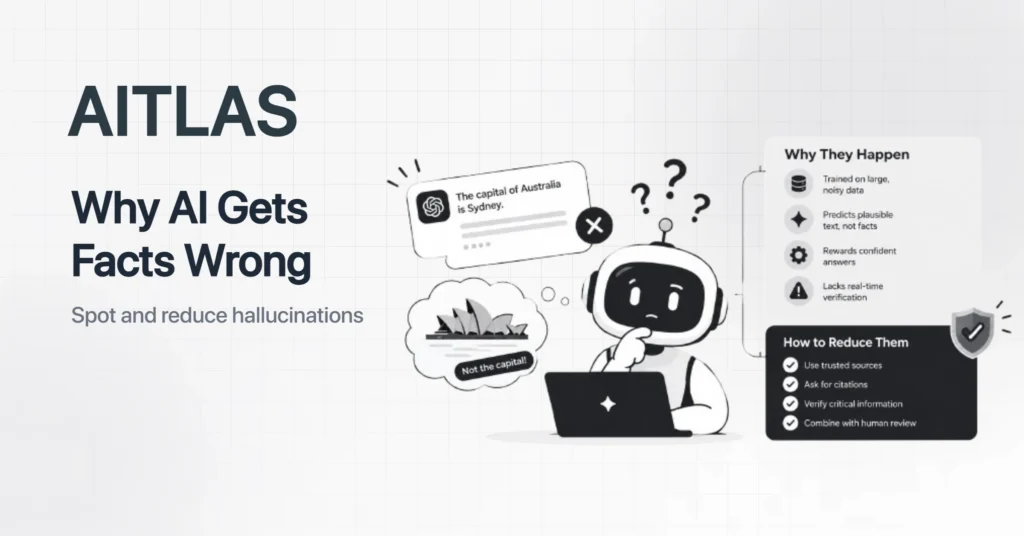
AI hallucinations happen when a language model like ChatGPT generates an answer that sounds right but is false, unsupported or invented. They occur because models predict plausible text, not verified facts, and because the way models are trained and scored often rewards a confident guess over an honest "I'm not sure".
You have probably seen one. You ask for a source and get a neat citation to a paper that doesn't exist. Or an assistant tells a customer your return window is 30 days when it is actually 7.
For individuals, that is an annoyance. For brands, it is a risk to trust, revenue and even legal standing. This guide explains why AI hallucinates, using the latest research, and gives you a practical way to detect, measure and reduce it.
What Are AI Hallucinations?
AI hallucinations are outputs from an AI model that are presented as fact but are false, fabricated or not supported by any source.
OpenAI's own help article, Does ChatGPT tell the truth?, describes it plainly. ChatGPT can produce incorrect or misleading outputs, and it may sound confident even when it is wrong. The article lists wrong dates or facts, invented citations or studies, and overconfident answers to complex questions as typical examples.
Some researchers prefer the word "confabulation", because the model isn't perceiving anything. The idea is the same: the model fills a gap with something that fits the pattern of a good answer.
Hallucinations vs simple mistakes
Not every wrong answer is a hallucination in the strict sense. A model may give an outdated price because its training data predates a change. That is a knowledge-cutoff problem.
A hallucination is different. The model invents a detail it never had evidence for, such as a feature your product doesn't offer or a court case that never happened.
Real AI Hallucination Examples
Hallucinations show up in every domain, but the costly ones share a pattern. Someone trusted a fluent answer without checking it.
- Invented legal citations. In the 2023 US case Mata v. Avianca, lawyers submitted a brief containing case citations generated by ChatGPT that did not exist. The court sanctioned them.
- A chatbot inventing a policy. In Moffatt v. Air Canada, a 2024 decision from British Columbia's Civil Resolution Tribunal, the airline's website chatbot told a customer he could claim a bereavement discount after travel. That wasn't the policy. The tribunal held Air Canada responsible for what its chatbot said.
- Fake references in research. Students and academics regularly find well-formatted references with real-sounding journals and authors that point to papers that were never written.
- Non-existent code libraries. Coding assistants sometimes import packages or call functions that don't exist, which wastes developer time and can create security gaps.
- Wrong brand facts. Assistants can misstate a brand's pricing, founders, delivery areas or product range, especially for smaller or newer brands with little coverage online.
Why this matters for your brand
The Air Canada ruling is a useful warning for any D2C brand using an AI chatbot. A customer doesn’t see a difference between your website and your bot. If the bot invents a refund rule or a COD policy, you may have to honour it, and you will certainly pay for it in trust.
Why Does AI Hallucinate?
AI hallucinates because language models are trained to predict the next likely word, and because evaluations reward confident guesses over admitting uncertainty. Recent research shows both causes are statistical, not mysterious.
1. Models predict text, they don't look up facts
An LLM learns patterns from huge amounts of text. When you ask a question, it generates the sequence of words most likely to follow, given those patterns.
That works well for things that repeat often, like grammar or the capital of India. It breaks down for facts that appear rarely, such as a mid-sized brand's founding year or a niche regulation.
2. Rare facts are where errors concentrate
The paper "Evaluating large language models for accuracy incentivizes hallucinations", published in Nature in April 2026 by Adam Tauman Kalai, Ofir Nachum, Santosh Vempala and colleagues, makes this precise.
“Facts lacking repeated support in training data (such as one-off details) yield unavoidable errors, whereas recurring regularities (such as grammar) do not.”
Kalai et al., Evaluating large language models for accuracy incentivizes hallucinations, Nature, 2026
The authors use the "singleton rate", the share of facts that appear only once in training data. Their example: if 20% of people's birthdays appear exactly once in the data, a pretrained model should be expected to hallucinate on at least about 20% of birthday questions.
For brands, the lesson is direct. If facts about your business appear once, on one page, a model is far more likely to get them wrong than facts repeated consistently across many sources.
3. Benchmarks reward guessing
The second cause is how models are graded. Most popular benchmarks score answers as simply right or wrong. Saying "I don't know" earns zero, exactly like a wrong answer.
Under that scoring, guessing is always the better strategy. It's like a multiple-choice exam with no negative marking: a student who guesses every blank question will outscore an honest one. The Nature paper found that most of the ten popular evaluations it reviewed use this binary grading.
4. Ambiguous prompts and missing context
Hallucinations also rise when a prompt is vague, asks about events after the model's knowledge cutoff or asks for content behind paywalls the model can't access. OpenAI's help article lists these same limitations and notes that confidence is not a signal of reliability.
What the Research Shows: Accuracy vs Errors
The Nature study's key finding is that a model with slightly lower accuracy can be far more trustworthy, because it abstains instead of guessing. The authors tested models on SimpleQA, a short factual-question benchmark, with 4,326 questions per model.
| Model (closed rubric, SimpleQA) | Accuracy | Errors | Did not answer |
|---|---|---|---|
| GPT-5-mini | 16.0% | 20.8% | 63.2% |
| o4-mini | 20.6% | 76.8% | 2.6% |
Source: Kalai et al., Nature, 2026.
On an accuracy leaderboard, o4-mini wins. But it was wrong on more than three out of four questions, while GPT-5-mini was wrong on about one in five. That is the incentive problem in one table.
The proposed fix: open rubrics
The researchers suggest "open rubric" evaluations. The prompt states how much a wrong answer is penalised, so the model knows when to answer and when to hold back.
A penalty translates into a confidence threshold. If a wrong answer costs three points and a correct answer earns one, the model should only answer when it is more than 75% sure. Testing across several thresholds shows whether a model actually adjusts its behaviour to the stakes.
The cautionary note
Better incentives reduce hallucinations, but they don’t remove them. The same paper argues some errors on rare facts are statistically unavoidable for a pretrained model. Treat any AI output on specific facts, figures or citations as a draft until it is checked.
How to Detect AI Hallucinations
You detect AI hallucinations by verifying claims against trusted sources and by checking how consistent a model is with itself. Use a mix of manual and automated methods.
Check claims against sources
Break an answer into individual claims: names, numbers, dates, quotes and links. Verify each one against a primary source. Open every citation, because a real-looking reference is one of the most common hallucinations.
If you use a tool with search, such as ChatGPT search or Perplexity, check that the cited page actually says what the answer claims.
Ask the same question several times
Hallucinated details tend to change between runs, while well-grounded facts stay stable. Ask the same prompt three to five times, ideally in fresh chats, and compare.
This idea has strong research backing. A 2024 Nature paper by Sebastian Farquhar and colleagues at the University of Oxford introduced semantic entropy, which samples several answers and measures how much their meanings disagree. High disagreement is a strong signal of a likely confabulation, and the method needs no task-specific training data.
Watch for warning signs
- Very specific numbers or quotes with no source.
- Citations you can't find with a quick search.
- Answers that change when you rephrase the question slightly.
- Confident claims about recent events or niche topics.
How to Measure Hallucination Rates
To measure hallucinations, run a fixed set of prompts with known correct answers and score every response as correct, incorrect or abstained. Tracking errors and abstentions separately is the key lesson from the research.
- Build a ground-truth set. Write 30 to 100 questions your users or customers actually ask, with verified answers.
- Run each prompt several times on every model or assistant you care about.
- Score three outcomes: correct, wrong and "didn't know". Report the error rate, not just accuracy.
- Set an error penalty that matches the stakes. A medical or legal use case should punish wrong answers far more than a brainstorming tool.
- Repeat on a schedule so you catch regressions when a model or your content changes.
The same approach works for brand monitoring. Our guide to AI search KPIs explains how to score answer accuracy alongside mention rate and share of voice.
How to Prevent AI Hallucinations
You can't eliminate AI hallucinations, but you can make them much rarer by grounding answers in reliable sources, rewarding abstention and keeping people in the loop.
Ground answers in your own data
Use retrieval-augmented generation (RAG) so your chatbot answers from your help docs, policies and catalogue, not from the model’s memory. Tell it to answer only from the retrieved text and to cite it.
Give the model permission to say “I don’t know”
Add explicit instructions such as “If the answer isn’t in the provided documents, say you don’t know and offer a human agent.” This applies the open-rubric idea to your own prompts.
Write specific prompts
Include context, constraints and the format you want. Vague prompts invite the model to fill gaps. Ask it to list assumptions and flag anything uncertain.
Keep humans on high-stakes outputs
Refund rules, prices, legal text, medical or financial advice and published content should always get a human review before they reach customers.
Use search-enabled tools for current facts
OpenAI notes that search and deep research let ChatGPT cite live web sources. Use them for anything recent, then click through and verify.
For individual users
Treat AI output as a first draft. OpenAI's own advice is to check important information before relying on it. Ask for sources, open them, and be most sceptical of precise numbers and quotes.
For businesses
Set clear rules on where AI can act alone and where it needs review. Log chatbot conversations, sample them weekly and track the error rate over time. A rising error rate is an early warning before a customer complaint.
How Hallucinations Affect What AI Says About Your Brand
AI assistants hallucinate most about the facts that appear rarely or inconsistently online, which often includes details about smaller brands. That makes hallucinations a visibility problem as well as an accuracy one.
If ChatGPT or Gemini invents your prices, delivery coverage or product range, buyers may rule you out without ever visiting your site. The singleton-rate finding suggests a practical response: make your key facts easy to find and consistent everywhere.
- Publish clear, factual pages for pricing, policies, product specs and company details.
- Keep the same facts consistent across your site, marketplaces, directories and press coverage.
- Earn mentions on trusted third-party sites so key facts appear more than once.
- Monitor what assistants say about you and correct the sources behind wrong answers.
Our guides on how to get cited by LLMs and checking whether your brand shows in AI search cover these steps in more depth.
See What AI Says About Your Brand
AiTLAS shows you how ChatGPT, Gemini, Perplexity and Google AI Overviews describe your brand, so you can spot wrong answers early.
- Track brand mentions across AI assistants
- Find inaccurate or missing facts about your brand
- Work on becoming visible and recommended in AI answers
Conclusion
AI hallucinations aren't random glitches. They come from how language models learn, which makes rare facts fragile, and from how they are scored, which rewards confident guessing.
The fix starts with measurement. Score errors and abstentions separately, ground answers in reliable sources, and let models say "I don't know". For brands, the most durable defence is clear, consistent facts that AI systems can find and repeat.
How AiTLAS Helps You Catch Hallucinations About Your Brand
AiTLAS by Shiprocket shows you what AI assistants and AI search say about your brand across ChatGPT, Gemini, Perplexity and Google AI Overviews. That makes it easier to spot when an assistant gets your products, pricing or policies wrong, instead of finding out from a confused customer.
From there, AiTLAS helps you work on becoming visible and recommended in those answers. Start with our overview of AI visibility and how to improve it, then check your brand with AiTLAS.
A common example is ChatGPT citing a research paper or court case that doesn't exist. In the 2023 Mata v. Avianca case, lawyers filed a brief with invented case citations generated by ChatGPT. Other examples include wrong dates, made-up statistics and false product details.
ChatGPT predicts likely text based on patterns in its training data rather than checking facts in a database. Research published in Nature in 2026 shows it also learns to guess because most evaluations score "I don't know" the same as a wrong answer. Rare facts and questions about recent events are the most error-prone.
No, current research suggests they can be reduced but not fully eliminated. Grounding answers in trusted documents, allowing the model to abstain and adding human review for important outputs all lower the rate. Always verify facts, figures and citations before you rely on them.
Verify each specific claim against a primary source and open every citation the AI provides. You can also ask the same question several times and compare answers, since hallucinated details tend to change between runs. Research methods such as semantic entropy use this idea to flag likely errors automatically.
It varies widely by model, task and how the test is scored. In the 2026 Nature study on the SimpleQA benchmark, o4-mini answered 76.8% of questions incorrectly while GPT-5-mini's error rate was 20.8%, largely because it declined to answer more often. Measure the error rate on your own questions rather than relying on a single published number.
Share this article
Newsletter
Stay ahead of AI search
Weekly insights on AI visibility, AEO strategies, and brand intelligence. No spam.

Sahil Bajaj: With 7+ years of digital marketing expertise, I'm dedicated to fusing technology and creativity for business success. Known for innovative strategies that drive growth and a passion for continuous improvement.
Related Articles