Blog Summary
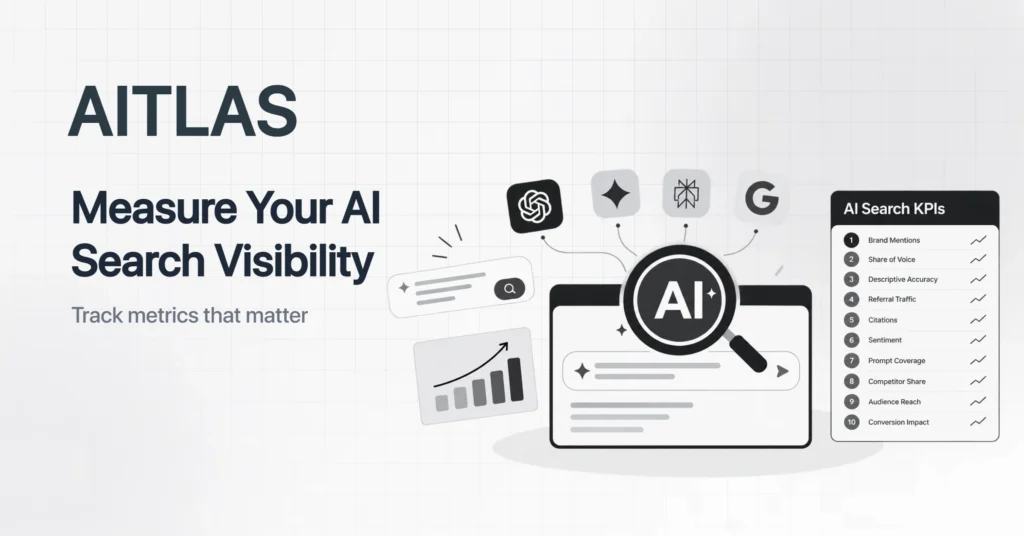
AI search KPIs tell you whether ChatGPT, Gemini, Perplexity and Google AI Overviews mention your brand, describe it correctly and send you customers. This guide gives you a four-layer AI Search KPI framework, the formula for each metric and a simple way to report them. You will also learn how to build a prompt set and track AI referral traffic in GA4.
AI search KPIs are the metrics that show how your brand performs inside AI-generated answers, not just on a results page. Your rankings can look healthy while ChatGPT recommends three competitors and never names you.
That gap is why classic SEO dashboards feel incomplete in 2026. Buyers now ask an assistant “best sunscreen for oily skin under 500 rupees” and get a shortlist, often without clicking a single link.
If you can’t measure that moment, you can’t improve it. Let’s look at which metrics matter, how to calculate them and how to report them without drowning in vanity numbers.
What Are AI Search KPIs?
AI search KPIs are metrics that track how often AI systems mention, cite and recommend your brand, how accurately they describe it, and what business value that visibility creates.
They cover AI search systems / assistants such as ChatGPT, Gemini, Perplexity, Microsoft Copilot and Google’s AI Overviews and AI Mode. Unlike a keyword ranking, an AI answer has no fixed “position 3”. The same question can produce a different answer each time a user prompts the LLM.
So AI search measurement works more like brand tracking than rank tracking. You sample many prompts, repeat them, and look at rates and trends instead of single snapshots. If the concept is new to you, our guide to what AI visibility means for your brand covers the basics.
Why Classic SEO KPIs Miss AI Search
Traditional SEO KPIs measure clicks, and AI answers often remove the need to click. A user can read a product comparison in ChatGPT, decide, and then search your brand name directly a day later.
In that journey, organic sessions don’t capture the moment of influence. The assistant did the persuading, but your analytics credits “direct” or “branded search”.
Reporting is also partial. As of October 2026, Google’s documentation on AI features says traffic from AI Overviews and AI Mode is included in your overall Search Console search traffic, not broken out separately. You need new metrics to see what is happening upstream.
The AI Search KPI Framework: Four Layers
The AI Search KPI framework groups metrics into four layers: Presence, Prominence, Perception and Performance. Each layer answers one question, and together they connect visibility to revenue.
| Layer | Question it answers | Core KPIs |
|---|---|---|
| Presence | Do AI assistants mention us at all? | AI mention rate, prompt coverage |
| Prominence | How strongly do we show up versus competitors? | AI share of voice, citation share, mention position |
| Perception | Do they describe us correctly and positively? | Answer accuracy rate, sentiment score |
| Performance | Does AI visibility drive business results? | AI referral sessions, AI-influenced conversion rate, branded search lift |
There is no single industry-standard formula yet. Tools weight mentions differently, so pick definitions, document them and keep them stable. Consistency matters more than which vendor’s version you choose.
Layer 1: Presence KPIs
Presence KPIs tell you whether you are in the conversation at all. Start here, because the other layers mean little if your brand never appears.
AI mention rate
AI mention rate is the share of tracked AI answers that name your brand.
Formula: answers mentioning your brand ÷ total answers sampled × 100.
Say you run 50 category prompts three times each on ChatGPT. That gives 150 answers. If your brand appears in 30, your mention rate is 20%.
Prompt coverage
Prompt coverage is the share of your prompt set where you appear at least once across all runs. It shows breadth. A brand can have a decent mention rate driven by a handful of branded prompts while being invisible for most category questions.
Track coverage by topic cluster, such as “pricing”, “comparisons” and “use cases”, to see where the gaps sit.
Layer 2: Prominence KPIs
Prominence KPIs show how strongly you appear relative to competitors. Being mentioned fifth in a list of eight is very different from being the first recommendation.
AI share of voice
AI share of voice is your share of all brand mentions across the competitor set for your tracked prompts.
Formula: your brand mentions ÷ total mentions of all tracked brands × 100.
This is usually the headline metric for leadership. It is relative, so it holds up better than raw counts when AI answers get longer or shorter over time. Our breakdown of why AI search recommends your competitors explains what typically drives a low share.
Citation share
Citation share measures how often your own pages are used as linked sources.
Formula: citations to your domain ÷ total citations in the sampled answers × 100.
A mention means the model knows you. A citation means it trusts your content enough to point users to it, which also creates a path for clicks. Here is a practical guide on how to get cited by LLMs.
Mention position
Mention position is where your brand appears in an answer: first, within the top three or further down. Record the average position, or the share of answers where you are the first brand named.
Layer 3: Perception KPIs
Perception KPIs check whether AI describes your brand accurately and favourably. Visibility can hurt you if the answer says your product is out of stock nationwide or quotes an old price.
Answer accuracy rate
Answer accuracy rate scores AI answers against a rubric built from your official facts. Score each answer on criteria such as factual correctness, alignment with your positioning and the presence of hallucinations.
Formula: rubric points earned ÷ total possible points × 100.
This matters because AI tools still get sources wrong. A March 2025 Tow Center study published by Columbia Journalism Review tested eight AI search tools and found they failed to retrieve correct citation details in more than 60% of queries.
Sentiment score
Sentiment score tracks whether answers frame you positively, neutrally or negatively. Look for repeated qualifiers too. If Gemini keeps calling your brand “budget” when you sell premium skincare, that is a positioning problem worth fixing.
Layer 4: Performance KPIs
Performance KPIs link AI visibility to traffic, leads and revenue. These are the numbers your CFO cares about.
AI referral sessions
AI referral sessions are visits that arrive from AI assistants. As of October 2026, Google Analytics 4 includes an AI Assistant channel in its default channel group, covering sources like ChatGPT, Gemini, Copilot and Grok.
Note the catch. Google’s definition says this channel excludes AI Overviews and AI Mode, which still sit inside Organic Search. Report the two separately so nobody assumes the AI Assistant channel is your full AI footprint.
AI-influenced conversion rate
AI-influenced conversion rate is the conversion rate of sessions that came from AI sources.
Formula: conversions from AI-referred sessions ÷ total AI-referred sessions × 100.
Compare it with your organic search conversion rate. Users who arrive from an assistant have often already compared options, so they can behave differently from a cold organic visitor. Measure your own baseline rather than borrowing someone else’s benchmark.
Branded search lift
Branded search lift tracks changes in branded queries in Search Console. Many AI-influenced buyers never click the assistant’s link. They search your name later, so a rise in branded impressions alongside rising AI share of voice is a useful signal.
Add a “How did you hear about us?” field with an “AI assistant” option at checkout or sign-up. Self-reported attribution is imperfect, but it captures journeys that analytics can’t.
How to Build a Prompt Set for AI Search KPIs
Your KPIs are only as good as the prompts behind them. A prompt set is the fixed list of questions you send to each assistant every measurement cycle.
Follow these steps:
- Start from real demand. Pull questions from Search Console queries, sales calls, support tickets and People Also Ask boxes.
- Cover the funnel. Mix category prompts (“best D2C shipping software in India”), comparison prompts (“X vs Y”) and problem prompts (“how to reduce RTO for COD orders”).
- Write how people talk. Indian users often mix English and Hindi, mention rupee budgets or name cities. Include those variants.
- Keep branded prompts separate. Branded prompts inflate mention rate, so track them as their own segment.
- Freeze the set. Change prompts quarterly at most, and log every change, or your trend lines break.
For most brands, 50 to 150 prompts is a workable starting point. Smaller teams can start with fewer, as we explain in our guide to AI visibility tracking for small marketing teams.
How to Measure Across AI Search Systems and Assistants
AI answers vary, so measure with repetition and clear rules. One run of one prompt tells you almost nothing.
Use these practices:
- Run each prompt several times per platform per cycle, and report the rate across runs.
- Track platforms separately. ChatGPT, Gemini, Perplexity and AI Overviews draw on different sources and behave differently.
- Control for location and login state. Answers can change by country, city and whether the user is signed in.
- Watch for fan-out. Google says AI Overviews and AI Mode may issue multiple related searches to build one answer. Our post on query fan-out and AI visibility covers what that means for content.
- Store the raw answers. Saved text lets you re-score accuracy later and show stakeholders real examples.
Which AI Search KPIs Should You Report, and How Often?
Report a small set of metrics at a cadence that matches how fast each one moves. Daily AI visibility numbers mostly show noise.
| Cadence | What to report | Audience |
|---|---|---|
| Weekly | Accuracy issues, new negative answers | SEO and content team |
| Monthly | Mention rate, AI share of voice, citation share, AI referral sessions | Marketing leadership |
| Quarterly | AI-influenced conversions, branded search lift, share of voice versus competitors | Founders, CFO |
Pick one north-star metric, usually AI share of voice for your core category prompts. Then show one supporting metric from each of the other layers.
Common Mistakes When Tracking AI Search KPIs
Most measurement problems come from inconsistent inputs, not bad tools. Watch for these:
- Counting raw mentions only. Mentions without context hide negative or inaccurate answers.
- Mixing branded and non-branded prompts. This inflates visibility and hides real category gaps.
- Changing the prompt set every month. Your trends become meaningless.
- Treating AI referral traffic as the full picture. Many AI-influenced journeys never produce a referral click.
- Chasing one platform. Strong ChatGPT visibility doesn’t guarantee you show up in Google AI Mode. Read our guide to Google AI Mode strategy for platform-specific tactics.
Conclusion
AI search KPIs give you a way to measure a part of the buyer journey your current dashboards can’t see. Start with presence, then move to prominence, perception and performance.
Keep the prompt set stable, measure each platform separately and report a short list of metrics every month. Within a quarter, you’ll know where you stand and which content changes actually moved the numbers.
How AiTLAS Helps You Track AI Search Visibility
AiTLAS by Shiprocket shows you what AI assistants and AI search, including ChatGPT, Gemini, Perplexity and Google AI Overviews, say about your brand. That gives you a starting point for presence, prominence and perception KPIs without running every prompt by hand.
Once you can see how assistants describe you, AiTLAS helps you work on becoming visible and recommended in those answers. Check your brand’s AI visibility with AiTLAS to get your baseline.
The most important AI search KPIs are AI mention rate, AI share of voice, citation share, answer accuracy rate and AI-influenced conversions. Together they show whether you appear, how strongly, how accurately and with what business impact. Start with mention rate and share of voice if you are new to AI measurement.
Build a fixed set of prompts your buyers would ask, run each prompt several times in ChatGPT, and record whether your brand is mentioned or cited. Divide the answers that mention you by the total answers to get your mention rate. Repeat the same process monthly to track trends.
Yes. As of October 2026, GA4's default channel group includes an AI Assistant channel for sources like ChatGPT, Gemini and Copilot. It excludes Google AI Overviews and AI Mode, which are counted within organic search traffic.
Track accuracy problems weekly and core visibility metrics such as mention rate and share of voice monthly. Review business outcomes like AI-influenced conversions and branded search lift quarterly. AI answers vary from run to run, so longer windows give more reliable trends.
A mention is when an AI answer names your brand in its text. A citation is when the answer links to your website as a source. Citations are more valuable because they signal trust in your content and can send traffic.
Share this article
Newsletter
Stay ahead of AI search
Weekly insights on AI visibility, AEO strategies, and brand intelligence. No spam.

Sahil Bajaj: With 7+ years of digital marketing expertise, I'm dedicated to fusing technology and creativity for business success. Known for innovative strategies that drive growth and a passion for continuous improvement.
Related Articles