
Blog Summary
Search is evolving from ranking links to generating recommendations. As AI assistants become a primary discovery channel, brands are increasingly competing for visibility in AI-generated answers rather than traditional search results. This shift, known as agentic search, is changing how products, services, and companies are found online. Learn how AI agents evaluate brands, what influences their recommendations, and what businesses can do to stay visible in an AI-driven search landscape.
For the last two decades, brands competed for visibility on search engine results pages. Over the next decade, they may be competing for something entirely different: inclusion in an AI-generated recommendation.
According to Gartner, 51% of consumers say generative AI has already changed how they research information online, while 71% have changed the way they phrase search queries to be more conversational. As AI assistants increasingly influence product discovery and purchase decisions, visibility is no longer limited to rankings and clicks. Brands are beginning to track how often they appear in AI-generated answers, which competitors are recommended instead, and what signals influence those recommendations through emerging disciplines such as AI visibility and Answer Engine Optimization (AEO).
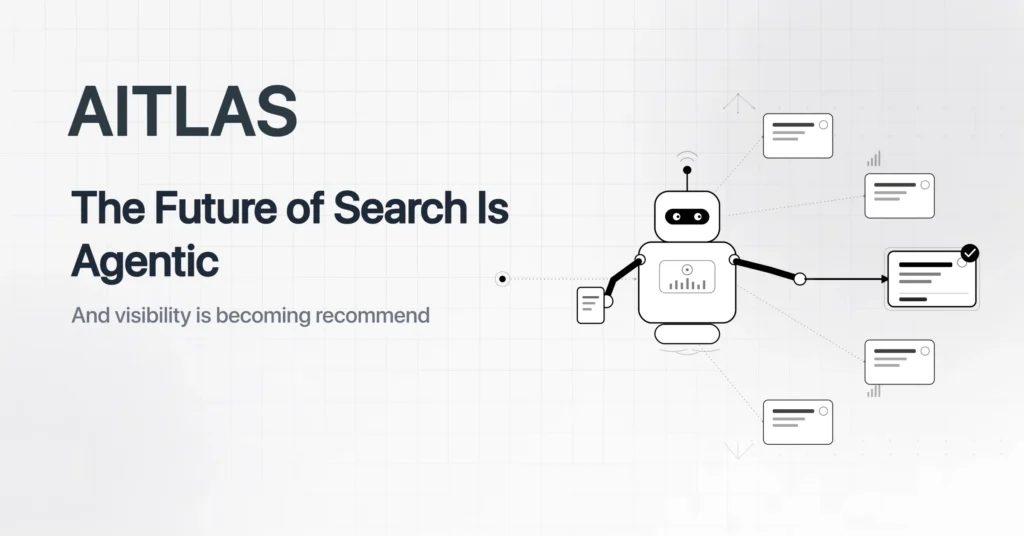
Traditional search engines index and rank web pages based on keywords and links. Agentic search uses AI agents that interpret intent, evaluate options, and increasingly make recommendations on behalf of users. Rather than simply returning a list of links, these systems attempt to understand what a user is trying to accomplish and surface the most relevant answer, product, service, or next action.
This shift is already reshaping digital discovery. Millions of users now rely on AI platforms such as ChatGPT, Gemini, Claude, and Perplexity to compare products, research services, and make purchasing decisions. As AI-generated answers become a primary discovery channel, visibility is no longer limited to search rankings. Brands must also understand how they appear across AI-driven experiences, how often they are cited, and why competitors may be recommended instead.
The conversation around AI search has expanded beyond traditional SEO into areas such as AI visibility, answer engine optimization, citation tracking, and AI recommendation analysis. Agentic search represents the next stage of that evolution.
Why Agentic Search Matters for Brands
Traditional search was designed to help users find information by presenting a ranked list of relevant web pages. AI search improved on this model by synthesizing information from multiple sources and generating direct answers to user questions. Agentic search represents the next evolution, where AI systems not only provide information but also help users make decisions and complete tasks. Instead of simply answering a question, an AI agent may compare products, evaluate service providers, recommend a preferred option, and eventually help execute the next step on behalf of the user.
As AI agents become more sophisticated, users will increasingly rely on them to:
- Compare products and vendors
- Evaluate pricing and features
- Research service providers
- Schedule appointments
- Book travel and accommodations
- Complete purchases
This changes the competitive landscape significantly. Instead of competing only for rankings and clicks, brands are increasingly competing for inclusion in AI-generated recommendations.
In many scenarios, users may never review ten different options manually. They may simply accept the shortlist provided by an AI system. That makes visibility at the recommendation layer increasingly important.
This shift is closely tied to the rise of AI visibility, where brands measure how frequently they are cited, summarized, and recommended across AI-generated answers rather than simply tracking rankings and traffic.
Market Context
Search is following the same AI transformation already visible across software, commerce, customer support, and productivity platforms.
This trend is especially relevant in India, where digital adoption continues to accelerate rapidly. According to McKinsey, artificial intelligence could contribute approximately $957 billion to India’s economy by 2035. As AI becomes embedded in everyday workflows, discovery systems are likely to become more personalized, contextual, and action-oriented.
For brands, this means understanding not only where they rank, but also how AI systems interpret, summarize, and recommend them.
How AI Agents in Search Work
The Role of AI Algorithms
AI algorithms analyze a wide range of signals, including search history, location, device context, engagement patterns, reviews, citations, and broader web content.
Unlike traditional search engines that primarily retrieve pages, AI systems attempt to infer intent and synthesize information into a single response. Their objective is not merely to find content but to determine what content best resolves a user’s query.
AI Agents vs Traditional Search Engines
Traditional search engines primarily return a list of links that users must evaluate themselves. AI search engines take a step further by generating direct answers based on information gathered from multiple sources. Agentic search systems go beyond both approaches by making recommendations, comparing options, and increasingly helping users complete actions such as booking services, purchasing products, or selecting vendors.
This distinction has significant implications for brand visibility. A brand that ranks highly in traditional search results may not automatically become the brand recommended by an AI agent. Instead, AI systems evaluate a broader set of signals, including relevance, authority, user intent, reviews, citations, and overall trustworthiness. As a result, brands must optimize not only for rankings but also for how AI systems interpret and recommend their content.
Agentic Search vs AI Search vs Traditional Search
| Feature | Traditional Search | AI Search | Agentic Search |
|---|---|---|---|
| Primary Output | Links | Answers | Recommendations & Actions |
| User Role | Research | Research | Delegation |
| Discovery Method | Rankings | Citations | Recommendations |
| Main Objective | Find Information | Understand Information | Complete Tasks |
| Success Metric | Clicks & Traffic | Citations & Visibility | Selection & Conversion |
As recommendation-driven discovery becomes more common, traditional SEO metrics alone often fail to explain why a brand appears in one AI platform but not another. This growing gap between rankings and recommendations is one reason discussions around AEO vs SEO have become increasingly important.
Step-by-Step Explanation of AI Agents Choosing Brands
Data Collection and Analysis
AI agents begin by gathering signals from a wide range of sources, including:
- Websites
- Customer reviews
- Industry publications
- Social media discussions
- Forums and communities
- Previous user interactions
These signals help build a more comprehensive understanding of both user intent and brand reputation.
Ranking Factors for AI Agents
Traditional SEO often emphasized rankings, backlinks, and keyword targeting.
AI agents still consider these factors, but additional signals are becoming increasingly important:
- Content relevance
- Source credibility
- User engagement
- Brand authority
- Citation frequency
- Review sentiment
- Consistency across sources
- Topical expertise
As a result, brands benefit more from being genuinely useful and authoritative than from relying on outdated optimization tactics.
This helps explain why some organizations discover that AI search recommends competitors instead even when they continue to perform well in traditional search rankings.
Decision-Making Process
AI agents continuously evaluate available information against user intent.
The process typically includes:
- Understanding the user’s goal
- Identifying relevant sources
- Comparing competing options
- Evaluating trust and authority signals
- Generating recommendations
- Updating recommendations as new information becomes available
Because these systems continuously learn from new signals, recommendation patterns can change rapidly.
What Makes Agentic Search Different?
The defining characteristic of agentic search is its ability to move beyond information retrieval. Traditional search engines help users discover relevant websites, while AI search engines help users understand topics by generating summarized answers. Agentic search systems take this a step further by assisting users throughout the decision-making process. Whether someone is choosing a software platform, comparing insurance plans, selecting a logistics provider, or booking a hotel, the AI agent increasingly acts as an advisor that helps narrow options and guide decisions rather than simply presenting information.
Examples include:
- Finding and booking a hotel
- Comparing insurance providers
- Choosing a shipping platform
- Scheduling appointments
- Purchasing products
In these scenarios, the AI system is not merely answering questions. It is helping users move toward a decision.
This makes recommendation visibility substantially more valuable than simple ranking visibility.
Agentic Search Optimization Strategies
Optimizing Content for AI Visibility
Brands that perform well in AI search and agentic search typically create content that:
- Answers questions directly
- Uses clear language
- Demonstrates expertise
- Covers topics comprehensively
- Remains consistently updated
The easier it is for AI systems to understand content, the more likely that content is to be cited, summarized, or recommended.
Leveraging AI Visibility Tools
As AI search ecosystems become more complex, brands increasingly need visibility into how they appear across different platforms. Monitoring citation frequency, recommendation rates, sentiment, and competitor visibility can reveal patterns that traditional analytics tools often miss. As AI search ecosystems become more complex, businesses are increasingly treating AI visibility tracking as a separate measurement category alongside SEO, paid media, and analytics.
Monitoring and Adapting to AI Trends
AI search environments evolve quickly. Brands should regularly monitor:
- Citation frequency
- Recommendation patterns
- Competitor visibility
- Source attribution
- AI-generated summaries
Monitoring becomes especially important as new experiences such as Google AI Mode continue changing how users discover products, services, and information.
Organizations that continuously adapt their content and messaging are likely to maintain stronger visibility as AI systems evolve.
AI Visibility, AEO, and Agentic Search
Agentic search is closely connected to Answer Engine Optimization (AEO) and AI visibility. Together, these disciplines focus on helping AI systems understand, trust, cite, and recommend content accurately. Key components include:
- Structured content
- Schema markup
- Question-and-answer formats
- Consistent brand messaging
- Authoritative citations
- Strong topical coverage
As AI search matures, AI visibility, AEO, and agentic search optimization are increasingly becoming part of the same strategic conversation.
What Early AI Visibility Trends Suggest
Early observations across AI platforms reveal that recommendation patterns vary significantly between systems. A brand that appears prominently in one AI platform may be absent from another. Different AI systems rely on different retrieval methods, ranking signals, source preferences, and evaluation criteria. These differences are one reason many brands are investing in AI visibility tracking to understand where they are being surfaced, ignored, or misrepresented across different AI ecosystems.
This creates a new challenge for marketers.
Visibility can no longer be measured through a single search engine alone. Brands increasingly need a broader understanding of how they are represented across multiple AI environments and recommendation systems.
Challenges and Opportunities in Agentic Search
Technical Challenges
One of the largest challenges is transparency. AI systems often provide limited visibility into:
- Ranking signals
- Source weighting
- Recommendation logic
- Content prioritization
This can make optimization more difficult than traditional SEO.
Unlike conventional rankings, brands often cannot easily determine why an AI system selected one source over another. This has increased interest in AI search optimization and visibility monitoring tools that provide additional context around citations and recommendations.
Strategic Opportunities
The same complexity also creates opportunities.
Brands that invest early in AI visibility, citation monitoring, content quality, and answer optimization may establish stronger positioning before agentic search becomes mainstream.
What Happens When AI Agents Ignore Your Brand?
When AI agents consistently overlook a brand, the consequences can extend beyond rankings.
Potential outcomes include:
- Reduced discovery
- Lower recommendation frequency
- Lost market share
- Fewer comparison appearances
- Reduced influence during purchasing decisions
In recommendation-driven environments, invisibility can occur long before traffic declines become visible in analytics.
Future of AI Agents in Search
Predicted Trends
Over the next several years, AI agents are expected to incorporate:
- Deeper conversational memory
- Purchase history
- Behavioral preferences
- Real-time context
- Cross-platform interactions
The result will be search experiences that feel increasingly personalized and action-oriented.
Long-Term Implications for Brands
Brands will need to think beyond rankings and traffic.
Future visibility strategies will likely require a deeper understanding of AI-driven discovery systems such as Google AI Mode , recommendation engines, and conversational search platforms.
Future visibility strategies will likely include:
- AI citation management
- Recommendation monitoring
- Brand knowledge optimization
- Structured content design
- AI visibility tracking
Organizations that adapt early may gain significant advantages as recommendation-driven discovery becomes more common.
Ethical Considerations of AI Agents in Search
Bias in AI Algorithms
Bias can influence which brands are surfaced and which are overlooked. Large brands, established publishers, and majority-language content may receive disproportionate visibility if AI systems rely heavily on existing popularity signals. This raises important questions about discoverability and fairness.
Transparency and Accountability
As AI systems play a larger role in discovery, transparency becomes increasingly important. Brands, users, and regulators are likely to demand greater visibility into:
- Source selection
- Recommendation logic
- Citation practices
- Correction mechanisms
Trust will become a critical differentiator for AI-powered search platforms.
Conclusion: Preparing for an AI-Driven Search Landscape
Agentic search represents the next major shift in digital discovery.
As AI systems move from retrieving information to recommending options and facilitating actions, the factors that determine visibility are changing. Rankings still matter, but citations, authority, trust signals, and recommendation frequency are becoming increasingly important.
The transition from traditional SEO to AI visibility, Answer Engine Optimization and agentic search optimization is already underway. Organizations that understand how AI systems evaluate, cite, and recommend information will be better positioned for the next generation of discovery. As recommendation-driven search continues to evolve, brands that actively measure and improve their visibility across AI platforms are likely to gain a meaningful competitive advantage.
Agentic search is an AI-driven search experience where AI agents do more than retrieve information. They can research, compare options, evaluate brands, and increasingly help users complete actions such as booking services, making purchases, or selecting vendors. Unlike traditional search engines that return links, agentic search systems focus on delivering recommendations and outcomes.
AI agents evaluate a variety of signals, including content quality, topical relevance, brand authority, reviews, citations, consistency across the web, and user intent. Rather than relying solely on keywords or backlinks, they look for evidence that a brand is trustworthy, relevant, and capable of solving the user’s problem.
Yes. Technical SEO, crawlability, site structure, and content quality remain important. However, agentic search expands the playing field by introducing additional factors such as AI visibility, citation frequency, brand reputation, and answer quality. Brands need both SEO and Answer Engine Optimization (AEO) to remain competitive.
Brands can improve AI visibility by creating authoritative content, answering customer questions directly, maintaining consistent brand information across channels, implementing structured data, earning third-party mentions, and monitoring how AI platforms describe and recommend them. The goal is to make content easy for AI systems to understand, trust, and cite.
As consumers increasingly use AI assistants to research products, compare services, and make decisions, brands need to understand how they appear in AI-generated answers. A brand that ranks well in traditional search may still be overlooked by AI systems. Tracking AI visibility helps marketers identify recommendation gaps, citation opportunities, and competitive threats before they affect customer acquisition.
Share this article
Newsletter
Stay ahead of AI search
Weekly insights on AI visibility, AEO strategies, and brand intelligence. No spam.
Related Articles