Blog Summary
Prompt research for AI SEO is the process of finding the full, conversational questions your buyers ask AI assistants, then checking how those assistants answer them. Prompts carry far more context than keywords, such as budget, location and use case, so the same need can produce very different AI answers. There is no public search volume for prompts, so you build a prompt set from personas, sales and support questions, long queries in Search Console and People Also Ask. Each core prompt should be expanded into variants, such as definition, comparison, cost, use case, objection and how-to, because AI engines split questions into related searches. Running every prompt on ChatGPT, Gemini, Perplexity and Google AI Mode shows where your brand is missing, misdescribed or beaten by a competitor. A focused set of 50 to 150 prompts, re-run weekly, is enough for most brands to spot gaps and measure whether content changes work.
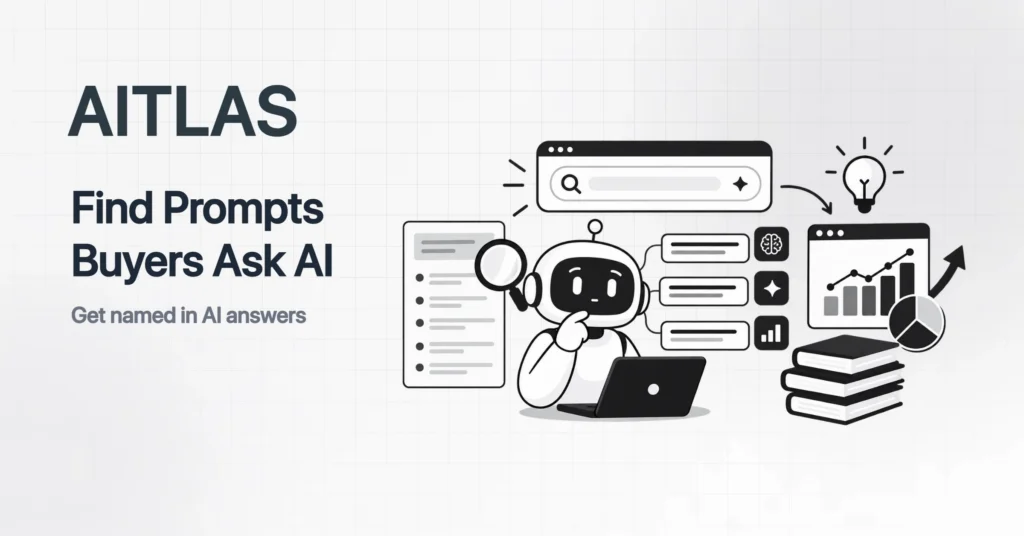
Prompt research for AI SEO is the practice of finding the questions your buyers type into ChatGPT, Gemini, Perplexity and Google AI Mode, and then checking whether those AI answers mention, cite or recommend your brand. It is to answer engines what keyword research is to Google's blue links.
The shift matters because people now ask AI full questions instead of typing short phrases. This guide explains how prompts differ from keywords, how to do prompt research in five steps, where to find real prompts without a big tool budget, and how to turn what you find into content that gets cited.
What Is Prompt Research for AI SEO?
Prompt research for AI SEO is the process of identifying, grouping and testing the natural-language prompts that lead AI assistants to recommend products, services or sources in your category. The output is a prompt set you track over time, not a keyword list.
It sits inside the wider discipline of AI SEO, and it is the starting point for answer engine optimisation (AEO). Without a prompt set, you have nothing fixed to measure your AI visibility against.
A good prompt set answers three questions. Which questions decide whether a buyer considers you? What do AI engines say in reply right now? And which sources do they trust when they say it?
How Is Prompt Research Different From Keyword Research?
Prompt research differs from keyword research because a prompt states its intent in full, while a keyword only hints at it. The difference is context, not just length.
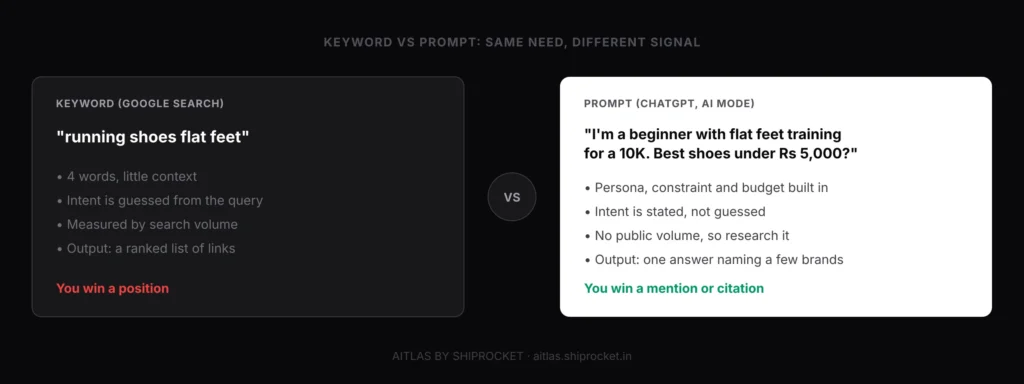
A keyword like "running shoes flat feet" leaves Google to guess who is asking and why. A prompt like "I'm a beginner with flat feet training for a 10K, which shoes under Rs 5,000 should I buy?" spells out the persona, the constraint and the budget. The AI engine uses all of it to decide which brands to name.
Similarweb reports that the average ChatGPT prompt is about 60 words, against about 3.4 words for a Google search, based on its own 2025 data. Even if the exact ratio varies, the direction is clear in Google's own results too.
Pew Research Center's analysis of real browsing data found that only 8% of one- or two-word Google searches produced an AI summary, compared with 53% of searches of 10 or more words. Questions starting with who, what, when or why triggered a summary 60% of the time. The longer and more conversational the query, the more likely an AI answer sits on top.
| Keyword research | Prompt research | |
|---|---|---|
| Unit | Short phrase, 2–5 words | Full question, often 10+ words |
| Intent | Inferred from the phrase | Stated by the user, with context |
| Demand data | Search volume from Google and tools | No public volume; estimated or researched |
| Result you compete for | A ranking position | A mention, citation or recommendation |
| Personalisation | Low to medium | High: history, location and wording change answers |
| Success metric | Rank, clicks, CTR | Mention rate, citation rate, share of voice |
Keyword research is still useful. It shows the words your buyers use, and many AI engines still retrieve pages through classic search. We cover how the two disciplines fit together in AEO vs SEO.
Why Does Prompt Research Matter Now?
Prompt research matters now because AI answers increasingly sit between your buyer and your website, and they name only a handful of brands. If you don't know which prompts matter, you can't tell whether you are in those answers.
Three shifts make this urgent as of October 2026:
- Clicks are thinning. Pew found that users clicked a traditional result on 8% of visits to pages with an AI summary, against 15% without one, and clicked a link inside the summary on just 1% of visits.
- AI use is broad, not just work. The NBER working paper "How People Use ChatGPT" found non-work messages rose from 53% to more than 70% of usage, and that practical guidance, seeking information and writing make up nearly 80% of conversations. That is where product questions live.
- One question becomes many searches. Google says that AI Overviews and AI Mode may use a "query fan-out" technique, running several related searches across subtopics to build one answer.
The last point changes how you research. You are not only trying to match one prompt. You need content that covers the sub-questions an engine will fan out into, which we explain in depth in our post on query fan-out and AI visibility.
Why this matters for your brand
An AI answer to “best shipping software for a small D2C brand” may name three companies and stop. Your brand is either one of them or invisible for that buyer. Prompt research tells you which of these decision-shaping questions exist in your category, so you can see where you stand before a competitor fills the slot.
How to Do Prompt Research in 5 Steps
To do prompt research, map your buyers, collect their real questions, turn them into full prompts with variants, audit how AI engines answer them, and then prioritise and track the gaps. The five steps below work for a solo marketer with a spreadsheet and for a large team with tools.
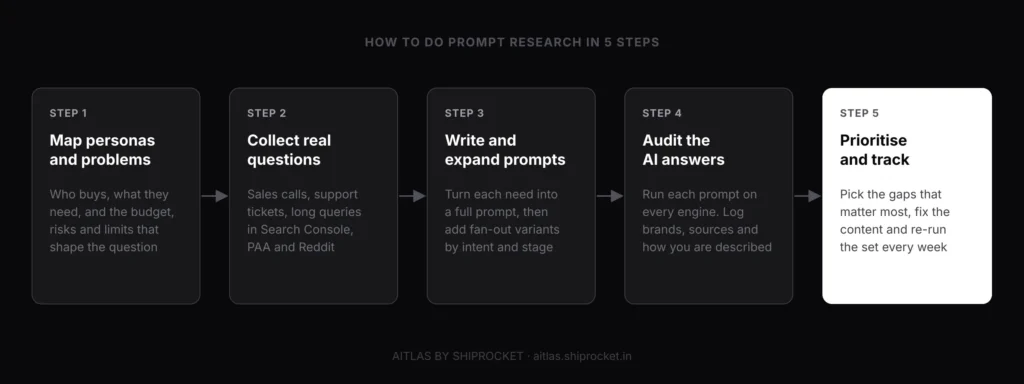
1. Map your personas and the problems they bring to AI
Start with who buys and what pushes them to ask. For each persona, write down the job they are trying to do, their budget, their constraints and what they fear getting wrong. These details are what turn a generic AI explanation into a recommendation, so they must be in your prompts.
2. Collect the questions buyers actually ask
Gather real wording before you write anything. Pull questions from sales calls, demo notes, support tickets, live chat, reviews, Reddit threads and People Also Ask boxes. In Google Search Console, filter queries with a regular expression such as ^(\S+\s+){9,}\S+$ to surface searches of 10 or more words, which are often prompt-like questions.
3. Write prompts and expand them into variants
Turn each need into a full prompt of roughly 10 to 30 words, written the way a buyer would talk. Then expand each core prompt into variants: definition, comparison, cost, use case, objection and how-to. Tag every prompt with persona, funnel stage and intent so you can report by group later.
4. Audit the AI answers on every engine
Run each prompt on ChatGPT, Gemini, Perplexity, Google AI Overviews and AI Mode, ideally in a logged-out or clean session from the same location. Record whether your brand is absent, mentioned, cited or recommended, which competitors appear, which URLs are cited and how your brand is described. Run important prompts more than once, because AI answers vary between runs.
5. Prioritise the gaps and track them weekly
Rank the gaps by business value. A missing mention in a high-intent comparison prompt usually matters more than one in a broad definition prompt. Fix the content behind the top gaps, then re-run the same prompt set every week so you can see whether the change worked.
How to Expand One Prompt Into a Full Prompt Set
You expand a prompt set by taking each core prompt and writing the follow-up and sub-questions an AI engine is likely to explore. This mirrors query fan-out, and it shows you which supporting pages you need.
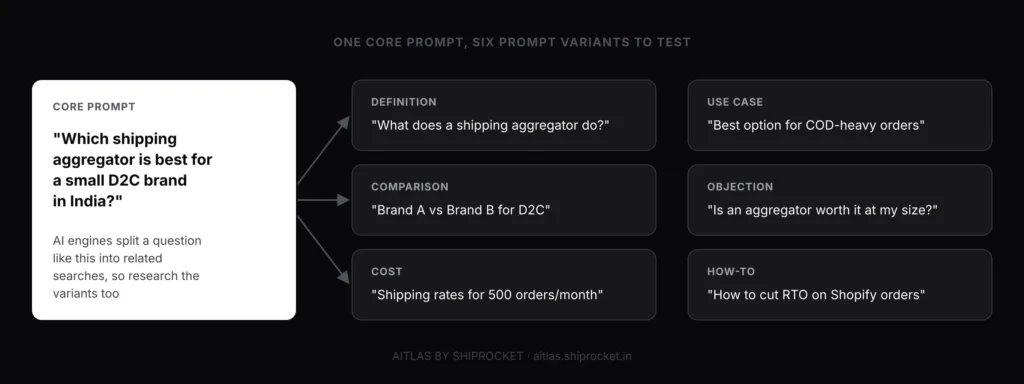
Here is how one core prompt for an Indian D2C buyer might expand:
| Variant type | Example prompt | Content it calls for |
|---|---|---|
| Definition | “What does a shipping aggregator do for an online store?” | Clear explainer with a one-line definition |
| Comparison | “Brand A vs Brand B for a small D2C brand in India” | Honest comparison table with criteria |
| Cost | “What do shipping rates look like for 500 orders a month?” | Pricing page or cost breakdown with dates |
| Use case | “Best shipping option for a COD-heavy fashion store” | Use-case page with specific examples |
| Objection | “Is a shipping aggregator worth it for a new brand?” | FAQ or guide that addresses the doubt directly |
| How-to | “How do I reduce RTO on Shopify orders?” | Step-by-step guide with real processes |
Write variants for each funnel stage. Top-of-funnel prompts ask "what is" and "how does", middle-of-funnel prompts compare and qualify, and bottom-of-funnel prompts ask about price, setup and alternatives. The middle stage often carries the most weight, because that is where AI names a shortlist.
Keep branded prompts in the set as well, such as "Is [your brand] good for small sellers?" or "[your brand] vs [competitor]". These show how AI describes you, which matters as much as whether it mentions you.
Where to Find Real Prompts Without Paid Tools
You can find real prompts without paid tools by mining the conversations your business already has and the long queries search engines already report. Most of the best prompt ideas are sitting in your own data.
- Sales and demo notes. The questions prospects ask before buying are close to what they ask AI. Ask your sales team for the ten most common ones.
- Support tickets and chat logs. These reveal objections, setup questions and comparisons in the customer's own words.
- Google Search Console. Long, question-style queries show the natural phrasing people use. Google confirms that traffic from AI features is included in the Search Console Performance report under the Web search type, though it is not split out separately.
- People Also Ask and AI Overviews. Note the follow-up questions Google surfaces, and the sub-topics an AI Overview covers for your core query.
- Reddit, Quora and community forums. Real buyers describe their situation in detail here, which is exactly the context a prompt carries.
- The AI engines themselves. Ask ChatGPT or Gemini what follow-up questions a buyer in your category would ask. Treat the output as ideas to validate, not as demand data.
Paid prompt research tools can add estimated demand, clustering and daily tracking. If you compare options, our roundup of the best AI visibility tools for Indian brands covers what each one measures.
A caution on prompt volume data
AI platforms don’t publish prompt volumes the way Google Ads publishes keyword volumes. Tools that show prompt demand estimate it from panels, clickstream data or keyword proxies, and their methods differ. Use these figures to rank prompts against each other, not as exact counts, and check them against your own customer conversations.
How Many Prompts Should You Track?
Most brands should track between 50 and 150 prompts to start, grouped by product, persona and funnel stage. That is large enough to show patterns and small enough to review properly every week.
Size the set by what you sell rather than by an arbitrary number. Semrush suggests that about 10 well-chosen prompts per product are usually enough to see whether AI consistently recommends your brand. A brand with eight core products or services would therefore start near 80 prompts, plus a few branded and competitor prompts.
Avoid two common mistakes. The first is tracking hundreds of near-identical prompts that all return the same answer, which adds cost without adding insight. The second is changing prompt wording every month, which breaks your trend lines.
For lean teams, our guide to AI visibility tracking for small marketing teams shows a simple weekly routine.
How to Measure Prompt Research Results
You measure prompt research by tracking how often your brand appears, how it is described and which sources AI cites across your fixed prompt set over time. A single check of one answer tells you very little, because AI answers change between runs.
| Metric | What it tells you | How to calculate it |
|---|---|---|
| Mention rate | How often AI names your brand | Answers mentioning you ÷ total answers |
| Citation rate | How often your pages are linked as sources | Answers citing your URLs ÷ total answers |
| Share of voice | Your presence against competitors | Your mentions ÷ all brand mentions in the set |
| Recommendation rate | How often you are the suggested choice | Answers recommending you ÷ total answers |
| Sentiment and accuracy | Whether AI describes you correctly | Share of answers with correct, positive framing |
| Cited sources | Which third-party sites shape the answer | Count of citations by domain |
Report these by engine, persona and funnel stage. A brand can lead on Perplexity and be absent on ChatGPT, or win definition prompts and lose every comparison prompt.
The cited-sources column is often the most useful. If AI keeps citing a particular review site, marketplace or forum for your category, that tells you where you need a presence beyond your own website. Our post on why AI search recommends your competitors explains how to act on those patterns.
How to Turn Prompt Research Into Content
You turn prompt research into content by mapping each prompt group to one strong page that answers it directly, then filling the sub-question gaps that fan-out reveals. The goal is to be the easiest, most trustworthy source for an engine to quote.
Map prompts to pages
Assign every prompt cluster to one existing or planned URL. If two of your pages answer the same prompt, merge them so the engine has one clear choice.
Lead with the answer
Open each section with a one- or two-sentence direct answer to the prompt, then add detail, examples and data. This is the format AI engines lift most easily.
Cover the variants
Add comparison tables, pricing context, use-case examples and FAQs that answer the fan-out sub-questions from your prompt set.
Use question-style headings
Mirror real prompt wording in your H2s and H3s, so retrieval systems can match a section to the question it answers.
Build presence where AI looks
Earn mentions on the review sites, publishers and communities your audit shows AI citing for your category.
Re-test after every change
Re-run the affected prompts for three to four weeks after publishing before you judge the result, because single answers vary.
For a deeper look at citation-friendly formats, read our guide on how to get cited by LLMs. And if you just want a quick read on where you stand today, start with checking whether your brand shows up in AI search.
Turn Your Prompt Set Into Weekly AI Visibility Data
Prompt research only pays off when you check the same prompts week after week across every AI engine. AiTLAS by Shiprocket tracks how ChatGPT, Gemini, Perplexity, Google AI Overviews and AI Mode describe and cite your brand, and helps you act on the gaps.
- RADAR monitors how your brand appears across AI platforms every week, so you can see which prompts you win, lose or share with competitors.
- HYDRA publishes AEO-structured content designed to improve your citation rates on the prompts where you are missing.
Conclusion
Prompt research for AI SEO replaces the keyword list with a living set of real buyer questions. It shows which questions decide whether you are considered, what AI engines say in reply and which sources they trust.
The process is simple to start. Map your personas, collect real questions, write full prompts with variants, audit every engine and track a focused set each week.
Brands that do this early learn where they are invisible before the gap shows up in pipeline. Start with ten prompts for your most important product this week, and build from there.
Prompt research in AI SEO is the process of finding the full, conversational questions people ask AI assistants such as ChatGPT, Gemini and Perplexity. It groups those prompts by intent and buying stage and checks how each engine answers them. The result is a fixed prompt set you use to measure and improve your brand's AI visibility. It plays the same role for AI answers that keyword research plays for Google rankings.
Start by mapping your buyer personas and the problems they bring to AI. Collect real questions from sales calls, support tickets, long Search Console queries, People Also Ask and forums. Turn them into full prompts, expand each into variants such as comparison, cost and objection, and run them on every major AI engine. Then prioritise the gaps where you are missing and re-run the set weekly to track progress.
No, prompt research complements keyword research rather than replacing it. Keywords still show the language buyers use and still drive classic rankings, which many AI engines rely on when they retrieve sources. Prompt research adds the context, intent and AI answer data that keywords miss. Most teams use keyword data as an input when they write prompts.
Most brands can start with 50 to 150 prompts, grouped by product, persona and funnel stage. Semrush suggests about 10 well-chosen prompts per product are usually enough to see whether AI consistently recommends a brand. Keep the wording fixed so your trend lines stay comparable. Add prompts only when they cover a genuinely new question or buyer type.
Yes, you can do prompt research with a spreadsheet and your own data. Sales notes, support tickets, reviews, Reddit threads, People Also Ask and long queries in Google Search Console all reveal how buyers phrase questions. You can then run the prompts manually on each AI engine and log the answers. Paid tools mainly add estimated demand, automation and daily tracking at scale.
Re-run your fixed prompt set every week, because AI answers and cited sources change from run to run. Review and refresh the prompt list itself every quarter, or when you launch a product, enter a new market or see new questions from customers. Keep core prompts unchanged so you can compare results over time. Retire prompts that no longer reflect how buyers ask.
Share this article
Newsletter
Stay ahead of AI search
Weekly insights on AI visibility, AEO strategies, and brand intelligence. No spam.

Sahil Bajaj: With 7+ years of digital marketing expertise, I'm dedicated to fusing technology and creativity for business success. Known for innovative strategies that drive growth and a passion for continuous improvement.
Related Articles