ChatGPT Shopping Optimization: A Complete Guide for 2027
Blog Summary
ChatGPT Shopping optimization is the work of making your products easy for ChatGPT to find, understand and trust, so they appear in its product cards and buyer's guides. OpenAI says ChatGPT picks products itself, using structured product data, third-party content and the shopper's own context, and that these results are not ads. As of March 2026, OpenAI has shifted ChatGPT shopping towards product discovery, with the purchase usually completed on the merchant's own site. Indian brands can already appear in ChatGPT's shopping answers, but direct merchant feeds and in-chat checkout launched in the US first, so crawlable pages and clean structured data matter most today. The seven levers are crawl access, Product schema, attribute-rich product copy, product feeds, third-party reviews, consistent price and stock data, and weekly prompt tracking. Getting ready for ChatGPT Shopping optimization in 2027 means building one accurate product data source now, so you can plug into feeds and agentic checkout when they reach your market.
ChatGPT Shopping optimization is the process of making your product pages, product data and brand reputation easy for ChatGPT to retrieve, compare and recommend. When a shopper asks ChatGPT for "the best cotton kurta set under Rs 2,000", the products in that answer are chosen by the model, not bought with ad spend, and optimisation is how you earn a place there.
The stakes are high in India. Sam Altman said in February 2026 that India has about 100 million weekly ChatGPT users, making it ChatGPT's second-largest market. This guide explains how ChatGPT Shopping works as of November 2026, what it means for Indian D2C brands, and the seven steps to get your products picked.
What Is ChatGPT Shopping Optimization?
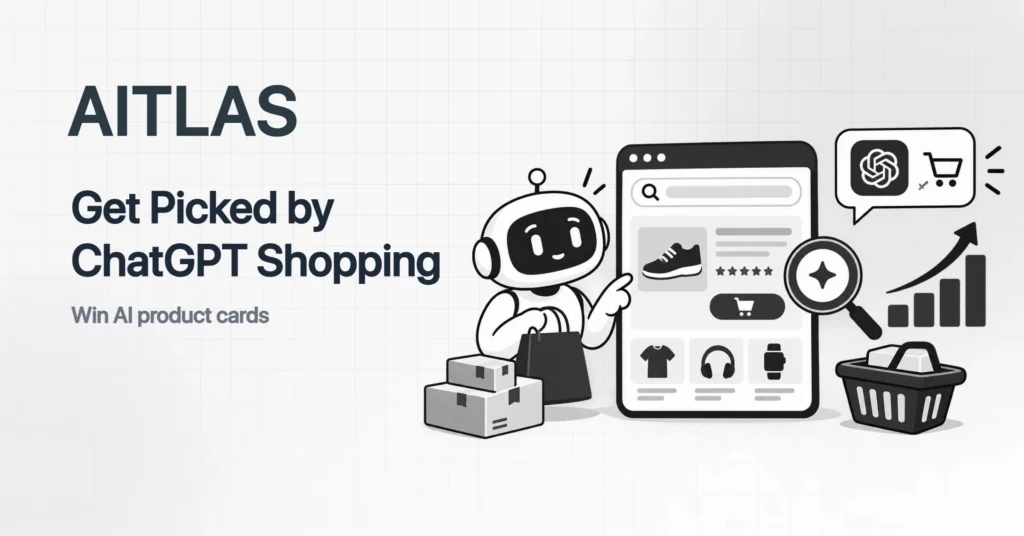
ChatGPT Shopping optimization is a branch of answer engine optimisation (AEO) focused on products rather than articles. Its goal is to get your products shown, accurately described and recommended when ChatGPT answers a shopping question.
It overlaps with classic ecommerce SEO, but the unit of success is different. In Google you compete for a ranking position. In ChatGPT you compete for one of a handful of slots in a single answer, and for the words the model uses to describe you.
If you are new to the wider discipline, our guide to what AI SEO is covers the foundations. This post goes deep on the shopping layer.
How Does ChatGPT Shopping Work?
ChatGPT Shopping works by detecting shopping intent in a prompt, pulling product data from the web and from merchant feeds, and then generating a visual answer with product cards, prices, reviews and links to buy. The model decides what to show, based on the query and what it knows about the shopper.
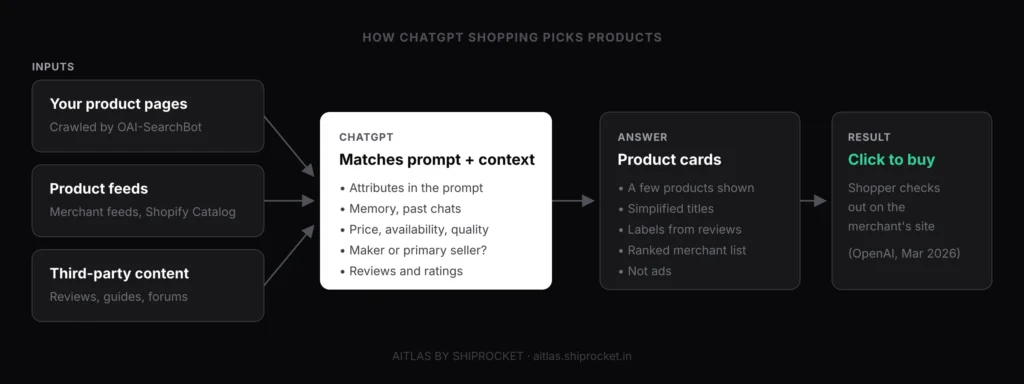
According to OpenAI's help article on shopping with ChatGPT search, product results are chosen independently and are not ads. ChatGPT considers structured metadata from first-party and third-party providers, such as price and description, plus other third-party content and the shopper's context, including Memory and custom instructions.
The same article says merchants are ranked on factors such as availability, price, quality and whether they are the maker or primary seller of the item. ChatGPT may also write its own simplified product titles and labels, such as "Budget-friendly", based on what reviews say.
The product has changed fast since launch. Here is the short timeline:
| Date | What changed | What it means for brands |
|---|---|---|
| April 2025 | Shopping results with product cards rolled out to Free, Plus, Pro and logged-out users | Any crawlable store could start appearing |
| September 2025 | Instant Checkout launched for US users, built on the Agentic Commerce Protocol (ACP) | Buying inside the chat became possible for approved merchants |
| November 2025 | Shopping research launched, building personalised buyer’s guides | Deeper comparison of specs, reviews and trade-offs |
| March 2026 | OpenAI refocused on product discovery and merchant-owned checkout | Feeds and product data now matter more than in-chat checkout |
The March 2026 shift is the one to note. That month, OpenAI extended ACP to cover discovery, so merchant feeds and promotions can appear in ChatGPT, while shoppers mostly complete the purchase with the merchant.
Is ChatGPT Shopping Available in India?
Yes, Indian shoppers can get product cards and buyer's guides in ChatGPT today, but the merchant-side programmes have rolled out in the US first. That gap shapes what Indian brands should prioritise.
The shopping results launched in April 2025 for users everywhere ChatGPT is available, and shopping research reached Free, Go, Plus and Pro users. So an Indian shopper asking for "a pressure cooker for a family of four under Rs 3,000" can see a carousel of products with prices and links.
Instant Checkout, however, launched for US users, and OpenAI's direct merchant feed programme runs through an application at chatgpt.com/merchants. As of November 2026, Indian brands should check that page for regional eligibility rather than assume access.
Why this matters for your brand
For most Indian D2C brands, ChatGPT Shopping optimization today happens on your own website and across the web, not in a feed dashboard. ChatGPT has to crawl your pages, read your prices in rupees, and find independent reviews before it will name you. Brands that fix these basics now will be ready the day feeds and checkout open up locally.
Indian shopping prompts also carry local context that your pages need to answer. Shoppers ask about COD, delivery to their pincode, GST-inclusive prices, size charts for Indian body types and return windows. If your product page doesn't state these clearly, ChatGPT has nothing to quote when a shopper asks.
How Does ChatGPT Choose Which Products to Show?
ChatGPT chooses products by matching the attributes in the shopper's prompt against the product data it can find, then weighing price, availability, reviews and the seller's credibility. The clearer and more consistent your data, the easier you are to match.
In practice, three kinds of signal decide whether you are picked:
Accessible data
Your pages can be crawled by OpenAI’s search crawler, and your price, stock and specs sit in the HTML and in structured data, not only in scripts or images.
Attribute match
Your titles and descriptions state the materials, sizes, use cases and constraints that shoppers put in their prompts, such as “for oily skin” or “for a 2BHK”.
Third-party trust
Reviews, ratings, comparison articles and community discussions confirm what you claim, so the model is confident enough to recommend you.
Prompts are much more specific than keywords. A buyer doesn't type "running shoes"; they describe their feet, distance and budget. We explain how to collect and group these prompts in our guide to prompt research for AI SEO.
Context matters as well. Because ChatGPT can use Memory and past chats, two shoppers asking the same question may see different products. That is why you measure visibility across a set of prompts, not one screenshot.
How to Optimise for ChatGPT Shopping in 7 Steps
To optimise for ChatGPT Shopping, open your site to OpenAI's crawler, mark up your products, rewrite product copy around buyer attributes, get into product feeds, build third-party proof, keep data consistent, and track results weekly. Work through the steps in this order, because each one depends on the one before.
1. Let OpenAI's search crawler in
OpenAI's crawler documentation says OAI-SearchBot is the bot used for ChatGPT search, and recommends allowing it in robots.txt if you want to appear in results. Check your robots.txt, and also your CDN or firewall rules, because bot protection often blocks AI crawlers silently. OpenAI notes that a robots.txt change can take about 24 hours to take effect.
2. Add complete Product schema to every product page
Mark up each product page with schema.org Product and Offer data: name, brand, GTIN or SKU, price in INR, availability, images, aggregate rating, shipping details and return policy. Make sure the visible page shows the same values. Mismatches between markup and page text give the model a reason to distrust both.
3. Rewrite titles and descriptions around buyer attributes
Replace vague copy like "premium comfort for everyday wear" with the facts a shopper prompts for. State the fabric, fit, size range, care, compatible devices, skin type or room size, and add a short "best for" line. A good test is whether your description could answer a 20-word prompt on its own.
4. Get into the product feeds ChatGPT reads
OpenAI publishes a Product Feed Spec for merchants who join its feed programme. Its help centre also says Shopify merchants' products already reach ChatGPT through Shopify Catalog. Even if you can't submit a direct feed yet, keep one clean master feed with stable IDs, current prices and live stock, so you can plug in quickly.
5. Build third-party proof
Earn reviews on your site and on the marketplaces your buyers use, and get your products into credible comparison articles, gift guides and community threads. OpenAI says shopping research reviews quality sources across the web, so independent mentions carry weight. Our post on how to get cited by LLMs covers which formats AI engines quote most.
6. Keep price, stock and delivery data consistent everywhere
ChatGPT ranks merchants partly on price and availability, so a product shown in stock on your site but sold out on a marketplace sends mixed signals. Sync prices, stock, offers and delivery promises across your website, feeds and marketplace listings. State delivery timelines and COD availability in plain text on the page.
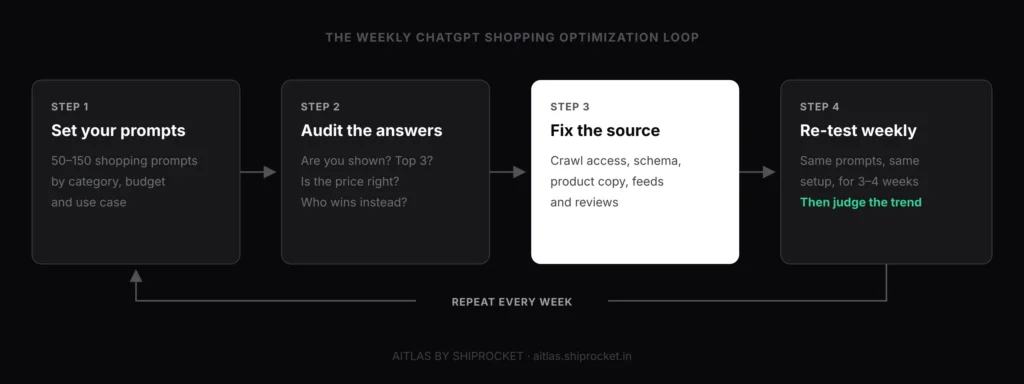
7. Track prompts, mentions and AI referrals every week
Build a fixed set of 50 to 150 shopping prompts, run it weekly across ChatGPT and other AI engines, and log whether your products appear, how they are described and which competitors win. In analytics, watch for referral traffic from chatgpt.com, which often carries a utm_source=chatgpt.com tag. Our framework for AI search KPIs shows which metrics to report.
What Does an Optimised Product Page Look Like?
An optimised product page states every attribute a shopper might prompt for, in plain text and in structured data, and backs it with reviews and clear policies. The difference from a typical Indian D2C page is usually completeness, not design.
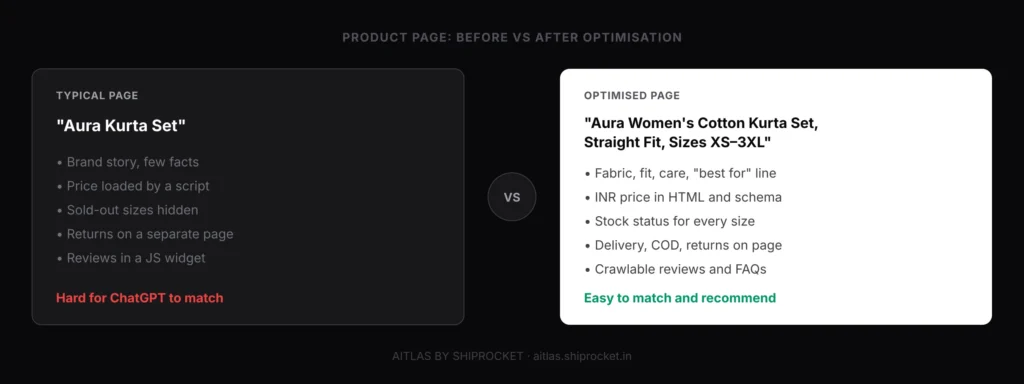
| Element | Typical page | Optimised for ChatGPT Shopping |
|---|---|---|
| Title | “Aura Kurta Set” | “Aura Women’s Cotton Kurta Set, Straight Fit, Sizes XS–3XL” |
| Description | Brand story, few facts | Fabric, fit, care, occasion and a “best for” line |
| Price | Shown via script, changes at checkout | In HTML and Offer schema, GST-inclusive, in INR |
| Availability | Out-of-stock sizes hidden | Stock status per variant, in markup |
| Delivery and returns | Linked policy page only | Delivery time, COD and return window on the page |
| Reviews | Star widget loaded by JavaScript | Review text crawlable, with aggregate rating in schema |
| FAQs | None | Sizing, washing and fit questions answered directly |
The title column is worth pausing on. ChatGPT may write its own simplified title, but it can only work from what you give it. A title packed with real attributes gives the model the material to match a specific prompt.
A caution on what OpenAI has not published
OpenAI explains the factors it considers, but it has not published a full ranking formula for ChatGPT Shopping. Treat any claim of a guaranteed “ChatGPT ranking factor” with care, including correlations reported by third-party studies. Test changes on your own prompt set and judge them over several weeks, because AI answers vary from run to run.
How Do You Measure ChatGPT Shopping Visibility?
You measure ChatGPT Shopping visibility by tracking how often your products appear for a fixed set of shopping prompts, how they are described and how much traffic and revenue AI referrals bring. One answer proves nothing; a weekly trend does.
Track these metrics by product category and by prompt type:
| Metric | What it tells you |
|---|---|
| Product inclusion rate | Share of shopping prompts where at least one of your products appears |
| Top-3 rate | Share of answers where your product is among the first three shown |
| Description accuracy | Whether price, specs and claims in the answer match your page |
| Competitor share | Which brands win the prompts you lose |
| Cited sources | Which reviews, publishers or marketplaces ChatGPT leans on |
| AI referral revenue | Sessions and orders from chatgpt.com in your analytics |
Description accuracy deserves special attention. If ChatGPT quotes an old price or a wrong spec, fix the source data first, because the model repeats what it finds. Our post on AI hallucinations and your brand explains how to trace and correct these errors.
ChatGPT Shopping Optimization in 2027: What to Prepare For
ChatGPT Shopping optimization in 2027 will likely reward brands with clean, real-time product data that agents can act on, not just read. You can't know exactly what OpenAI will ship, but the direction since 2025 is clear: more structured feeds, more personalisation and more agent-led buying.
Here is what to prepare for, based on what OpenAI has already built:
1. Feeds will matter more than pages
The Agentic Commerce Protocol already covers both discovery and checkout. If merchant feed programmes widen to more regions, brands with a ready master feed will be listed first.
2. Agents will compare on hard facts
Shopping research already asks clarifying questions and weighs trade-offs. Vague claims like "best quality" won't survive a comparison against a rival that lists its thread count, warranty and delivery time.
3. Personalisation will widen the gap
As ChatGPT uses more memory and context, the same prompt will return different products for different shoppers. That makes broad attribute coverage, across sizes, budgets and use cases, more valuable than a single hero product.
Audit crawl access this week
Confirm OAI-SearchBot is allowed in robots.txt and isn’t blocked by your CDN or firewall.
Fix Product schema on top sellers
Start with your 20 best-selling products and add complete Product, Offer and review markup.
Rewrite copy for prompts
Add attributes, “best for” lines and FAQs that match the questions buyers ask AI.
Build one master product feed
Keep stable IDs, INR prices and live stock in one source that can feed any channel.
Earn independent reviews
Invest in reviews, comparison features and community presence where your buyers research.
Track a fixed prompt set weekly
Measure inclusion, accuracy and competitor share, and re-test after every change.
For a wider view of why rivals show up where you don't, read why AI search recommends your competitors.
See Which Products ChatGPT Recommends in Your Category
ChatGPT Shopping answers change week to week, and most brands only find out they are missing when sales dip. AiTLAS by Shiprocket shows how ChatGPT, Gemini, Perplexity, Google AI Overviews and AI Mode describe your brand, and helps you close the gaps.
- RADAR monitors your brand across AI platforms every week, so you can see which shopping prompts you win, lose or share with competitors.
- HYDRA publishes AEO-structured content built to improve your citation rate on the buying questions where you are absent.
Conclusion
ChatGPT Shopping optimization is less about tricks and more about data quality. ChatGPT picks products it can crawl, understand and verify, then ranks sellers on price, availability and trust.
For Indian brands, the work starts on your own site: open the door to OAI-SearchBot, mark up every product, write copy that answers real prompts, and earn reviews beyond your website. Feeds and in-chat checkout will matter more as they reach new markets.
Start small. Pick one category, write 20 shopping prompts your buyers would ask, and check what ChatGPT says today. That baseline tells you exactly where to begin.
ChatGPT Shopping is the set of features that lets people discover and compare products inside ChatGPT. When a prompt shows buying intent, ChatGPT can show product cards with images, prices, reviews and links to merchants. Its shopping research mode goes further and builds a personalised buyer's guide after asking clarifying questions. OpenAI says the product results are chosen independently and are not ads.
Start by allowing OpenAI's OAI-SearchBot crawler in your robots.txt, because ChatGPT needs to access your pages to show them. Add complete Product schema with price, availability and reviews, and write detailed product titles and descriptions. Shopify merchants' products reach ChatGPT through Shopify Catalog, and other merchants can apply for OpenAI's product feed programme at chatgpt.com/merchants. Third-party reviews and mentions then help ChatGPT trust your products enough to recommend them.
No, according to OpenAI, the organic product results in ChatGPT are chosen by the model and are not paid placements. OpenAI's help centre says ads, where shown, are separate from these results. The way to appear organically is to improve your crawl access, structured data, product content and reviews. Treat any agency offering guaranteed paid placement in organic shopping answers with caution.
Yes, shoppers in India can see product cards and use shopping research in ChatGPT, as these features rolled out beyond the US. Merchant programmes such as Instant Checkout launched in the US first, and direct feed access depends on OpenAI's regional eligibility. Indian brands should focus on crawlable pages, Product schema and reviews, which work wherever ChatGPT search does. Check chatgpt.com/merchants for the latest eligibility before planning a feed integration.
Google Shopping SEO focuses on a Merchant Center feed and on ranking in a grid of listings, often alongside paid ads. ChatGPT Shopping optimization focuses on being selected and described correctly inside a conversational answer that shows only a few products. It relies more on attribute-rich content, third-party reviews and the shopper's context. Many basics overlap, such as accurate feeds, clean product data and strong reviews, so work on one usually helps the other.
Crawl access changes can apply within about a day, since OpenAI says robots.txt updates take around 24 hours to take effect. Content, schema and review improvements usually take several weeks to show up consistently, because ChatGPT has to recrawl pages and answers vary between runs. Track a fixed prompt set weekly for at least a month before judging a change. Third-party reputation builds more slowly, often over a few months.
Share this article
Newsletter
Stay ahead of AI search
Weekly insights on AI visibility, AEO strategies, and brand intelligence. No spam.

Sahil Bajaj: With 7+ years of digital marketing expertise, I'm dedicated to fusing technology and creativity for business success. Known for innovative strategies that drive growth and a passion for continuous improvement.
Related Articles