Google AI Overviews Cite Your Listicle, Recommend Rivals: Why?
Blog Summary
This guide explains why Google AI Overviews cite your listicle but recommend competitors: Google often uses a brand's own "best of" page as a source, then recommends the rivals named inside it. In Lily Ray's June 2026 study of 100 B2B software queries, the brand that ranked itself first was left out of the recommendation 69% of the time; her September update put that figure at 83%. A citation means your page was used as evidence, while a recommendation means the answer told the reader what to choose, and only the second one wins buyers. Google appears to decide recommendations from wider web consensus, such as third-party mentions, category leadership and link authority, not from the ranking on your own page. Self-ranking listicles still earn citations and a small lift in mentions, but Scrunch found a competitor was recommended instead of the author in 24.3% of answers that cited one. To turn citations into recommendations, track recommendation share separately, publish honest comparisons with evidence and earn coverage on sites you don't control.
Why do Google AI Overviews cite your listicle but recommend competitors? Because Google treats your "best tools" page as research material, not as a verdict. It pulls the list of options from your page, checks each one against what the rest of the web says, and recommends the brands with the strongest independent support, which are often your rivals.
That gap matters more than any ranking report. As of October 2026, the clearest public data shows that a self-promotional listicle can earn the citation link and still hand the recommendation, the part buyers act on, to the brands it compares itself with. This guide explains why that happens, what the research found and how to change it.
What Does It Mean When AI Overviews Cite You but Recommend a Competitor?
It means Google used your page as a source for the answer but told the reader to choose a different brand. Your link appears in the AI Overview, yet the product names in the answer belong to someone else.
The pattern shows up most on "best [category]" queries. These are the high-intent searches where a buyer is close to choosing, so they are also the queries where vendors publish listicles ranking themselves first.
Here is the example that made the pattern famous. For "best LMS for selling courses", Google's AI Overview cited Oasis LMS's own listicle, which ranks Oasis first. The answer then recommended Kajabi, Thinkific, LearnWorlds and Teachable, all of which appear in the Oasis article.
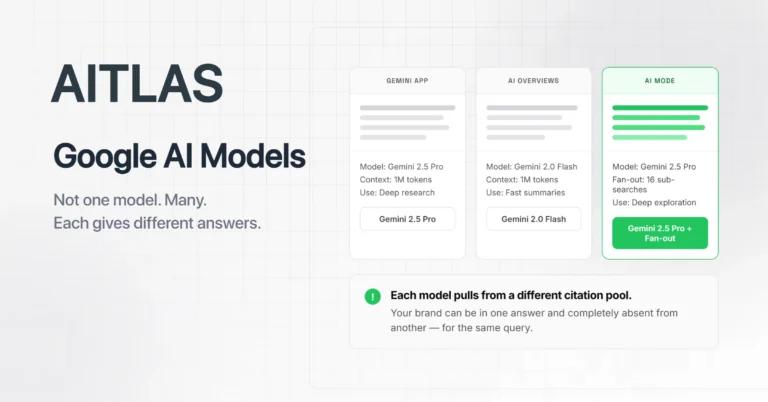
If you're still getting to grips with how the different Google AI surfaces work, our explainer on Gemini vs AI Overviews vs AI Mode covers the basics.
Why Google AI Overviews Cite Your Listicle but Recommend Competitors
Google AI Overviews cite your listicle but recommend competitors because retrieval and recommendation are separate decisions. Your page wins at retrieval because it is relevant and well structured. It loses at recommendation because the model weighs what many sources say, not what one vendor says about itself.
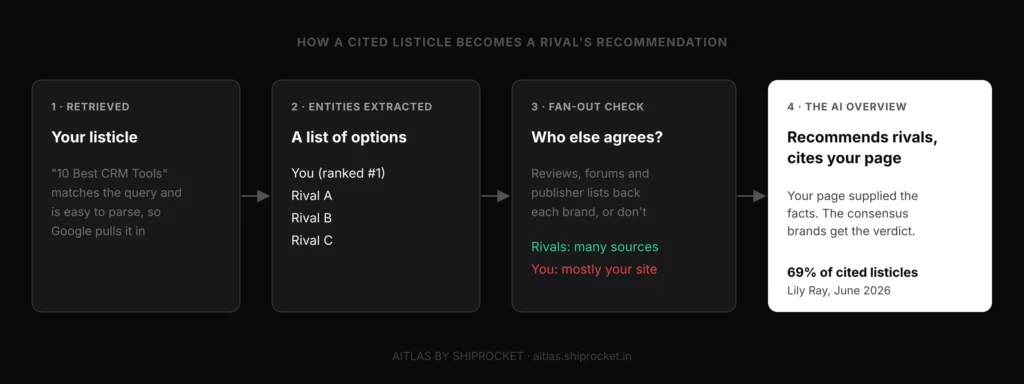
Google's own documentation describes part of this process. It says AI Overviews and AI Mode may use "query fan-out", issuing multiple related searches across subtopics and data sources, and that the models identify more supporting web pages while the answer is generated. We go deeper on fan-out in our post on Google's R4T-Diffusion and AI visibility.
In practice, the journey from your listicle to a rival's recommendation tends to follow four steps:
1. Your listicle is retrieved
A page titled "10 Best CRM Tools for Startups" matches the query almost word for word. It has headings, a ranked list and short descriptions, so it is an easy candidate for retrieval.
2. The model extracts the entities
The model reads your page as a list of options in the category. Your brand is one entity on that list, and so is every competitor you named.
3. Each entity is checked against other sources
Fan-out searches bring in reviews, forums, publishers and other listicles. Brands that appear across many of those sources look like the consensus answer. A brand that ranks first mainly on its own domain looks like a single, interested opinion.
4. The answer recommends the consensus
The AI Overview names the brands with the broadest support and keeps your page as a citation, because it supplied useful facts. You did the research for the answer, and your rivals got the credit.
Why this matters for your brand
A citation report can make a self-promotional listicle look like a win. If the answer next to your link names three competitors, that page may be sending buyers straight to them. Measure the recommendation, not just the link.
What Did Lily Ray's Research Find?
Lily Ray's research found that Google usually recommends someone else when it cites a brand's self-ranking listicle. The share rose from 69% in June 2026 to 83% in her September 2026 update.
For the original study, Ray, VP of SEO Strategy and Research at Amsive, ran 100 B2B "best [category] software" queries in Google, checking each one three times between April and June 2026. Of those, 80 triggered an AI Overview. Self-ranking listicles were cited 323 times, and in 224 of those cases the publishing brand was not recommended, according to Search Engine Land's coverage.
The same split appeared in CRM, help desk and SEO software, not just LMS. Ray also found that the brands Google did recommend had far more referring domains and more mentions across AI Overviews and ChatGPT than the brands that were cited but passed over.
Her September update, reported by PPC Land, added two changes:
| Measure | June 2026 | September 2026 |
|---|---|---|
| Cited self-ranking listicles where the author brand was not recommended | 69% | 83% |
| Vendor-written "best of" pages cited by AI Overviews | Baseline | 38% fewer than in June |
| Queries studied | 100 B2B software queries | 100 B2B software queries |
So Google now cites these pages less often, and when it does, it is even less likely to recommend the brand that wrote them.
A note on the data
Ray’s study covers one vertical, B2B software, and one surface, Google AI Overviews, with a sample of 100 queries. PPC Land notes that the September essay does not explain how recommendations were classified or how the two query sets were matched. Treat the percentages as a strong signal, not a settled benchmark, and test your own category.
Citation vs Mention vs Recommendation: What's the Difference?
A citation links to your page, a mention names your brand in the answer text, and a recommendation tells the reader to choose you. Each is a different level of visibility, and each can happen without the others.
| Visibility level | What the reader sees | Business value |
|---|---|---|
| Citation only | Your page appears as a source link, but your brand is not named | Low: a "ghost citation" that builds little recall |
| Mention | Your brand is named, perhaps in a neutral list | Medium: awareness, but no endorsement |
| Recommendation | The answer suggests your brand for the reader's need | High: this is what shortlists are made from |
| Recommendation plus citation | Named, endorsed and linked | Highest: trust plus a path to your site |
Citation-only appearances are more common than most teams expect. A June 2026 Semrush study with Kevin Indig logged 3,981 domain appearances across 115 prompts and four engines, including Google AI Overviews, and found that 61.7% were ghost citations: the site was cited, but the brand was never named.
There is an Indian angle in that data too. India was among the countries with the highest brand mention rate in the study, at 50%. Comparative prompts such as "best", "vs" and "recommend" also produced a 43.3% mention rate, about 2.4 times the rate for informational prompts. The listicle query is exactly where brand naming happens, which is why losing the recommendation there hurts.
Which Signals Make Google Recommend a Brand?
Google appears to recommend the brands with the strongest independent consensus. In Ray's data, recommended brands tended to lead their categories, to be widely mentioned on third-party sites and to have stronger link profiles than the brands that were only cited.
Category leadership
Brands that already lead a category show up in more sources, so the model sees them as the safe default answer.
Third-party mentions
Reviews, publisher roundups, forums and videos you don’t control count as independent evidence. Your own page counts once.
Link authority
Recommended brands had far more referring domains, a sign that the wider web vouches for them.
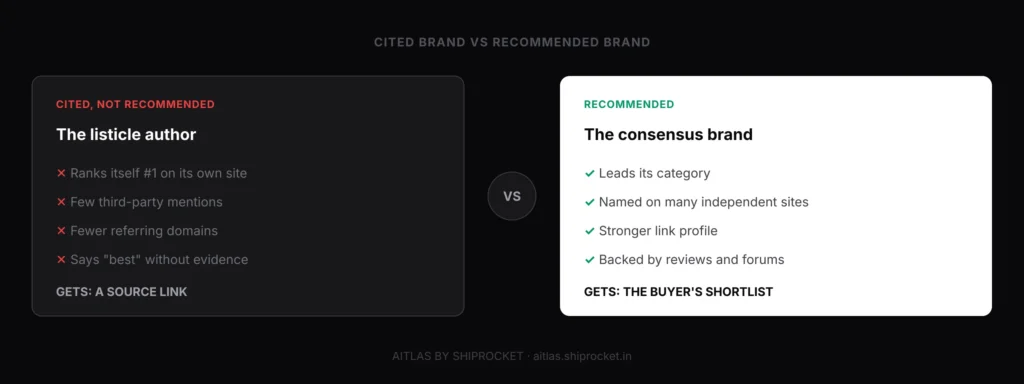
The common thread is corroboration. A single vendor page saying "we are the best" is one claim from an interested party. Ten independent pages that name a rival as a top pick look like a fact.
Google's guidance on reviews points the same way. Its documentation on writing high quality reviews asks that when you recommend something as the best, you "include why you consider it the best", and that you "provide evidence such as visuals, audio, or other links of your own experience." Most self-ranking listicles skip both.
This is the same logic we cover in how AI agents choose which brands to recommend, applied to Google's AI Overviews.
Do Self-Promotional Listicles Still Work for AI Search?
Self-promotional listicles still earn citations and a modest lift in brand mentions, but they are a weak route to recommendations. Two 2026 vendor studies support both halves of that answer.
Scrunch analysed about 10,000 AI-cited URLs collected between May and June 2026, including 818 self-ranking pages, and found that the author brand's recommendation rate rose from about 4% to about 7% when its listicle was cited. In 63.9% of responses, the AI used the listicle as raw material for a balanced overview rather than adopting its number one ranking.
Several other findings from that study are useful:
- Google AI Overviews recommend less often. When a self-ranking page was cited, the author brand was recommended in 8.9% of AI Overview answers, compared with 15.6% on Claude and 14.8% on Gemini.
- Mentions rise more than recommendations. Brand mentions appeared in about 39% of answers that cited the listicle, against about 19% when it was not cited.
- List size matters. Pages listing 4 to 10 brands performed best for the author brand.
- Rivals are often already winning. Competitors were recommended instead of the author in 24.3% of citing answers, though a placebo test suggested those rivals were already gaining for other reasons.
“Crowning yourself No. 1 may give you a small boost, but don’t expect the crown to do all of the work.”
Niharika Sharma, Scrunch, September 2026
Peec's earlier analysis of 232,000 citations in software review prompts, from December 2025 to February 2026, found that about 11% of AI search citations came from self-promotional listicles. ChatGPT cited them least, at about 3.6%, against roughly 10% for Google AI Mode and Perplexity. Even so, Peec's researchers advised against the tactic because of reputational and algorithmic risk.
Put together, the data says a self-ranking listicle is a citation asset, not a recommendation engine. Ray's September figures suggest Google is also citing these pages less, so the citation benefit may be shrinking.
How to Measure Whether AI Overviews Recommend Your Brand
You measure it by running a fixed set of buyer queries repeatedly and recording citations, mentions and recommendations as separate fields. A report that counts only cited URLs will hide exactly the problem this post describes.
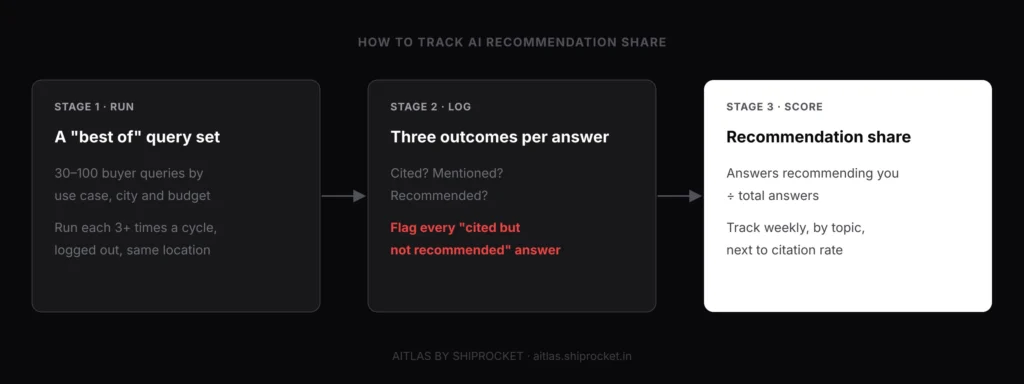
1. Build a "best of" query set
List 30 to 100 buyer queries for your category, such as "best courier aggregator for small business in India" or "best Shopify app for COD". Include "best for" variants by use case, city and budget.
2. Run each query several times
AI Overviews change from run to run, as Ray's three checks per query reflected. Run every query at least three times per cycle, logged out, from a consistent location.
3. Log three outcomes per answer
For each answer, record whether your page is cited, whether your brand is mentioned and whether it is recommended. Note which competitors are recommended and which of your URLs are cited.
4. Flag "cited but not recommended" answers
These are your highest-priority rows. They show that Google trusts your page for facts but not your brand for the verdict.
5. Calculate recommendation share
Divide the answers that recommend you by the total answers for the query set. Track this alongside citation rate, by topic, every week.
A spreadsheet is enough to start. Our guide to AI visibility tracking for small marketing teams shows a lean weekly setup.
How to Turn AI Overview Citations Into Recommendations
You turn citations into recommendations by giving Google independent reasons to agree with you. That means more honest comparison content on your own site and, above all, more coverage of your brand on sites you don't control.
Separate citation and recommendation reporting
Add a recommendation column to every AI visibility report. A rising citation count with a flat recommendation share is a warning, not a win.
Rewrite listicles as honest “best for” guides
Replace “we are number one” with clear use cases, such as best for COD-heavy D2C brands or best for under 100 orders a day. Explain why each pick fits, as Google’s review guidance asks.
Add evidence only you can provide
Publish screenshots, test results, pricing tables and original data from your own use. Evidence makes your page worth citing and your claims harder to ignore.
Earn places on listicles you don’t own
Pitch the independent publishers, YouTube reviewers and newsletters that already rank for your “best of” queries. One honest third-party mention can outweigh your own page.
Build reviews and community presence
Encourage reviews on the marketplaces and review platforms your buyers use, and join relevant forum discussions with genuine answers rather than plugs.
Study the brands that get recommended
For every “cited but not recommended” query, list where the recommended rivals are mentioned and close those gaps first. Our guide on why AI search recommends your competitors covers the common causes.
You don't have to delete your existing listicles. They still earn citations and mentions, and a fair, well-evidenced comparison helps readers. Just stop counting them as your recommendation strategy. For more on building pages that engines want to quote, see our guide on how to get cited by LLMs.
Give each change time. AI answers vary between runs, so judge results on several weeks of repeated checks, not on the first AI Overview you see after publishing.
See Where AI Overviews Cite You, and Who They Recommend
A citation that sits next to a rival’s recommendation is easy to miss in a standard SEO report. AiTLAS by Shiprocket shows how Google AI Overviews, AI Mode, ChatGPT, Gemini and Perplexity describe your brand, so you can see which “best of” queries you are winning and which ones you are handing to competitors.
- RADAR monitors how your brand appears across AI platforms every week, so you can spot queries where you are cited but a competitor is recommended.
- HYDRA publishes AEO-structured content designed to improve your citation rates on the queries that matter to your buyers.
Conclusion
The answer to why Google AI Overviews cite your listicle but recommend competitors is that a citation and a recommendation answer different questions. The citation asks whether your page is useful evidence. The recommendation asks which brand the wider web agrees is best, and a vendor ranking itself first is rarely enough to settle that.
As of October 2026, the data points one way. Ray's studies show the author brand is usually left out, Scrunch finds only a modest lift from self-ranking pages, and Google is citing fewer of them than it did in June.
Start by measuring recommendation share on your "best of" queries. Then put your effort where recommendations come from: honest comparisons with real evidence, and a steady flow of independent mentions on the sites Google already trusts.
Google uses your page as a source of facts and a list of options, then decides which brand to recommend based on wider web consensus. If your competitors have more third-party mentions, reviews and links, the AI Overview is likely to recommend them. Your page keeps the citation because it was useful evidence. In Lily Ray's June 2026 study, this happened in 69% of cases where a self-ranking listicle was cited.
An AI citation is a link to a page the answer used as a source. An AI recommendation is a brand the answer tells the reader to choose. A page can be cited without its brand being named or endorsed, which Semrush calls a ghost citation. Recommendations drive buying decisions, so they are the metric to track for "best of" queries.
They still earn citations and some extra brand mentions, but they rarely win the recommendation. Scrunch found the author brand's recommendation rate rose only from about 4% to about 7% when its listicle was cited. Lily Ray's September 2026 update found Google AI Overviews cited 38% fewer vendor-written "best of" pages than in June. Treat them as one citation asset, not a full strategy.
Build independent evidence that your brand is a strong choice. Earn placements in third-party reviews and listicles, encourage genuine customer reviews and keep your comparison pages honest and evidence-backed. Google's review guidance asks you to explain why something is the best and to show proof of real experience. Then track recommendation share weekly to see whether the changes work.
Build a set of "best [category]" queries your buyers use and run each one several times, because AI Overviews vary between runs. For every answer, record whether your page is cited, whether your brand is mentioned and which brands are recommended. Flag the answers where you are cited but not recommended. Those are the queries where a competitor is winning the buyer.
You don't need to delete them, because they still earn citations and mentions. It is better to rewrite them as fair "best for" guides that explain each pick and include evidence from your own testing. Keep your brand on the list where it genuinely fits, and be clear about who each option suits. Then spend more of your effort earning coverage on sites you don't control.
Share this article
Newsletter
Stay ahead of AI search
Weekly insights on AI visibility, AEO strategies, and brand intelligence. No spam.

Sahil Bajaj: With 7+ years of digital marketing expertise, I'm dedicated to fusing technology and creativity for business success. Known for innovative strategies that drive growth and a passion for continuous improvement.
Related Articles